

I recently overheard a year 12 student say to her friend:
“I can’t be bothered studying English … I can’t be bothered studying maths or biology … I’ll just sit here and do nothing.”
I suspect that this student was feeling overwhelmed by everything she had to do.
And we all know what this feels like. You have so much work to do, where do you even start? In those moments, it can feel easiest to simply do nothing and pretend that the work doesn’t exist.
But trust me, doing something is always better than doing nothing. All those little bits add up to something really solid.
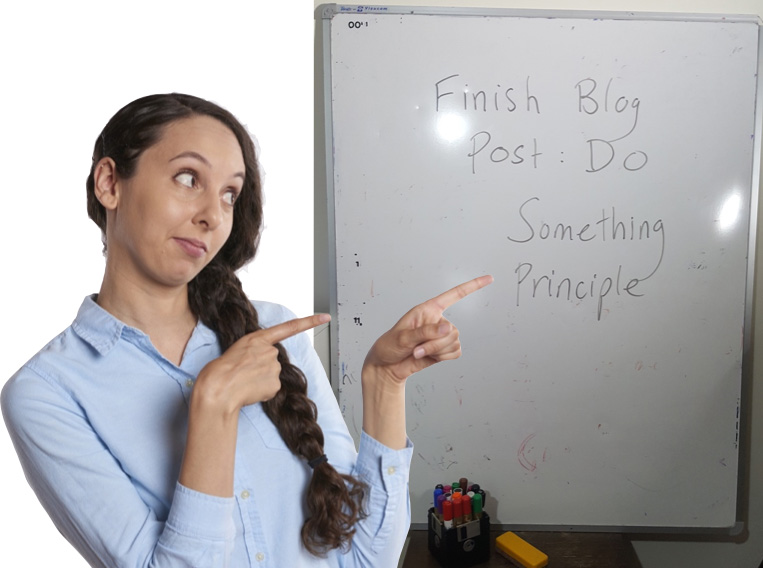
The Do Something Principle works like this: when you’re feeling overwhelmed, you do something. Anything. It doesn’t matter what piece of work you choose to do. Just make a start.
• Clear away all other projects (out of sight is out of mind).
• Keep the task small and make it have a clear end point (e.g. “I will read this paragraph” or “I will create 10 flash cards”).
• Write down the task on a white-board or post-it note (this helps you to stay on track).
• Put a timer on for 5-10 minutes (whatever you feel you can handle).
• If your brain starts saying things like, “I don’t want to do this!” or “This is going to be painful!” simply ignore these thoughts.
• Pair the task with something enjoyable, such as drinking a smoothie or listening to some enjoyable music (preferably without lyrics).
• Focus on the process, not the finished product: In other words, don’t worry about completing the task in the allocated time.
And most importantly …
The reality is there is no ideal time to start your work. So just get started on one part, regardless of how you feel.
Yes, it will feel uncomfortable.
Yes, you’re work will probably be messy (at least to start with).
Yes, you’re brain will be screaming out for novelty and distraction.
But that’s okay. Just stick with the process.
Because eventually you will strike gold.
As artist Chris Anderson says:
“There have been times when I’ve just sat there doing something over and over in different ways, scrapping every idea in frustration until I finally made that one right pencil stroke, took one photo with the right angle, chose a slightly different shade of the same colour – until finally everything comes together absolutely perfectly.”
Good work takes time. If you want to do your best, you need to start the process early and give yourself enough time to properly engage with the work.
So what are you waiting for? Go do something. No matter how small the task may be, just make a start. Remember, all those little bits of something add up to something really solid.
How can you implement The Do Something Principle into your life? What work have you been avoiding that you can make a start on?

But if you keep making the same mistakes over and over, it can be demoralising.
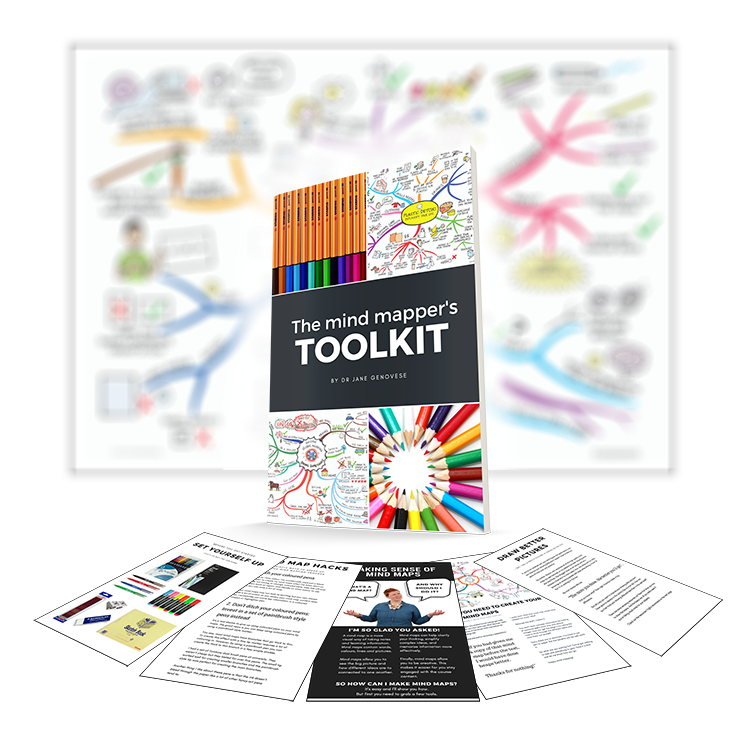
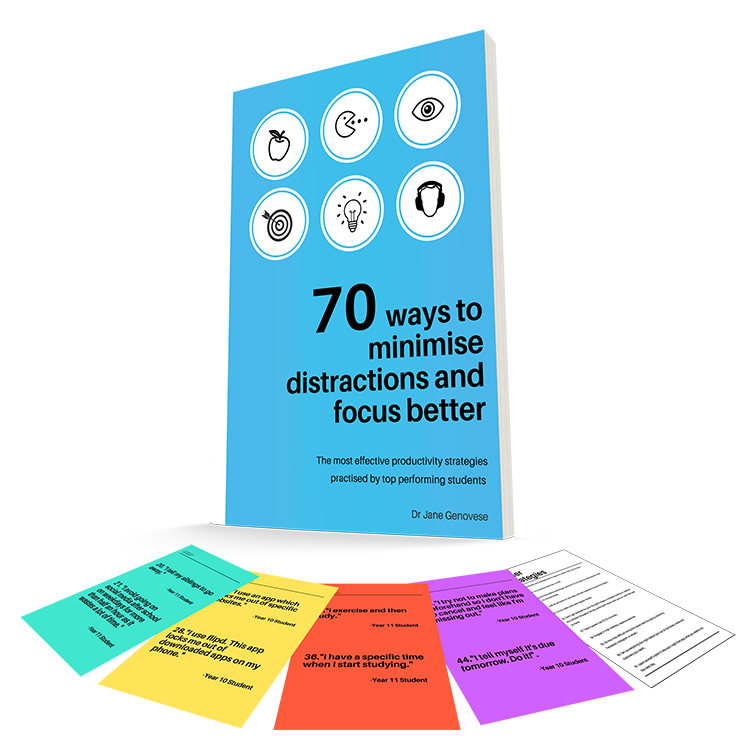
In this article, I share 12 common mistakes students make when preparing for exams, and what you can do to avoid making them.
But let me be clear, this article isn’t just for students and it’s not just about exams. It’s for anyone who is up to stuff in life. It’s for anyone who wants to keep learning and growing.
My advice is don’t read this article all in one sitting. Treat it like a practice exam: print it out, put your phone away, and work through 1-3 points at a time. Then, get up and take a fun rest break!
Are you ready to dive in? Let’s go!
Without a doubt, this is where most students go wrong with tests and exams. They don’t give themselves enough time to learn the content properly.
They leave studying until the last minute and try to cram as much information as possible.
First, there are a few things you need to understand about how you learn:
Based on this, start preparing for exams before you feel ready, while you can still think clearly (i.e., you’re not panicking and freaking out).
Not all stress is bad. Stress can be a source of fuel and energy. It can help you focus your mind and swing into action.
But too much stress – the freaking out kind – can mess with your ability to focus and learn. If you’ve reached that point, where you feel like bursting into tears or curling up into the foetal position, you’re experiencing bad stress. You need to stop whatever you’re doing and calm your nervous system.
Start preparing early. The more prepared you are, the calmer you’ll feel and the better you’ll do.
Other strategies you can use to decrease bad stress:

“Be calm and know that you can do this.”
Many students spend all their time leading up to their exams creating beautiful sets of notes. By the time they finish their notes, they’ve run out of time to do practice exams.
Notes can be super handy, but it’s what you do with your notes that really matters. Are you testing yourself with them? Do you create flashcards from your notes and test yourself with those cards?
The best way to ace any exam is to practise pulling information out of your brain. You need to test yourself (i.e., use active recall strategies).
Take it from me, this won’t feel as nice or easy as simply taking notes leading up to an exam. But at least you’ll be grounded in the reality of what you know and what you don’t know.
When your only exam preparation strategy is note taking, you go into the exam with a false sense of confidence (experts call this an ‘Illusion of Competence’).
Sitting tests and exams is also a skill. Whether you do well or not isn’t so much a reflection of your intelligence. It’s more a reflection of your exam technique and how well you have prepared.
Practise in the medium you’re going to be assessed in: do lots of past exam papers (ideally under timed conditions using pen and paper).
Treat it like you’re training for a marathon. At first, you might just do a 30-minute ‘exam’ workout. As you build your strength and stamina, work your way up to 45 minutes, then an hour. Eventually, be brave and attempt the full 2-3 hours.
After wrestling with some exam questions, make sure you check to see how you went (what you got right and wrong). Take note of any gaps in your knowledge, and give that content a bit more time and focused attention.
Distraction is the enemy when it comes to learning. When your attention shifts rapidly from one task to another, you destroy your ability to memorise information.
Multitasking also slows you down (i.e., it take you longer to do your work), whilst speeding up your thinking. Fast and frenetic thinking is the opposite of what you need for deep learning. To deeply understand information, you need slow and deliberate thinking.
Before you sit down to study, deal with distractions from the outset. Put your phone away from your body, on silent in another room. Install an Internet blocker app, such as Cold Turkey or Freedom.

If you use social media, get someone to change the password on your social media accounts so you can’t access them during the exam period.
Do what you need to do to focus your mind for a short, intense burst of study (25-45 minutes).
“Put your phone and other distractions away while studying as this will benefit you in the future … however phones will destroy your future.”
The complex terms, jargon and the text-heavy nature of your syllabus can make it scary to look at. But don’t let those things put you off looking at this document.
Your syllabus is too important to ignore. Referring to this document will help focus your mind and save you hours of time.
Bypass all the jargon and head straight to the unit content section. This section tells you exactly what you’ll be assessed on.
Print this section out so you can easily refer to it without having to go on your computer (and potentially get derailed).
When you start a study session, choose a syllabus point and use an effective study strategy to make it stick (e.g., active recall).
You spent hours re-reading your books, highlighting chunks of information and re-writing your notes before the exam. You can’t understand why you didn’t do better?
I’ll tell you why: you weren’t using effective study strategies.
Swap ineffective ways of studying (e.g., re-reading and highlighting) with effective study strategies, such as active recall.
You can practise active recall in different ways, including testing yourself with a deck of flashcards, doing past exam papers, and teaching a concept to a friend.
You’ve also got dual coding (i.e., using words and pictures to help you learn). I’m a big fan of mind mapping. In fact, I mind mapped my way through my undergraduate degrees in Law and Psychology, and my PhD.
Dual coding is a great way to understand new ideas and how those ideas are connected. But to make those ideas stick, make no mistake: you’ll also need to do active recall practise.

To learn more about how I combine mind mapping and active recall, check out my short online course, Let’s Mind Map!
Entering the exam room (or any important situation) in a chronically sleep deprived state is a terrible idea. Expect to have trouble recalling information and focusing your mind.
Bottom line is: Sleep matters. It matters a lot.
This study found that students who participated in an ‘Eight Hour Sleep Challenge’ and prioritised getting 8 hours of sleep each night leading up to their final exams outperformed those who didn’t take the sleep challenge.

Make getting 8-10 hours of quality sleep a non-negotiable part of your study plan. Plug your phone into charge at least one hour before bed and don’t touch it until you get up the next day.
Remember, sleep is the ultimate performance enhancer. Everything you do, you’ll do better after a good night’s sleep.
“Sleep the night before. Don’t cram.”
By the time you get to your final exam, you’re feeling over it. You’ve lost all motivation to study. You don’t really care how you go. So, you do the bare minimum to prepare. You go in with a plan to … wing it. But winging it isn’t an effective strategy.
If you’re running low in motivation and energy, do little activities to re-energise and feel normal again.
One student shared this piece of great advice that made me laugh:
“Study early, study late, and somewhere in the middle treat yourself to an $11 Medium meatbox from Kebab Lads.”
Perhaps an $11 meat box isn’t the best way for you to restore your energy. But that’s beside the point. The point is you must do things to keep your spirits up during exams.
You’re asking ChatGPT to give you summaries of different topics and create practice exams for you, which you then do on your computer. Perhaps you steer clear of AI, but you type up your notes on your laptop.
The problem is if you’re working at a computer, you’re more likely to get distracted. As soon as it gets boring or difficult, you’ll find yourself running to the fun stuff (e.g., YouTube).
But there’s another big problem that often gets overlooked by schools that invest heavily in EdTech: the Screen Inferiority Effect. Reading on a screen and taking notes using a keyboard are not as effective when it comes to learning as using pen and paper.
As Dr Jared Cooney Horvath writes in his brilliant book The Digital Delusion:
“Learning doesn’t arise from the brain alone, it emerges from the rhythms, movements, and sensations of our entire physical selves.”

Invest in a printer and a big box of A4 paper. Print out your readings, past exam papers, the unit content section of the syllabus, any important emails, and your exam timetable.
By printing out these documents, you’ll shift from passively skimming to active reading. This will allow you to form a deeper understanding and stronger memories of the content.
Students who study in only one location (e.g., at a desk in their bedroom) sometimes struggle to recall information once they get into the exam.
Why would this be?
It’s because information is context-dependent. That means when we study in the same place, our memories become tethered to that environment.
Mix up where you study. You don’t need to abandon your desk, but don’t make it the only place you study.
Do some flashcard practice at the kitchen table, a past exam paper in the library, and explain a concept to a friend outside under a tree. You get bonus points if you can do a past exam paper in the actual exam venue!
When you practise in different settings, you train your brain to be able to recall information anywhere.
Stress is contagious. If you’re hanging around people who are freaking out about exams (saying things like, “I hardly studied! I’m going to fail!”), don’t be surprised if you start to freak out, too.
Before the exam, keep away from people or anything else (e.g., caffeine, too much sugar, and social media) that triggers anxiety in you. It helps to feel calm, steady, and grounded as you walk into the exam room.
After the exam, don’t waste time ruminating about it with your friends. This is a total waste of your time and energy. You can’t change what just happened. What’s done is done!
Instead, shift your focus to what you can control (e.g., taking a fun rest break and preparing for the next exam).
“Get in, do it, and get out!”
I once met a law student who didn’t read the exam question properly. She was visibly distressed as she told me she missed reading the part that said you had to write only two of six essays.
What did she do?
She wrote six essays in three hours.
This may sound extreme, but mistakes like these are all too common.
Read the question carefully. Take your time. It will be time well spent.
As you read the question, look for clue words such as explain, discuss, and compare. These words have different meanings. They determine the approach you need to take to answering the question. Some students find it can help to rewrite the question in a way that makes sense to them.
Not sure what the difference is between the words discuss and explain?
Use effective study strategies, such as dual coding and active recall, to understand and remember the meaning of each clue word.
No one expects you to be perfect at preparing for and sitting exams. Like any skill, this takes practise.
So, what areas could you strengthen? My advice is to focus on just one area.
If you need more sleep, then make getting to bed at a reasonable hour your top priority. If you want to start using more effective study strategies, spend 20 minutes creating a mind map or doing a past exam paper.
A few simple tweaks to your lifestyle and study habits can dramatically improve your ability to focus and learn, as well as how confident you feel walking into your exams.

Some of us have a tendency to ignore our Future Self, preferring to live for the moment.
But when it’s the night before an exam and you’re scrambling to revise, I’m guessing you probably wish you’d given more thought to your Future Self.
In short, if you want to live a calm life, you can’t go ignoring Future You.
In this article, I share how you can get more connected to your Future Self to combat procrastination.
In every moment, we face choices such as these:
Do I watch YouTube or start studying for that upcoming test?
Do I eat a piece of cake or a piece of fruit?
Do I buy the new shirt or wear one I already own to save money?
Do I use ChatGPT or my brain?
In other words, do we choose the thing that gives us instant gratification, or do we choose the thing that will help us move towards our future goals?
When you choose instant gratification, you’re voting for Present You.
When you choose to delay gratification, you’re voting for Future You.
Just to be clear, it’s not always one or the other. Often you do things that benefit both Future You and Present You.
For instance, some people prepare healthy homecooked meals. This doesn’t feel like a sacrifice. The process can be enjoyable.
Some people also love the work they do, stating that the work feels more like play than a hard slog.
When we take both of these versions of ourselves into account (Present You and Future You), we are in a much better place, mentally and physically. It’s a win-win situation.
But often, these two versions of ourselves are not in perfect alignment. We wake up and find that we really don’t want to study for that upcoming exam. Or we feel a strong urge to buy that new shirt even though we have 20 perfectly good shirts in our closet.
Enter letter writing.
Research shows the simple act of writing a letter to your Future Self can help you feel more connected to Future You. This in turn can help you make better decisions in the present.
When you get connected to your Future Self, studies have found you’re more likely to save money, do better academically, exercise, and consider future consequences. You’re also less likely to procrastinate with your study.
Rather than letting things pile up for your Future Self to deal with (cue panic and overwhelm), your Present Self gets on with them in a calm and grounded way.
There’s a popular website called Futureme.org that allows you to write letters to your Future Self.
Here’s how it works . . .
You write a letter on the website and then set the date you want to receive your letter. For a small fee, the letter is emailed to you on that date.
On this website, people can select to make their letters available to the public to read. It’s fascinating to get a glimpse into other people’s lives and what they desire for their Future Selves.
It also gives you a sense of where people go wrong when writing to their Future Self.
One thing I’ve noticed is people can fall into the trap of ‘magical thinking’. They imagine their Future Self being wildly successful while failing to consider what it will take to actually achieve that future.
In one letter, a person writes, “YOU BETTER BE A SUCCESS!!!!” (no pressure). This anonymous person talks about getting a job (and if not, getting a Sugar Daddy), traveling the world, and not doing drugs. It’s a good start, but it doesn’t go far enough.

It’s like a person creating a vision board with cut-out images of things they desire, and thinking that by sticking these images onto a piece of card, they are manifesting these things into existence.
This is magical thinking, and in times of uncertainty, magical thinking tends to go into overdrive.
It may seem like a bit of harmless daydreaming, but research shows this kind of thinking can be harmful to our growth and development.
In her book Rethinking Positive Thinking, Dr Gabriele Oettingen writes:
“…dreamers are not often doers. My research has confirmed that merely dreaming about the future makes people less likely to realize their dreams and wishes (as does dwelling on the obstacles in their path). There are multiple reasons why dreaming detached from an awareness of reality doesn’t cut it. The pleasurable act of dreaming seems to let us fulfil our wishes in our minds, sapping our energy to perform the hard work of meeting the challenges in real life.”

What’s missing from this picture is being grounded in reality.
Science reveals a simple way to counteract this tendency to engage in magical thinking when writing a letter to Future You, and it’s simple:
Once you’ve written a letter to your Future Self, you must step into the shoes of Future you and draft a reply.
In other words, don’t let your Future Self ghost your Present Self.
This study found that the most effective way to get connected to your Future Self is a two-way letter exchange between Present You and Future You.

These researchers took a group of Japanese high school students and split them into two groups:
Group 1: Send only group – participants sent a letter to their Future Self
Group 2: Send and reply group – participants sent a letter to their Future Self and then stepped into the shoes of their Future Self and wrote a reply to their Present Self.
At one-month follow up, the students in group 2 who engaged in a back and forth exchange felt more connected to their Future Self than the students in group 1.
Group 2 also engaged in more intense career planning, and were better able to delay instant gratification when it came to their studies.
The researchers believed having to write a reply forced the students to engage in a practice called ‘mental contrasting’.
The students were able to dream big in their letters to their Future Selves, but the response letter grounded them in reality, shedding light on the obstacles and barriers that could prevent them from achieving their dreams.
When you step into the shoes of your Future Self and write a reply to your Present Self, it forces you to come up with a strategy on how to accomplish certain tasks and goals.
Writing a letter to and from your Future self is easier than it sounds.
Here’s what I find helps:
It can be a little daunting to write to your Future Self and step into the shoes of Future You, especially when things are so uncertain and the world is changing so rapidly (e.g., generative AI).
As humans, we like certainty. But the reality is we really don’t know what’s coming next.
This is why I find it helps to focus on 3-6 month timeframes.
Why 3-6 months?
It’s far easier to imagine what you’ll be like in 3 months than 20 years. It’s less abstract.
Whereas when you think of your Future Self in 20 years or even 2 years, we tend to be overly optimistic (even slightly delusional) about what we’ll be like.
As humans, we like to think that in 3 years, we’ll be more confident, less stressed, more capable, and more on top of things.
What happens when we think of our Future Selves in this way is that we tend to offload things to them (“Oh, I’ll leave that problem for my Future Self to deal with!”). In other words, we procrastinate.
In contrast, I’m far less likely to mess around if I’m inflicting pain on my Future self in 3 months. I can see that if I don’t get started on projects, tomorrow I’m going to wake up and feel annoyed with myself. Why? Because I have less time to do what I need to do. I’m going to feel stressed.
Where do you start when it comes to this unique letter writing exchange?
If you feel stuck, here are some prompts to get you started with your letter to Future You:
Right now, here’s what’s been happening in my life . . .
A task I’ve been procrastinating on is . . .
An area I currently feel stuck is . . .
Here’s what I’m struggling with . . .
A goal I’m working on is . . .
My daily routine goes something like this . . .
Here’s a special message for you . . .
You can also ask your Future Self questions such as: What goals are you working on? and What does a typical day in your life look like?
When you’ve finished writing your letter to your Future Self, give yourself a little break before you step into the shoes of your imagined Future Self to write a reply.
Go for a little walk, make yourself a nice drink, or do a short meditation. Do something to reset and re-energise your mind.
Once you’ve had a break, close your eyes and imagine stepping into the shoes of your future self. Imagine everything has gone according to plan. Imagine what your surroundings are like. Notice the way Future You feels.
Then reread your letter to your future self. After you’ve finished reading it, draft your reply.
Make sure you outline how you were able to achieve your goals (what steps did you take?). Remember, we want to get out of ‘magical thinking’ mode and get grounded in the reality of what the grimy work looks like.
If you’re tempted to simulate a conversation with your Future Self using AI, think twice.
One study used AI to assist people with talking to their 60 year old Future Self.
When I viewed an example of a simulated conversation from this study, it felt a bit clichéd and soulless (see image below). I wasn’t surprised to read that the participants reported the chat interactions felt ‘artificial’.

But it was something in the Limitations & Ethics section of the paper that caught my eye. The researchers wrote:
“There are many potential misuses of AI-generated future selves to be mindful of, including but not limited to: inaccurate depiction of the future in a way that harmfully influences present behavior, endorsement of negative behaviors, and the potential of over-reliance on such systems to assist decision-making.”
Since this paper was published back in 2024, we’ve seen concerns about these misuses and more come true: ChatGPT convincing teens to harm themselves, AI psychosis, and people becoming overly reliant on AI to the point where they no longer trust their own judgement.
This is why I recommend steering clear of AI to get connected to your Future Self. Trust yourself to be able to do this. You know yourself better than an AI chatbot.
Our current world is geared towards instant results and instant gratification. This can make it hard to make decisions in the present that benefit our future selves.
Research shows that a letter writing exchange between Present You and Future You is more effective than writing just a letter to Future You (with no reply).
I invite you to set aside 30 minutes to write these letters. Ideally, get away from screens and chatbots, and use your brain and hands to do this (trust me, it will feel nicer and more wholesome).
If you can stay grounded in reality, writing to and from your Future Self can be a simple practice to help you combat procrastination and do the things that are most important to you.

The other day, I was getting my haircut when my hairdresser told me something her 15-year-old son had said. His words took her completely by surprise. He said:
“Mum, I need to try harder this year.”
I hear those words a lot. Try harder.
I hear them from students who want to do better at school and from teachers who are trying to motivate students (“You need to try harder”).
But what does it actually mean to “try harder”?
The problem is that this advice is too vague and abstract.
If you don’t have a clear picture of what ‘trying harder’ looks like, you’re in dangerous territory because you’re attempting to motivate yourself towards an abstraction.

In the book Tiny Habits, Professor BJ Fogg explains the problems associated with motivating yourself to achieve a vague goal. He writes:
“You’ve probably seen a well-meaning public-health poster in the doctor’s office that shows lots of colourful vegetables with the headline: EAT THE RAINBOW!
At first glance, you think: Yes, I need to eat better food. But then you’re not sure what practical steps to take. How much green and how much red? That means salad and apples, right? It can’t mean mint ice-cream and red licorice, can it? You are motivated to “eat the rainbow,” but maybe you don’t know how. You feel frustrated and end up being a little hard on yourself.”
I didn’t want my hairdresser’s son to feel frustrated and annoyed with himself. He clearly had good intentions.
I asked my hairdresser, “What does trying harder look like for your son? If he’s trying harder, what is he doing?”
She said she wasn’t sure. So, I kept asking questions.
“Does it look like him sitting down and testing himself with flashcards before a test? Taking notes in class? Listening to the teacher instead of chatting with his mates?”
The answer was clear. She said, “Listening to the teacher! He needs to start listening to his teachers.”
I also mentioned that it would help if he learnt his teachers’ names (you’d be surprised how many teachers tell me their students don’t know their names).
Remembering a teacher’s name, staying focused on what they have to say, resisting distractions, taking notes and reading your textbook may sound easy, but these are skills that require continuous practice.
If you’re not used to doing them, they can feel hard.
Even with years of practice under my belt, understanding new ideas still feels hard. These days, reading feels like weightlifting for my mind!
After getting my haircut, for the next 24 hours, I kept thinking about those words “try harder”.
Something was bugging me about it because I felt it wasn’t helpful to tell yourself to “try harder”. . . and then, like a bolt of lightning, the answer hit me: my hairdresser’s son doesn’t need to try harder. He needs to focus on doing a few specific hard things.

By ‘specific hard things’, I mean concrete behaviours he can do right now (or at a specific point in time) to improve his understanding of his school subjects.
For example, if he wanted to start a home study routine, here are some concrete behaviours I’d recommend he try:
These are just a few behaviours that come to mind when I think about “trying harder” with your studies.
Doing these concrete behaviours just once won’t make you go from good to great. But you’ll be surprised by how much meaningful progress you can make in a single, effective study session.
We live in a world where comfort and convenience are increasingly normalised. We expect things, including learning, to be easy.

You don’t have to cook (thank you Uber Eats).
You don’t have to move (thank you car).
You don’t have to experience boredom (thank you social media and Netflix).
You don’t even have to use your brain anymore (thank you ChatGPT and Claude).
By outsourcing tasks that require physical and cognitive effort, we may save time, but there are hidden costs.
People are losing their skills, destroying their health, and atrophying their brains, all while being flooded with unhealthy levels of dopamine. I’d even go as far as saying that people are losing their lives and what it means to be human.
In every moment, we have a choice: we can do the easy thing that gives us a quick dopamine hit, or we can do the hard thing that gives us a slow and healthy release of dopamine.

When you wake up, you can scroll on your phone or do some physical activity.
At the end of the day, you can order takeaway that is engineered to light up the reward pathways in your brain, or you can prepare a healthy homemade meal.
When you’ve got a spare 30 minutes, you can watch some YouTube or go for a walk outside.
You can use ChatGPT to write your essay, or you can use your brain and build your skills.
You can talk to an AI chatbot and have a friction-free relationship, or you can organise to meet up with a friend.
Every time you choose the hard thing over the easy thing, you build your confidence. You can trust yourself to do hard things and survive them. Over time, as you build your skills, those hard things don’t feel as hard as they once did.
For instance, if the Internet goes down and you’re not dependent on ChatGPT, you know you’ll be okay. You can rely on yourself to think and entertain yourself (thank you brain).
This is why I’m committing to doing hard things this year. I’m challenging myself, and I know I’ll be better for it.
Just to be clear, I’m not talking about self-harm or inflicting extreme pain on myself.
I’m referring to activities that bring up a cringey discomfort and make me think, “Ahhh, I don’t want to do this!”.
These include activities that require sustained focus and/or mental and physical effort, such as writing an article, going for a run, riding my bike to the shops, and meditating.

The simplest way is to ease into doing those hard things. Turn those hard things into tiny habits.
Here is a list of tiny habits for hard things I’m focusing on doing:
Some of these things may not seem like much, but all of these behaviours require mental and physical effort. Remember, there’s a much easier alternative: sitting, tapping, swiping, and scrolling on your phone.
For instance, I don’t need to chop vegetables and cook my meals. I could eat out or order food to my door. This would save me time and effort (cooking my meals can feel like a part-time job).
But I know I would suffer at some point (physically, mentally, and financially).
Chopping vegetables and cooking take effort, but it helps me cultivate calm. When done with a focused mind (not listening to podcasts or talking on the phone), I really enjoy these activities.
If I were to outsource these activities, I’d be going backwards, because I’d most likely lose my valuable cooking skills over time.
Similarly, writing articles like this one feels hard. But hard doesn’t mean bad. It’s satisfying to focus my mind, wrestle with ideas, and write.
Many of us mistakenly believe that an easy life is a better life. But it’s not. A life where you are constantly pursuing pleasure and taking the easy path can lead to anhedonia.
Anhedonia is the inability to experience pleasure in things that were once pleasurable (e.g., a homecooked meal or a sunset). Some people describe it as life in greyscale.

It turns out the more pleasure we pursue, the more pleasure we need and the more pain we experience.
It may sound counterintuitive, but pursuing hard things makes you feel more motivated and more positive about life.
As humans, we want to challenge ourselves. We’re wired for it.
Psychiatrist Dr Anna Lembke encourages us to take on difficult, even painful, activities as a way of “aligning our primitive wiring with our modern ecosystem”. She writes:
“We are survivors. We’re wired for struggle, especially of physical nature. Yet we live in a world in which we’re largely insulated from pain. And not just pain, but also discomfort of any kind. Everything is supplied to us at the touch of a finger. Now we struggle just to get up off the couch. Our modern ecosystem incentivizes inactivity. Inactivity breeds lethargy. Lethargy breeds anxiety and depression. We must fight against this.”
So, forget trying harder. Work out a few hard things you want to do and focus on doing them instead.