Like drinking smoothies for breakfast?
If so, consider adding a handful of blueberries or a tablespoon of cocoa powder into your next one.
According to scientific studies performed on humans, these ingredients can help boost your brainpower.
For instance, in a study conducted by Professor Jeremy Spencer, young adults aged between 18 – 30 were split into two groups:
1) A blueberry smoothie drinking group (Experiment condition)
2) An alternative drink containing no blueberries group (Placebo condition)
After drinking the beverages each group had to perform cognitive tasks (attention tests) 1 hour and 5 hours later.
What did the researchers find?
The participants who consumed the blueberry smoothie (containing 200 grams of blueberries) had sustained their attention 5 hours later whereas the placebo group’s attention had declined by about 15%–20%.
Why do blueberries enhance our cognition?
It’s all about the flavonoids that they contain. Flavonoids are a group of antioxidant phytonutrients that you’ll find in a range of fruits and vegetables.
When consumed they activate an enzyme which increases the flow of blood and oxygen to the brain.
Italian researcher Dr Valentina Socci and her colleague’s state:
“…flavonoids and their metabolites cross the blood-brain barrier and have been localized in the brain, particularly in areas crucial for learning and memory such as hippocampus, cerebral cortex, cerebellum, and striatum…
In memory-related areas such as the hippocampus, flavonoids promote the expression of brain-derived neurotrophic factor (BDNF), that is crucial to adult neurogenesis, synaptic growth, and neuronal survival.”
In short, flavonoid-rich foods can help enhance our ability to pay attention and memorise information (cognitive functions that are critical for learning).
But let’s face it, blueberries aren’t cheap
You may be sold on the research but not by the price of blueberries. In Australia fresh blueberries can cost anywhere between $4-$7 a punnet (125 grams) depending on whether they are in or out of season.
If you’re a student living on a tight budget, you have to ask yourself, “Can I justify spending nearly $30-$50 a week on blueberries?”
Probably not.
But that doesn’t mean you have to go without. Below are some other (more frugal/thrifty) options that will deliver the same or similar results as fresh blueberries.
1.Frozen Blueberries
You can purchase 500 grams of frozen blueberries for around $4. If you throw half a cup of frozen blueberries into your breakfast smoothie, a frozen packet of blueberries can go along way.
If you can afford it, buy frozen blueberries that are grown locally and organically in your area.
You may remember a few years ago one brand (Nanna’s) of imported frozen berries was found to contain Hepatitis A. Thousands of packets of Nanna’s berries had to be recalled from supermarket freezers (you can read more about this event here). Just this year, another big brand (Creative Gourmet) recalled a batch of its frozen mixed berries due to being linked with three cases of Hepatitis A.
Would you like a spoonful of Hepatitis in your smoothie? I didn’t think so. Take no chances. Keep your blueberries local.
2. Grow your own berries
With fresh blueberries costing a bomb and some types of frozen blueberries being riddled with disease, why not try growing some of your own blueberries?
This is what I do to save money and avoid plastic waste. In my garden, I have several blueberry bushes, which produce handfuls of berries. I add blueberries to my morning smoothie. I have blueberries with yoghurt for dessert. When I’m feeling lazy, I just eat them straight off the bushes!
The good news is growing blueberries is actually pretty easy. It may cost a little bit of money to purchase the blueberry bush in the first place ($25-$30) but remember, that bush will eventually give you dozens of punnets of blueberries. Like solar panels, your blueberry plants will pay for themselves over time off. You just need to be patient and look after them.
3. Try other berries and foods containing flavonoids
Blueberries aren’t the only food containing flavonoids. Other foods that are just as good and can produce similar effects include any kind of berry (e.g. strawberries and raspberries), grapes and cocoa.
One study involving healthy young adults found that the consumption of flavanol-rich chocolate counteracted the cognitive impairments from a night of total sleep deprivation.
The researchers concluded that cocoa flavanols are effective in “sustaining higher order cognitive performance during sustained effortful processing in healthy individuals”.
In other words, when you’re completely exhausted and need to perform a challenging mental task, consume some cocoa. It will help you think better.
What’s the best way to consume cocoa? Will a block of milk chocolate do the job? Think again.
In this video, Dr Michael Gregar assesses various food products containing cocoa. It’s probably no surprise that cocoa powder is best. As a general rule, the less processed the better.
To sum up
Without a doubt, your brain is your biggest asset. So why not invest in it with some berries? If you can’t afford to buy them fresh, consider buying them frozen or growing your own. It may take a couple of years for your blueberry bushes to start producing but be patient. It’s well worth it.

But just to be clear – this car wasn’t in bad shape when I first got it. I turned this car into a jalopy through neglect and ignoring basic warning signs.
Whenever I gave my friends a lift in this car, I remember that they always looked visibly uncomfortable. They’d say with a nervous laugh:
“Jane, what’s that strange rattling sound?”
“Why is there a red warning light on your dashboard?”
I wasn’t fussed about the red light or the strange rattling sound.
Somehow, I’d missed the adulting lesson on basic car maintenance.
For many years, I never bothered to get my car serviced. I drove it to the point where it rattled and shook violently, the engine would cut out while driving, and the brakes squealed at a painfully high pitch.
It got to the point where I could no longer ignore these problems, but by then, it was too late. My car was beyond repair and could only be salvaged for scrap metal.

I’m embarrassed to share this, as that’s no way to treat a car that gets you from A to B and uses the Earth’s finite resources. But stay with me because there’s an important point I want to make, and it’s this. . .
When I was younger, I engaged in several unhealthy lifestyle practices. Whilst I never smoked, took drugs, or consumed alcohol, I ate huge amounts of processed junk food (I didn’t know how to cook).
I also frequently sacrificed sleep to pull all-nighters to complete my assignments (I struggled with procrastination).
My body seemed resilient. It appeared capable of handling the shocks. But over time, I started feeling tired and rundown. Still, I kept pushing myself like my old car. The only time I could rest was when I got sick.
These days, everything’s quite different.
I am physically unable to thrash my body around like an old jalopy.
Something as simple as consuming too much salt or sugar can send my brain spiralling out of control.
I was reminded of this a couple of weeks ago when I visited a friend in hospital. Because I was spending a lot of time at the hospital, my usual routines of grocery shopping and cooking from scratch were disrupted.
But then to make matters worse, I was given $80 worth of vouchers to spend at the hospital cafeteria. I thought, “How bad can hospital cafeteria food be?”.
It turns out really bad.
Cheese kranskys (sausages), heaps of salty hot chips, deep-fried chicken, and soft drinks were the main options at this hospital cafeteria.
Unhealthy food seemed completely normalised in this hospital environment. My jaw dropped when I saw a patient order not just one but five cheese kransky sausages!
In this hospital setting, I also started to eat poorly. It was on my third day of eating hot chips from the hospital cafeteria when I noticed that these chips weren’t doing me any favours. I was feeling off my game.

So I decided enough was enough. I gave the remaining hospital food vouchers to a homeless man who was hanging around the cafeteria, desperate for a feed. It was back to home cooked meals for me!
This greasy processed hospital food had a ripple effect on the rest of my life. I slept badly, which impacted my ability to run the next morning (my joints hurt). I felt resistance to using my treadmill desk because everything felt much harder than usual. Since I was moving less, I was more distracted.
I know all this might sound a bit dramatic, especially to those of us who enjoy a few hot chips (e.g., my husband). Given my friend was in a hospital bed and couldn’t walk, I am fully aware of how lucky I am to be able to run in the first place (even with sore joints).
The point I’m trying to make is this . . .
I also know that small decisions, like eating too many hot chips or staying up late, can add up and take their toll on your mind and body. These tiny decisions can have a big impact on the way you feel.
When I was younger, I could eat whatever I wanted and still feel pretty good. Sometimes I’d feel a bit off, but not in a noticeable way.
As Dr Randy J Paterson states in his book How to Be Miserable in Your Twenties:
“In your twenties, some people can do practically anything to their bodies, experience no immediate physical consequences, and feel emotionally more or less well. Random sleep cycle, sedentary lifestyle, lousy diet, 90 percent of the day staring at screen, binge-drinking, isolation, the works. The body doesn’t completely fall apart, and the mind, while not thrilled, hangs on.
Later on, the effect is more immediate. Live exactly the same way at thirty-five, at forty-five, and things don’t go so well. Take a middle-aged car and drive it aggressively down jolting roads, loaded to the max, old oil clogging the engine, and it’s not going to last long. The baseline mood at forty-with no maintenance, no exercise, no dietary adjustment, no stability, and no social life- is misery. ”

Like a car, the human body requires regular basic maintenance. I see this basic maintenance as a collection of small behaviours that leave me feeling calm, grounded, and focused.
Here are a few things I need to do to keep myself running smoothly:
Every now and then, I’ll abandon these behaviours. I’ll have a day where I eat and do whatever I like. I’ll order takeaway, sit on the couch and binge-watch a series until late at night. I usually pay for it the next day, but it also gives me a better appreciation of these healthy practices and what they do for my body and mind.
It’s all about tuning in and noticing how certain things make you feel. For example, when I was in my mid-20s, I noticed every time I ate deep-fried chicken, I experienced sharp stomach pains.
That was like the red warning light on my car dashboard going off in my body. But instead of ignoring it, I paid close attention. Eventually, I decided it wasn’t worth the pain. So I stopped buying greasy deep-fried chicken and eventually went plant-based, which immediately improved my mental and physical health.

There’s no doubt that modern life can be hectic and stressful. When you’re rushing from one thing to another, it’s easy to overlook the basics and ignore the warning signs.
I’m not proud of how I treated my first car, but I learnt from the experience. Now I make sure I get my car serviced regularly. This saves me time, money, and stress in the long run.
Similarly, we need to pay attention to the way in which we look after ourselves. By dedicating time, energy, and attention to the small things that make us feel better, our experience of the present moment becomes richer. As longevity researcher Dan Buettner says, “You can add years to your life and life to your years”.
“Suzuki Swift 1.3 GTi 1990” by RL GNZLZ is licensed under CC BY-SA 2.0. (used in image 1)
“Scrap yard 22l3” by Snowmanradio at English Wikipedia (Original text: snowmanradio) is licensed under CC BY-SA 3.0. (used in image 2)
“KFC Wicked Wings” by avlxyz is licensed under CC BY-SA 2.0. (used in image 5)

This means you need to prepare yourself mentally and physically for them.
You can work so hard to memorise large quantities of information for an exam, but if you’re not mentally and physically prepared, all that hard work can sadly go to waste.
When it comes time to take your exams, you have to relate to yourself as a professional athlete. Leading up to the day of the big performance (i.e. the exam), you need to eat nutritious food, be in the right frame of mind, manage your nerves, and allow your body to rest. These simple things can make all the difference to your exam performance.
You may be thinking “But isn’t this just common sense?”
It is! But creating healthy habits takes time and practice.
It’s one thing to intellectually know you should be eating well but it’s another thing altogether to incorporate healthy meals and snacks into your lifestyle.
I see a lot of students drinking energy drinks, getting very little sleep, and eating highly processed foods in the days leading up to exams. I have to admit, there was a time when I engaged in these behaviours too. I can tell you from personal experience, this is a recipe for mediocre grades and a miserable existence.
Here are my top 10 tips to prevent burnout and boost exam performance:
Sleep is critical to the learning process, exam performance, and wellbeing. Yet it’s usually the first thing students sacrifice to get more study done.
If you miss two hours of sleep each night for a week, the cognitive effects are as bad as going without sleep for two days straight!
Studies have also found that if you stay awake for 18 hours straight that’s like having a blood alcohol level of 0.05. In other words, it’s like being legally drunk. Your ability to focus, think, and learn will be seriously impaired.
You can’t adapt to getting less sleep. As adolescents, you need about 9-10 hours of sleep per night to be as alert as possible when you wake up.
If that feels unachievable, try to just get an extra 15 minutes of sleep tonight. Gradually increase this each night until you reach your target.
Often students stop exercising when they start preparing for exams. They think “I don’t have time to exercise!”. It’s as if they think they must spend every moment studying. Don’t fall into this trap.
Movement is your friend when it comes to studying for exams.
Research shows engaging in regular physical movement will help you to study more effectively. Firstly, it’s a great way to relieve stress and release feel good chemicals. Secondly, it gets the blood flowing more efficiently to your brain, which can give you a cognitive boost.
One study found students who engaged in 5 minute movement breaks every 17 minutes during a lecture retained more information and could focus better.
Every time you engage in a short movement break, you’re enhancing your study sessions.
Research has found that students who skip breakfast experience a decrease in cognitive performance and alertness compared to students who eat breakfast.
Eating a nutritious breakfast will give you a cognitive boost before an exam. It will also help you to feel fuller for longer, stabilise your mood, and give you plenty of energy to get through the exam.
Here are some healthy breakfast ideas:
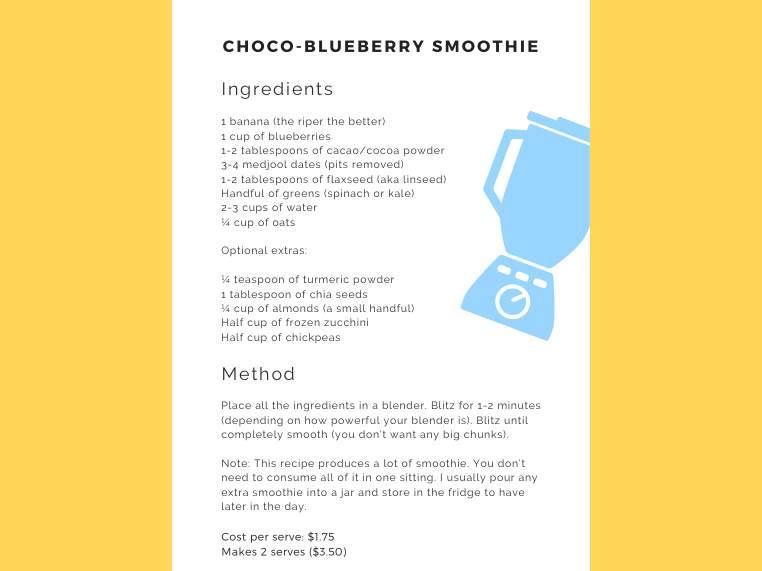
Muesli or porridge with nuts and fresh fruit (e.g., berries) Wholemeal toast with a variety of toppings (e.g., baked beans, tomatoes, and avocado) and a piece of fruit A healthy homemade smoothie (click here for my brain boosting smoothie recipe)
Your brain requires adequate hydration to function properly. Drinking water ensures that your brain receives the necessary fluids to perform tasks efficiently, such as retaining information and problem-solving.
Take regular sips of water as you study. It’s a good idea to have a glass of water or a reusable drink bottle within arms reach.
You may even want to create a tiny habit to remind yourself to engage in this simple behaviour (e.g., “After I finish answering a practice exam question, I will take a sip of water”).
Many years ago, I started thinking that my teachers and lecturers were out to get me. I thought they would mark me down wherever they got the chance. As a result of this distorted thinking, I became too scared to write anything in one of my first tests at law school. After receiving a terrible grade (5%), my brother said to me:
“Remember sis, your teachers want you to do well. They will try to give you marks wherever they can. It’s in their best interest to do so.”
Don’t worry about writing a perfect answer. If you’re unsure, be brave and still write something down. Even if it’s just a few dot points, it’s better than nothing. You may not get any marks for it, but your teachers won’t take marks off.
Just remember, most of the time your teachers are on your side and they want you to succeed. When you do well, it makes them look good.
Chances are there will always be something that you could have studied more thoroughly come the day of your exam. But on the morning of an exam, you can’t do much about that, so there’s no point worrying. Worrying will just deplete your finite energy, which you need to conserve for the exam.
Instead of worrying, try saying this to yourself before each exam:
“I now know so much more than I did before. I’ll be able to answer many questions in this exam.”
Telling yourself this positive micro-thought will allow you to enter the exam in a calm and confident frame of mind.
It’s normal to feel a bit nervous before an exam. But there are certain things and people that can push your anxiety levels into dangerous territory and impair your exam performance.
For example, coffee and energy drinks will skyrocket your stress levels. Similarly, hanging out with people who have a lot of nervous energy and are venting about the exam (“I’m going to fail!” and “I hardly studied!”) are going to leave you feeling distracted and a little jangled.
Before the exam, do your best to isolate yourself from these people. If you’re worried about offending someone who is venting to you, you could say “I’m sorry but I really need to do some last minute cramming”. Then proceed to pull out your notes and pretend to read them.
How many times have you stayed back after an exam to talk to your friends about what you put for each question? Have you ever felt terrible after doing this?
It can be reassuring to know that you wrote the same answer as your friends. But if you find out that you wrote something completely different, you may start to second guess yourself. If you have another four or five exams to go, this may throw you off your game.
This is why I don’t recommend engaging in a postmortem of the exam until you get your results/exam paper back.
When you walk out of the exam room, tell yourself:
“That exam is over. There’s nothing I can do to change how I went. It’s time to move on!”.
You could imagine yourself locking the exam in a box and throwing it off a cliff or rolling it up and stuffing it in a bottle and throwing it out to sea. The point is you need to mentally disconnect from that exam and focus on studying for the next one.

If you come across a question that you’re not sure how to answer, stop for a moment and take a few deep breaths (in for the count of 4 and out for the count of 4).
A simple breath activity you can try is the Box Breathing Technique. This involves imagining yourself breathing along the sides of a box (breathing in for the count of four on one side, out for the count of four on the next side, etc). Repeat this 2-3 times. Then take a look at the question again.
If you are still unsure how to answer the question, move on to another question.
The worst thing you can do is panic (remember, stress impairs your ability to think and recall information).
By engaging in Box Breathing, you can help yourself to remain in a calm and stable state.
Many of us are familiar with writer’s cramp. This can be caused by gripping onto your pen too tightly. Try loosening your grip a little.
Alternatively, experiment with a range of different pens. Some biros require you to press down hard on the page to make a mark, but not gel pens. The ink just flows onto the page!
The reality is, even with a good gel pen, your elbow will start to hurt at some point if you’re taking a 3 hour exam. When it does start to hurt, have a rest for a few seconds (yes, you have time to do this). Stretch your arm out. Shake it a little.
Treat each exam like a mountain hike rather than a 100 metre sprint. Resting for a few moments here and there will be time well spent and will enhance your overall performance.
These simple strategies can help to elevate your exam performance. My advice is to start small. Even if your exams are several weeks away, select one or two of these ideas and start testing them out today. At first, the strategies will require a bit of mental effort. But like anything in life, if you persevere they’ll become second nature to you and they’ll just be things you do without even thinking.
Want to learn more exam strategies? Click here to download a free copy of 70 ways to ace your exams.

This is despite the fact plenty of research shows we’d be less stressed, have more energy, and feel more relaxed if we spent more time out in nature.
Nature is a powerful antidote to the stresses and pressures of modern life.
With this in mind, I’ve been experimenting with creative ways to get my daily dose of nature. One strategy I’ve been testing out is working outside.
I recently listened to a podcast interview with Kim Stanley Robinson (author of The Ministry for the Future). Kim has been writing books outdoors for the last 15 years. In fact, he believes this is what saved his writing career.

On the podcast Wild with Sarah Wilson, he mentioned how this interesting habit came about. He said:
“I was feeling tired of writing . . . burnt out. And then I moved outdoors to a café table that’s in a courtyard that’s fenced in by the side of the house. There’s a Japanese maple shading it but it wasn’t quite enough shade for the laptop screen. So I slung a tarp from the fence and tree branches.”
He later added:
“I realised I wasn’t sick of writing. I was sick of being indoors all day.”
For Kim, writing outdoors has been a joy and an exhilarating experience. “The little birds are my office mates”, he said.
After listening to this interview, I thought “What have I been doing all this time?”
I knew I needed to head outdoors and set up a second workspace.
I didn’t waste any time. I went on Gumtree and found a cute retro vintage table with drawers. It fit perfectly in the space I had available on my back verandah.
Mosquitos are a real problem in my neighbourhood. Like a phone pinging constantly, they are a source of distraction and irritation.
To combat this problem, I purchased a secondhand mosquito net for $5 to hang over my workspace. Upon inspection, the net had one little hole but this was easily fixed with a needle and some thread. With a couple of clothes pegs, I am able to close the opening of the net so mosquitos can’t get in.
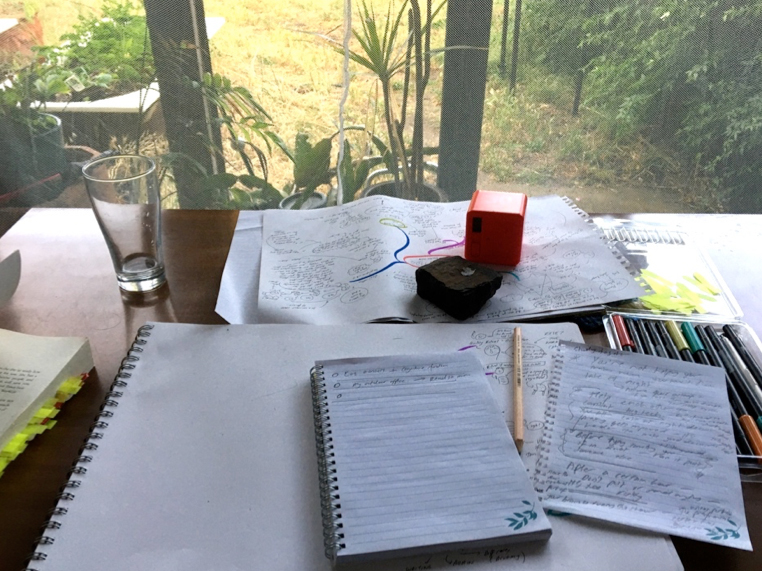
I can’t tell you how satisfying it is every time I am working away and I see a mosquito buzzing on the outside of the net. I think “Victory!”.
With my outdoor workspace, I need to be able to easily access the right tools and stationery once I enter the netted space. I don’t want to have to get up and unpeg the mosquito net every few minutes and risk a pesky mosquito entering my space.
• Pads of paper
• Pencils and gel pens
• Coloured pens
• Post-it notes
• Electronic timers (to track my work sessions and breaks)
• Water bottle and glass
• A couple of solid rocks (to act as paper weights so my papers don’t fly away when it’s windy)
• Ergonomic laptop stand (to prevent neck strain), a keyboard, and mouse
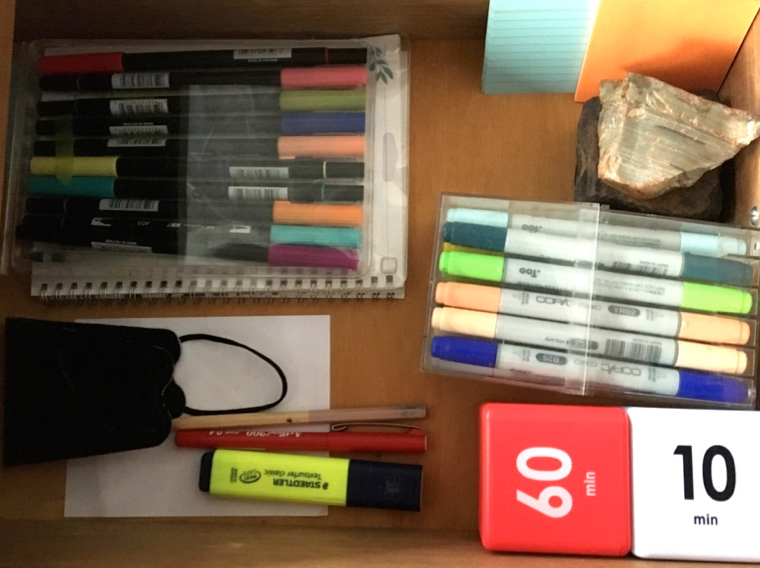
Having these items within arms reach means I can get into a flow state quickly and stay in flow.
When I’m working outdoors, I have a simple rule: my mobile phone is off limits (I leave it inside the house). It’s amazing how when my work gets difficult, instead of checking my phone to get a quick shot of dopamine, I’ll notice a little bird or a wasp flying nearby. This gives me a mini mental break without getting completely derailed and losing sight of what I need to be doing.
This is probably the biggest downside associated with working outdoors. You have no control over the elements.
If you live in a warm climate like I do, you may want to set up a fan. Kim Stanley Robinson who lives in California installed one of those misting devices that pubs and cafes use in their outdoor areas to keep customers cool. He says this keeps him cool during Summer.
I live in Western Australia where in Summer it’s easy to feel like you’re being slow roasted outside. When it gets too hot, it’s hard to think and near impossible to learn.
Similarly, when it’s too cold, I can’t focus and learn for the life of me!

But in Winter, you can layer up. You can put on a warm jumper, beanie, some uggboots, and/or use a blanket. Kim Stanley Robinson says in the colder months he puts on his mountaineering gear to write outdoors. He sometimes even uses an electric heating pad for his feet.
Bottom line is this: do what you need to do to be comfortable in your outdoor workspace.
I understand Kim and I are both in privileged positions. Not everyone has a backyard, verandah, and/or the space to set up an office outside.
If you don’t have a backyard, here’s what I would recommend: create a mobile office. This is a backpack that contains everything you need to do your work.
Then, take your backpack to a local park (ideally one that has plenty of shade) and set yourself up at a picnic table.

Alternatively, simply having a picture or painting of a natural environment in your study space and looking at it from time to time can be beneficial. This study found staring at a picture of a flowering meadow green roof for just 40 seconds was associated with better sustained attention.
Indoor plants are a fabulous investment, too. Having indoor plants in your space has been found to boost creativity (you can check out the research here).
In a world where we are becoming increasingly disconnected from the natural environment, working outdoors can be a great way to get a good dose of nature.
Since setting up my outdoor office space, I’ve noticed so many wonderful little creatures in my garden that I normally wouldn’t see (mainly birds and bandicoots). I also feel calmer and more energised at the end of the day. I can focus better, too.
I strongly encourage you to invite a little more nature into your life, whether it be by setting up a desk outside or adding some indoors plant to your study space.