
Staying focused in the age of distraction isn’t easy.
But it can be done with a little mental training and restructuring your environment.
If you want to develop razor sharp focus, greater peace of mind and the ability to get things done, consider decluttering your workspace.
 Research has found that clutter in our environment is mentally overwhelming and distracting. Clutter makes it hard for you to focus on what you need to do.
Can’t find your keys or an important document? Clutter and bad systems are probably to blame.
Having excess stuff in your life means you spend more time:
And less time on the things that are most important to you.
The thing about clutter is that it’s incompatible with having an active and fulfilling life. Why?
It creates a barrier between you and the items you need to get into the day and do the things you need/want to do.
In short, clutter doesn’t really enrich our lives. Having a giant selection of things often just exhausts us and depletes our energy.
So it’s important to ask the question …
By understanding the root causes of clutter, it can help us to tackle our mountain of stuff and keep junk at bay.
Our piles of stuff are mostly due to the unexamined habit of accumulating things without discarding.
Let’s take a quick look at technology. It keeps changing and we’re told that we need the newest model (even though the one we currently have may still work perfectly fine). For example, if you bought every new iPhone version since the first was released in 2007, you would have purchased at least 8 phones. That’s a new phone every year.
So what happens is you accumulate the newest model and the old one just sits there. Some of the reasons for why you hold onto such items may include the following:
1. Too Lazy/busy: You’re either too lazy or busy to get rid of it. You say to yourself, “I don’t have the time to deal with this and sort through this stuff!”.
2. Perceived Value: You think “This is valuable!” and perhaps you could make some money from it in the future.
 3. Emotional ties: You’ve got a strong emotional attachment to item (fond memories are associated with it).
4. Impulse purchase you regret: You made a mistake buying it but you don’t want to admit it to yourself so … you hang onto it.
But here’s the thing …
Decluttering allows you to start fresh, organize your space and make room for new ideas and creative projects.
So how can you declutter your life without feeling completely overwhelmed by the job?
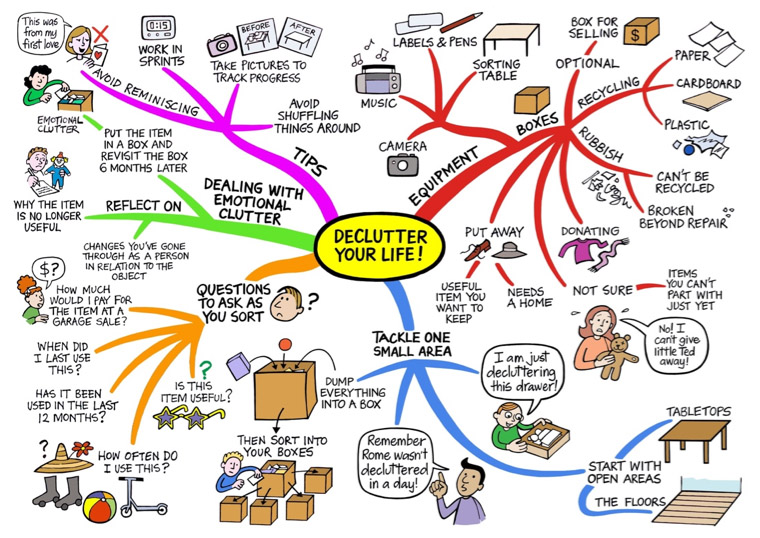
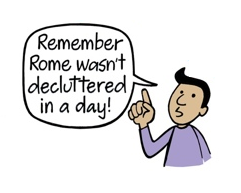 First of all, it’s important to understand that it took years for you to accumulate all your stuff so it’s going to take some time to deal with it all. As decluttering expert Don Aslett states, “Rome wasn’t dejunked in a day”.
This process will take some time, so go easy. Baby steps.
One mistake a lot of people make before they start decluttering is they run out and buy books on how to declutter and lots of storage and organisation boxes. Resist the urge to do this!
Storage boxes have been described as junk bunkers and being like a shot of morphine. Don Aslett states:
“They ease the pain, take care of the problem for a short time – and then it comes back”.
When you run off and buy storage boxes and decluttering books, all you’re usually doing is creating more clutter in your life that you’re going to have to deal with at some point.
Decluttering isn’t rocket science and the equipment you need is fairly basic.
You’ve usually already got what you need or you can get it for free.
1. Recycling box: This is for papers, cardboard and plastic (anything that can be recycled in your area).
2. Rubbish box or a rubbish bag: This is for anything that can’t be recycled and is broken beyond repair.
3. Put away: For useful things you want to keep but these items aren’t in the right place. You need to find a home for these items.
4. Give away box: This is for stuff you no longer use but it’s still good enough for others to use.
5. Note sure box: This box is for items you’re undecided about (You’ll come back to this box at the end of your decluttering session).
Some people ask:
“What about a box for selling?”
If you want to make sure the item is going to someone who will really appreciate it, then advertising it online can be a great idea.
 But sometimes, you just want a quick clean release from some objects. So if the item isn’t worth much and you don’t have a strong emotional connection to it, it’s not a bad idea to give it away. Consider putting it on your local Buy Nothing group or take it to your local op shop.
Once you’ve got your basic equipment, you’re ready to start the decluttering process.
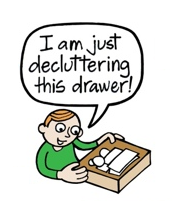
All you have to do is focus on one small area. It could be a section of a book cupboard, a surface, a pile of papers or a drawer.
 The key is to stay focused on this area (don’t get distracted by other cluttered areas). You want to get the job done properly. Seeing improvements in one little area will help to build your clutter clearing confidence.
I like to start the decluttering process with my office desk as this is where I spend most of my work day.
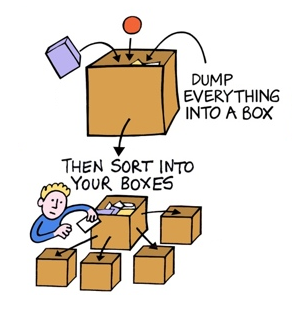
What you’re doing is you’re clearing the backlog and starting fresh.
Then you’re going to sort through that box. As you pick up an item, ask yourself:
When did I last look at this item?
Has it been used in the last 12 months?
Is it really useful?
What is the cost of holding onto it?
Repeat this process. Remember, don’t overdo it. Pace yourself by setting a timer and working in 15 minute bursts. Tackling one little area each day is enough.
It’s important to keep in mind that decluttering is a journey not a destination. It’s an ongoing process, not an end product.
You have to keep at it and make time to do it because new papers and items will keep coming in to fill those empty spots. You have to be like a ninja and fight off stuff coming into your space all the time.
But if you can stay on top of it, you’ll have more energy to focus on the things that matter most to you.

For context, she was a sales manager who used a BlackBerry phone for work (a fancy, expensive device at the time).
Every minute of the interview, her phone pinged with a notification or she received an email alert on her laptop. She’d glance at one of her devices and, with a panicked look, say, “I need to answer this!”
It was an awkward and disjointed conversation, full of stops and starts. I have to admit, her behaviour annoyed me. I soon realised I wasn’t the only person feeling this way.
The sales manager mentioned that she had a 4-year-old daughter who would get upset with her.
She told me that her little girl would beg her to put her phone and computer away. She’d tug at her clothes and cry, “Mummy! Mummy! Put your phone away!”

I appreciated this woman’s honesty, especially when she said to me:
“On the weekend, I’m with my kids but not truly with them… if you know what I mean”.
I knew exactly what she meant.
That was over 10 years ago. Fast forward to today, and we’re all a bit like that sales manager. But things are a lot worse now.
Instead of being overwhelmed and distracted by phone calls and work emails, we’re dealing with powerful Big Tech companies that hijack our time, energy, and attention.
They’ve made us weak-willed and impulsive.
We’re now in a position where distraction is something we crave rather than put up with.
When we have a gap in our schedule or we have to wait in line, what do most of us do? We reach for our phones without even thinking.
Rather than be alone with our thoughts, we desperately try to fill the space with ‘phone snacks’.
When we feel confused, frustrated, or bored, we run to our devices to escape the discomfort and our brains reward us for doing so.
Every time we switch tasks, our brain releases a little shot of dopamine.
It’s these quick hits of dopamine that train us to crave checking our phones and, ultimately, multitasking.
In an environment of unrestricted tech use, my brain is like a wild monkey. It wants to run around, make a mess, and explore many different things all at once.

I can relate to Dr Nancy Colier when she writes in The Power of Off, the mind on technology is like a “wild, locked-up monkey that’s drunk two bottles of wine chased by a shot of Scotch and been stung by a whole swarm of bees”.
When I start multitasking (and it doesn’t take much to get me going), I feel amped up, frenzied, and agitated. My energy feels a little crazy.
Research shows that as we quickly switch from one task to another, we rapidly deplete our finite mental resources and put our brains under a lot of stress.
But it gets worse . . .
When we multitask, we also experience what researcher Sophie Leroy calls Attention Residue.
In a research paper called Why is it so hard to do my work? Leroy explains Attention Residue as the extent to which your attention is only partially focused on the current activity because a prior activity (the task you rapidly switched from) is still holding part of your attention.

Why does this matter?
Leroy’s research found that when you experience Attention Residue, your performance suffers.
It’s as if you’ve taken a big dollop of the previous task and put a thick slather of it all over the current task, thereby making a mess of the present moment.
The good news is we can stop messing with our precious moments by focusing on one task at a time.
In his excellent book Time Surfing, Zen Monk Paul Loomans encourages us to focus on one task at a time, with minimal interruptions, and do it until completion. He says if we do this, we will experience a sense of calm and pleasure in everything we do.

Even tasks we consider boring or mundane (e.g., peeling potatoes or cleaning your room) can be transformed into artistry when you are truly present.
Part of the problem is that we’re often in a rush to get to the next thing on our to-do lists. But as Loomans warns, “Rushing is like gulping down time. You’re not living for now but for later”.
To counter this frenetic urge to race ahead, Loomans suggests that we accept whatever we are doing as “the activity of the moment”. In other words, we view the task before us as the most important thing we can be doing in this moment and we forget the rest.
It’s a simple but powerful mental shift.
I’ve noticed that when I accept whatever I am doing as the thing I should be doing right now, I no longer feel the urge to work with such intense energy. I feel calmer. An added bonus is that when I slow down, I make fewer mistakes and tend to do a better job.
At the heart of it, doing one thing at a time means showing up to life and being present, to the good stuff but also the painful, boring bits.
If you find yourself reaching for your phone more than you’d like, ask yourself this question:
“Am I reaching for my phone to escape the present moment?”
For me, the answer is usually yes. I’m trying to avoid the discomfort of life. But life tends to be more meaningful and enjoyable when I stay fully present to what’s happening around me, with my phone out of sight.
Technology will dominate your life, and multitasking will be an issue unless you have strategies to protect your time, energy, and attention.
What motivates me to set limits on my tech use (specifically my phone) is a desire to feel calm, grounded, and focused. I also want to live a life of substance, not one in which I am constantly chasing instant gratification.
Here are the strategies that I am currently practising to help me decrease multitasking and cultivate calm:

When I’m with someone or working on an important task, I put my phone away and keep it out of sight. I want to be fully present with the person I’m with or the task at hand. Why?
Because attention is how we show others they matter.
When someone is checking their phone in a social situation, it communicates “I’m more interested in what’s happening on this screen than I am in you”.
When I think back to the interview with the sales manager, it would have been a better experience for everyone if she had put her phone on silent, left it in her bag, and closed her laptop.
There would have been fewer times saying “What was the question again?” and “Sorry, I can’t remember what we were talking about”.
We probably would have felt more connected, too.
Note: Even when my phone isn’t within arm’s reach, I can still catch myself rapidly switching between web browsers and tasks. However, I’ve noticed that my multitasking significantly increases when my phone is within arm’s reach.
You’ve probably heard of intermittent fasting, where you have a window for eating (e.g., 10am to 6pm). But have you heard of phone fasting?
Phone fasting is a period during the day when your phone is not within reach.
As TJ Power states in The Dose Effect:
“A phone fast enables your dopamine to replenish and creates the opportunity for connection and restoration.”
So, as an experiment, for 30 days, I phone fasted from 8pm until 12noon the next day (allowing myself to make urgent calls if needed). I discovered that this made a big difference to my ability to focus. I also experienced a sense of calm like never before.
At the start of the day, I create a ‘Wish List’ (another wonderful concept from Paul Looman’s Time Surfing book).
I write down all the things I’d like to do in the day, but there’s no pressure to do all of them. I then put the list away, and depending on how I feel, I listen to my intuition and trust myself to choose the right activity to begin with.
Before I start a work session, I also declare what I intend to do (e.g., “Chop vegetables for curry” or “Write for 45 minutes”). If possible, I also like to share what I plan to do with another human (I use an online coworking community called Cave Day to do this).

After every 25-30 minutes of work, I aim to take a short movement break (usually 2-5 minutes in duration). This helps me to stay energised and alert. But most importantly, it gives me a brain boost.
What I wish I had understood when I was younger is that you can’t focus for hours on end. It’s not humanly possible because your brain has a finite amount of attentional resources. This means as you focus on doing a task, your attentional resources get depleted (and if you multitask, you accelerate the depletion even more!).
However, research shows you can boost your attentional resources by taking short breaks or, as Paul Loomans likes to call them, ‘breathers’.
A ‘breather’ is any activity that allows you to get out of your head and grounded in your body.
Some of my favourite breather activities include going for a short walk, chopping vegetables, or riding my bike to pick up a package from the post office. These activities allow my brain and thoughts to roam free.
Although many of us default to checking our phones during breaks, resist the urge. The problem with using your phone on a break is that you’re still in your head. This means you’re churning through your attentional resources instead of replenishing them.
The sense of calm and pleasure I experience when I stop multitasking and focus on doing one thing at a time is second to none.
But in the age of the Attention Economy, with so many companies trying to hijack our attention, it takes discipline and practice to stay focused.
Without strategies in place to protect your focus, the default will be multitasking and its friends – chaos, stress, and fatigue.
We may not have a 4-year-old child tugging on our clothes when we’re using our phones. But perhaps we should all listen to the wisdom of that little girl and put our phones away.

But just to be clear – this car wasn’t in bad shape when I first got it. I turned this car into a jalopy through neglect and ignoring basic warning signs.
Whenever I gave my friends a lift in this car, I remember that they always looked visibly uncomfortable. They’d say with a nervous laugh:
“Jane, what’s that strange rattling sound?”
“Why is there a red warning light on your dashboard?”
I wasn’t fussed about the red light or the strange rattling sound.
Somehow, I’d missed the adulting lesson on basic car maintenance.
For many years, I never bothered to get my car serviced. I drove it to the point where it rattled and shook violently, the engine would cut out while driving, and the brakes squealed at a painfully high pitch.
It got to the point where I could no longer ignore these problems, but by then, it was too late. My car was beyond repair and could only be salvaged for scrap metal.

I’m embarrassed to share this, as that’s no way to treat a car that gets you from A to B and uses the Earth’s finite resources. But stay with me because there’s an important point I want to make, and it’s this. . .
When I was younger, I engaged in several unhealthy lifestyle practices. Whilst I never smoked, took drugs, or consumed alcohol, I ate huge amounts of processed junk food (I didn’t know how to cook).
I also frequently sacrificed sleep to pull all-nighters to complete my assignments (I struggled with procrastination).
My body seemed resilient. It appeared capable of handling the shocks. But over time, I started feeling tired and rundown. Still, I kept pushing myself like my old car. The only time I could rest was when I got sick.
These days, everything’s quite different.
I am physically unable to thrash my body around like an old jalopy.
Something as simple as consuming too much salt or sugar can send my brain spiralling out of control.
I was reminded of this a couple of weeks ago when I visited a friend in hospital. Because I was spending a lot of time at the hospital, my usual routines of grocery shopping and cooking from scratch were disrupted.
But then to make matters worse, I was given $80 worth of vouchers to spend at the hospital cafeteria. I thought, “How bad can hospital cafeteria food be?”.
It turns out really bad.
Cheese kranskys (sausages), heaps of salty hot chips, deep-fried chicken, and soft drinks were the main options at this hospital cafeteria.
Unhealthy food seemed completely normalised in this hospital environment. My jaw dropped when I saw a patient order not just one but five cheese kransky sausages!
In this hospital setting, I also started to eat poorly. It was on my third day of eating hot chips from the hospital cafeteria when I noticed that these chips weren’t doing me any favours. I was feeling off my game.

So I decided enough was enough. I gave the remaining hospital food vouchers to a homeless man who was hanging around the cafeteria, desperate for a feed. It was back to home cooked meals for me!
This greasy processed hospital food had a ripple effect on the rest of my life. I slept badly, which impacted my ability to run the next morning (my joints hurt). I felt resistance to using my treadmill desk because everything felt much harder than usual. Since I was moving less, I was more distracted.
I know all this might sound a bit dramatic, especially to those of us who enjoy a few hot chips (e.g., my husband). Given my friend was in a hospital bed and couldn’t walk, I am fully aware of how lucky I am to be able to run in the first place (even with sore joints).
The point I’m trying to make is this . . .
I also know that small decisions, like eating too many hot chips or staying up late, can add up and take their toll on your mind and body. These tiny decisions can have a big impact on the way you feel.
When I was younger, I could eat whatever I wanted and still feel pretty good. Sometimes I’d feel a bit off, but not in a noticeable way.
As Dr Randy J Paterson states in his book How to Be Miserable in Your Twenties:
“In your twenties, some people can do practically anything to their bodies, experience no immediate physical consequences, and feel emotionally more or less well. Random sleep cycle, sedentary lifestyle, lousy diet, 90 percent of the day staring at screen, binge-drinking, isolation, the works. The body doesn’t completely fall apart, and the mind, while not thrilled, hangs on.
Later on, the effect is more immediate. Live exactly the same way at thirty-five, at forty-five, and things don’t go so well. Take a middle-aged car and drive it aggressively down jolting roads, loaded to the max, old oil clogging the engine, and it’s not going to last long. The baseline mood at forty-with no maintenance, no exercise, no dietary adjustment, no stability, and no social life- is misery. ”

Like a car, the human body requires regular basic maintenance. I see this basic maintenance as a collection of small behaviours that leave me feeling calm, grounded, and focused.
Here are a few things I need to do to keep myself running smoothly:
Every now and then, I’ll abandon these behaviours. I’ll have a day where I eat and do whatever I like. I’ll order takeaway, sit on the couch and binge-watch a series until late at night. I usually pay for it the next day, but it also gives me a better appreciation of these healthy practices and what they do for my body and mind.
It’s all about tuning in and noticing how certain things make you feel. For example, when I was in my mid-20s, I noticed every time I ate deep-fried chicken, I experienced sharp stomach pains.
That was like the red warning light on my car dashboard going off in my body. But instead of ignoring it, I paid close attention. Eventually, I decided it wasn’t worth the pain. So I stopped buying greasy deep-fried chicken and eventually went plant-based, which immediately improved my mental and physical health.

There’s no doubt that modern life can be hectic and stressful. When you’re rushing from one thing to another, it’s easy to overlook the basics and ignore the warning signs.
I’m not proud of how I treated my first car, but I learnt from the experience. Now I make sure I get my car serviced regularly. This saves me time, money, and stress in the long run.
Similarly, we need to pay attention to the way in which we look after ourselves. By dedicating time, energy, and attention to the small things that make us feel better, our experience of the present moment becomes richer. As longevity researcher Dan Buettner says, “You can add years to your life and life to your years”.
“Suzuki Swift 1.3 GTi 1990” by RL GNZLZ is licensed under CC BY-SA 2.0. (used in image 1)
“Scrap yard 22l3” by Snowmanradio at English Wikipedia (Original text: snowmanradio) is licensed under CC BY-SA 3.0. (used in image 2)
“KFC Wicked Wings” by avlxyz is licensed under CC BY-SA 2.0. (used in image 5)

I was the kid who was always late for school. I’d forget things. I’d lose my stuff. I’d regularly have to check the grimy lost property bin.
When I was younger, I admired people who were organised. Seeing someone with colour-coded files, a neatly arranged bag, and a tidy bedroom was inspiring.
I figured I was just wired differently. Being messy was just how I was—a simple fact of life. My boyfriend (now my husband) even affectionately nicknamed me Mess Pot.
It never dawned on me that perhaps these ‘organised’ people I was so in awe of had been exposed to other organised people and practices from a young age.
It wasn’t until I was in my early twenties that the penny finally dropped.
Here’s what I realised . . .
No one pops out of the womb knowing how to be organised.
If you know how to learn, you can learn how to become organised. It’s not rocket science.
So, that’s exactly what I did.
Over the past 15 years, I’ve taught myself to be organised.
I’ve read many books on the topic, from Marie Kondo’s bestseller The Life Changing Magic of Tidying Up to David Allen’s Getting Things Done.

I’ve experimented with numerous organisational methods, systems and strategies that the authors promised would transform my life from chaos to freedom, control, and ease.
In this article, I share what I’ve learnt from all these books, organisational gurus, and personal experiments I’ve conducted to become organised. I hope this inspires you to develop your own systems and strategies that work for you.
You can follow other people’s systems and methods, but I’ve discovered that it’s best to develop your own organisational system. The organisational system you adopt must align with your values and goals. If it doesn’t, abandon it or tweak it until it feels right for you.
For instance, I love books, and I own many. This is why I yelped out in pain when I read Marie Kondo’s advice on how to deal with books.
In her book The Life Changing Magic of Tidying Up, Kondo advises readers to rip out relevant pages from reference books and discard the rest of the book. There was simply no way I would do that to my precious books!
Central to her KonMari method is holding an object in both hands and feeling the emotion that arises.
If the object sparks joy? You keep it.
If there is no joy? You get rid of it.
I can see how this strategy has enormous appeal. It simplifies the decluttering process. You don’t have to think too hard. But there are dangers in the spark joy approach.
You can end up on a consumer treadmill of discarding items that no longer spark joy and constantly acquiring new ones that do. However, you can bet that the joy will soon dissipate from those new items as you habituate to them.
In addition, this ‘Spark Joy’ strategy also overlooks the functional role of many items in our lives.
My toilet plunger doesn’t exactly spark joy, but it’s incredibly useful when I need it!
The point is you need to trust yourself. Don’t give all your power away to a stylish organisational guru with a cult following and a Netflix series!
Trial and error is the key to getting your organisational groove on. And patience.
Your life won’t be transformed in a day or a week. You have to trust that the solutions will come, but it will take time.
This may sound a bit woo-woo and new age. So, let me frame it another way . . .
On your journey to become organised, pretend to be a scientist. Run some personal experiments.
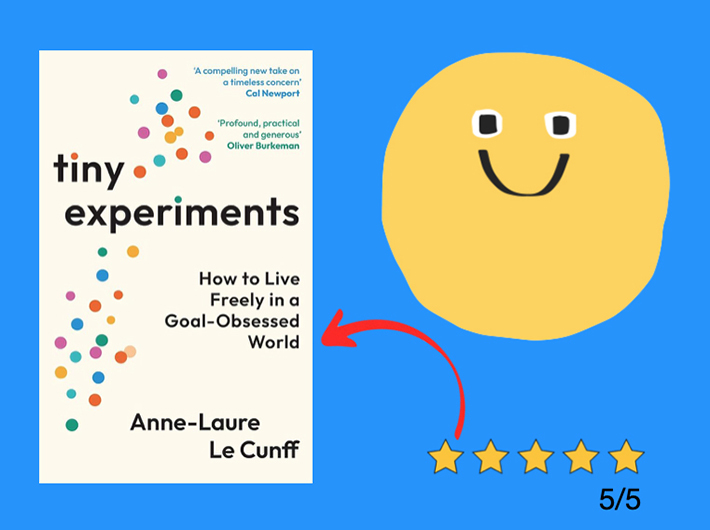
In the book Tiny Experiments, Anne-Laure Le Cunff encourages us to come up with a research question and then turn it into a hypothesis. She states:
“Don’t overthink it. Formulating a hypothesis is an intuitive process based on your past experiences and present inclinations. It should simply be an idea you want to put to the test- an inkling of an answer to your research question.
If you observed that you dread giving presentations, maybe improv classes could help build your confidence. If you feel anxious in the morning, maybe meditation could help regulate your emotions. If you enjoy graphic design, maybe freelancing could help strengthen your portfolio.”
Don’t be put off by this scientific language (e.g., ‘Hypothesis’ and ‘research question’). Running a tiny experiment and formulating a hypothesis is easy.
Here’s an example from my own life . . .
I’ve noticed that when clutter piles up on my desk, I am more easily distracted and feel overwhelmed. So, I came up with the following research question:
“How can I decrease feelings of overwhelm and increase my ability to focus when I’m at my desk?”
My hypothesis to this question was:
“Decluttering my desk by removing all non-essential items will decrease feelings of overwhelm and increase my ability to focus on the task at hand.”
Then, I put this idea to the test and observed what happened.
Some experiments you run will work. Others will flop, but that’s okay. The point is you won’t know unless you run some tiny experiments.
As Anne-Laure Le Cunff states:
“Once you have a hypothesis, you can design an experiment and turn your life into a giant laboratory for self-discovery.”
Through running tiny experiments, I’ve come to realise that being organised isn’t about having a beautifully colour-coordinated filing system or a nicely decorated home.
It’s also not about following 10 simple steps and waking up one day to find that you’ve magically become an organised person.
In our materialistic culture, we are sold a particular idea and image of what it means to be organised. But I’m not buying it. And you shouldn’t either. Why? Because it’s a lie designed to make us feel bad about ourselves, so we buy more stuff!
In stark contrast to the slick images you see online and in glossy magazines, life is messy. It’s a constant struggle.
Purchasing pretty storage containers and having a tidy, organised home won’t make your life less messy and uncertain.
But I can say this: being organised will make it easier to navigate the mess and chaos of life. It will help you focus your time, energy, and attention on what matters most to you.
So, I’m suggesting that you block the influencers and ads from your feed and burn the home lifestyle magazines. You’re going to create your own personal philosophy for organised living.

Being organised is about helping my day go a little more smoothly.
It’s about removing friction and resistance between me and the tasks I need to do. When I’m organised I can easily find what I need, which allows me to dive into my projects: filming that video, cooking that new recipe for dinner, and mind mapping that book I’ve just read.
Being organised is a way to enjoy the present moment more. Instead of feeling overwhelmed by mess and clutter, I feel calm and grounded. It’s easier to focus on the task at hand.
Is it worth taking the time to become more organised and experiment with your own systems and strategies?
Yes. 100%.
Being organised has decreased my stress levels and boosted my confidence. It has also saved me a significant amount of time and energy.
I’ve found that developing a few guiding principles helps ground you in your quest to become organised.
Below, I share my guiding principles and how I’ve integrated each one into my life.
I’m not here to tell you to copy what I do (it’s best to develop your own philosophy, guiding principles, systems, and strategies). However, if you’re unsure where to start, feel free to experiment with the systems and strategies listed below.
Give every item a home. Everything should have a special place in your space.
Professional chefs do this. Before they start cooking a dish, they prepare the ingredients and take out the kitchen utensils they need. There’s a term for this practice. It’s called the mise en place.

Mise en place is a French term that literally translates to ‘putting in place’, but it means a place for everything and everything in its place.
When it comes time for a chef to start cooking a dish, they know where the ingredients and kitchen utensils are. This allows the chef to work efficiently and focus on the task at hand: cooking the dish.
In the book Work Clean, Dan Charnas explains how this concept can be applied outside the kitchen to our everyday lives.
Charnas encourages us to arrange our spaces to remove resistance. He states:
“The less friction we have in our work, the easier it is to do, the more we can do, and the quicker we can do it; and thus the more physical and mental energies we can preserve for other things.”
Mise en place changed my life for the better. I used to spend a lot of physical and mental energy trying to find my keys, wallet, etc., but not anymore.
I now have a designated spot for my keys, hat, wallet, and bag. After using these items, I return them to their special place.
With the mise en place, I no longer waste time searching for items. I can quickly and easily find what I need. You can read more about how I apply mise en place to my life here.
If something is important, I can’t have it stuffed away in a cupboard, drawer, or file. If it’s hidden away, it doesn’t exist.
This is why you’ll see vertical wall hangers in most rooms of my house. These hangers contain key items I frequently use in the space.
By having one item per pouch, I can easily find what I need when I need it.
I get easily overwhelmed by piles of stuff, so I have to be vigilant and stay on top of the mess.
I have a simple trick for keeping my space relatively tidy. I tell myself:
“All I need to do is put away three things. That’s it!”
The sink is overflowing with dishes? I tell myself, “Just do three dishes!”
Laundry is scattered all over the bed? “Just put away three pieces of clothing!”
The kitchen bench is covered in random stuff? “Put away three spices!”
Putting away three items feels easy. And when something feels easy, I’m more likely to get started.
When everything has its special place (see Principle #1: Embrace mise en place), it’s easy to implement this principle.
There’s nothing more frustrating than having a brilliant idea and having no way to capture it. You need to be able to catch thoughts as they occur.
This is why I have whiteboards, markers, pads of paper, and pens placed in key locations.
These random ideas that I capture get thrown into my in-tray to process later on.
Distractions keep you from doing what you need to do. Like a pile of clutter on your desk or boxes obstructing your entryway, distractions are a barrier to your goals and intentions.
If you want to be more organised, you need to deal with anything that could distract you before sitting down to do your work.
Like most people, the biggest distraction I face is my phone.
If I’m constantly checking my phone, I feel scattered, frenzied, and overwhelmed. Everything speeds up. I start to feel like I’m spinning out of control.
I know I have to avoid this mental state at all costs if I want to have any chance of having a productive, enjoyable day.
This is why I have a morning ritual of placing my phone in pocket 1 of my vertical wall hanger in my dining room (well away from my workspace) before I start my workday. Out of sight is out of mind.

I used to feel intimidated by the idea of planning, so I rarely planned my week or day.
But over the past few years, I’ve become a planning machine. Why? Because plans are powerful. Even rubbish plans work wonders!
As Ned Brockman says, plans “help make you less anxious about the howling chaos of modern life.”
Here’s how I create my ‘rubbish’ plans for the week and day:
At the end of every week (on a Sunday), I create a plan for the week ahead.
I do this by reflecting on the week I’ve just had (What did I do this week? Can I claim any wins? Are there any unfinished tasks or people I need to get back to?) and looking at the week ahead (What do I need to do this week?).
I write out all the major to-dos for the next seven days on a list.
This list usually overwhelms me (there’s always a lot to do!). To combat this feeling of overwhelm, I transfer a few tasks from the list to an index card. This is my daily card (the to-do list for the day).
As I complete each task, I mark it off my daily card. As I see more items being marked off, it builds positive momentum and a sense of progress and satisfaction.
I use a paper-based planner and a massive year-in-a-glance calendar to help me keep track of my commitments.

When I can see how many days I have before an important presentation or my next holiday, I feel calmer and more in control.
Using planners also frees up precious mental space for learning as you’re not trying to hold so much information in your working memory.
I’m far from being a minimalist. I love my stuff. But having too much can be overwhelming. More stuff means more things to manage, making it harder to stay organised.
As someone who loves to op-shop, I frequently have to remind myself of the following quote by William Morriss:
“Have nothing in your house which you do not know to be useful or believe to be beautiful.”
Every few months, I’ll collect some items to donate to my local op-shop. Reducing my possessions makes cleaning and organising a lot easier and quicker.
It’s important to remember why you are striving to be organised in the first place. It’s not to impress other people. You are doing this for you.
Being organised helps you pursue your goals and live in accordance with your values. You have to keep your goals front and centre of your mind; otherwise, the goal of being organised can dominate your life. Organising can become a form of procrastination.
This is why I keep coming back to my values and goals (which I have captured on a mind map). This reminds me that being organised helps me to live a good life. But it’s not the point of my life. There are more important things I want to do with my time, energy and attention.
That said, it’s hard to focus on and work towards my goals if I’m completely disorganised. I lose sight of them! You need to find a healthy balance.
If you want to be more organised, I encourage you to experiment with developing systems and strategies that work for you. Come up with an organisational philosophy and set of guiding principles that align with your values.
Why not treat your life as a laboratory and run some tiny experiments to become organised?
Through trial and error, you’ll discover what works and what doesn’t.
Remember, this isn’t about having a perfectly decorated home or trying to impress others. The point of being organised is to allow you to do the things you want to do without as much friction. It’s about living a good life.