

This is perhaps why Australians spend approximately $2 billion a year on lottery tickets. Every time someone purchases a lotto ticket, they’re buying into the dream of instant success and life on easy street.
According to mathematician and statistician Professor Peter Adams the chances of winning division one lottery with a single entry are …
Take a moment to let that sink in. Yep. It’s kind of depressing.
Professor Adams explains why he isn’t rushing out to buy a lotto ticket anytime soon. He states:
“The reason that the prize has jackpotted for so many weeks is because it is just so hard to win. So for weeks and weeks not a single person in the whole country has won division one and that’s why it jackpots but the marketing says that’s a good thing … but what they don’t say is the only reason it’s a big prize is because it’s too darn hard to win!”
Given the terrible odds of winning, you need a better strategy for life success. Here’s what I suggest …
Let’s face the reality: behind the vast majority of overnight successes are years of hard slog. How many years of work are we talking?
Seth Godin argues that it takes about 6 years of hard work to achieve overnight success. But that’s just his opinion.

Research has found it takes about 10,000 hours of deliberate practice to achieve mastery in a particular area.
Achieving any goal is the result of small habits performed on a regular basis. Little by little. Step by step. All those little steps add up to something really solid over time.
But here’s the problem we currently face …
In a fast paced, instant results world, things that take time to master aren’t so appealing.
Here’s what our lives can look like:

I’m not having a go at you. I’m a product of this instant results world, too. I’m prone to frequent bouts of unrealistic expectations.
But as Seth Godin writes:
“ … some people have trained themselves to believe that the only kind of success worth having is overnight success. That if you don’t hit #1 the first week, you’ve failed …”
Godin suggest that instead of embracing overnight success, we embrace the idea of being “an overnight failure, but one that persists”.
Very few people would ever consider hiring a taxi to finish a marathon. If they did, at some level they’d know that they’d be cheating themselves. Why? Because it’s the process that matters most.

Similarly, if you’re after overnight/instant success, you’ve missed the point.
You see, it’s the years of challenge, struggle and hard work that make the success so sweet when it finally comes. How do I know? From personal experience.
I know, that’s a long time, right?
Let me tell you, those 7 years weren’t all ponies, kittens and rainbows.
There were times when I wanted to call it quits. But I pushed through the pain and discomfort and completed my thesis.
And you know what? I’m so glad I didn’t give up.
My brain grew (as did my confidence levels).
I developed an awesome set of skills.
I learnt that good work takes time.
I discovered the power of grit.

I can now look at my thesis and say, “I finished that beast!” (and if I could do that, what else is possible?). But best of all, I learnt to enjoy the process of whatever I do.
As Tara Moss once said:
“Give yourself the mental freedom to enjoy the process. Because the process is a long one.”
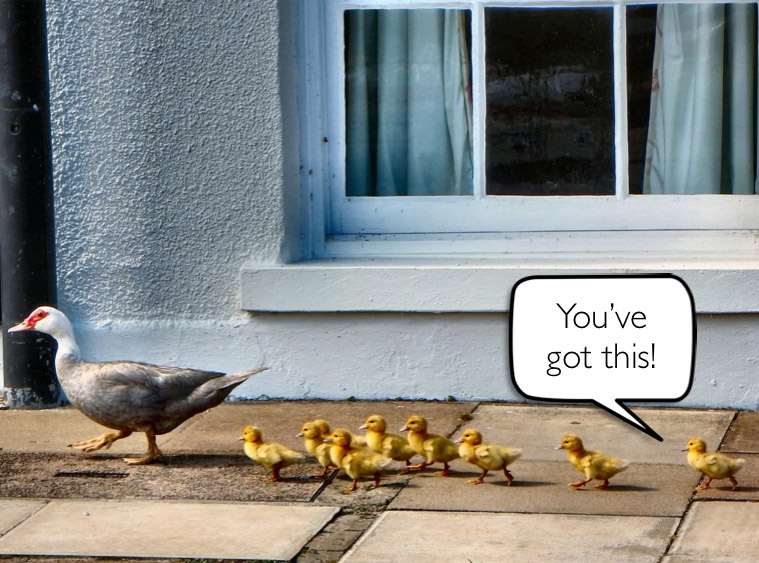
Habits expert James Clear says there are three steps to becoming pro:
1. Decide what you want to get good at.
2.Set a schedule for your actions.
3. Stick to your schedule for one week.
In relation to point 3, James Clear states:
“Stop thinking about how hard it will be to follow a schedule for a month or a year. Just follow it for this week. For the next 7 days, don’t let distractions get in the way . . . Next week, start again.”
Next time you consider buying a lotto ticket, resist. Instead, ask yourself the question, “What small action can I take today towards my goal?” Do it for a week and then rinse and repeat! Remember, all those little bits add up to something really solid over time.

Not smart enough.
Not pretty enough.
Not successful enough.
This feeling of inadequacy drove me to work in unsustainable and unhealthy ways. I felt desperate to make something of myself in this world.
It took doing a PhD to make me realise why I felt this way and learn how to escape the trap of workaholism and materialism.
Now I can say that I feel satisfied with myself and my lot in life. I am enough. I have enough. I feel successful according to my own definition and metrics of success.
In this article, I share a cautionary tale and a radical approach that can help you feel successful just as you are.
When I was a university student, my good friend became a rep for a multi-level marketing company.
This gave me a glimpse into a world of people at a whole other level of desperation to become “successful” according to Capitalism’s definition of success (i.e., having lots of money and material goods).
As a poor law student, I was invited to several multi-level marketing ‘parties’. The aim of these parties was to get you to buy the products (e.g., makeup, skin creams, and vitamin supplements).
There were also more hardcore gatherings that focused on signing you up to become a rep for the multi-level marketing company, so you’d recruit more people to the scheme and sell more products.
A rep high up in the multi-level marketing company would facilitate these recruitment drives in the comfort of my friend’s family home.
The reps were always impeccably dressed as they sold a grandiose vision of being a sales rep (e.g., international travel, limousine rides, and a life of leisure).

The underlying message being peddled was:
“If you join us, you’ll be making money in your sleep!”
It sounded too good to be true. And that’s because it was.
This particular multi-level marketing company encouraged the reps to engage in personal development through reading.
My friend’s reading list included titles such as Reject Me – I Love It!, How to Win Friends and Influence People, and The 7 Habits of Highly Effective People.

Taped to the walls of her family’s home were cut-out pictures from magazines of luxury cars, cruise ships, and attractive women dressed in stylish clothes. Smack bang in the centre of the wall was a massive hand-drawn picture of a diamond.
When I asked why these images were on the walls, I was told they were reminders of why they were working so hard. The walls were like a massive vision board for the family. These images represented what a “successful” life looked like.
These images made me feel sad and uneasy, because in my eyes, my friend had already achieved so much in her life. She was already successful.
It was even more unsettling when the selling of products moved beyond the multi-level marketing parties and into informal social gatherings.
One social gathering I will never forget. It haunts me to this day.
For some context, I was in my early twenties, and I felt quite insecure about my appearance. Like most young people, I was still figuring out who I was, and what I wanted to do with my life.
So when my friend casually pointed out after a meal that I had bad acne, but she had a skin cream she could sell me, this left me feeling hurt and confused.

I was in a difficult position: did I purchase the expensive skin cream to maintain our relationship? Or did I say no to buying the skin cream, embrace my acne, and potentially hurt my friend’s feelings in the process?
It was a difficult and messy situation I wouldn’t wish on any young person.
My younger self didn’t have the skills or tact to handle this situation with the care it needed, and sadly, our friendship didn’t survive.
I understand why my younger self felt so confused during this period. I can clearly see the lies the multi-level marketing company pushed.
Before I go any further, I want to be clear that my friend and her family, who were reps for this multi-level marketing company, had no malicious intent.
They were good people who were desperate to make a better life for themselves. They were victims of a predatory corporate structure that peddled a bunch of lies to hook people in.
One of the big lies that this multi-level marketing company pushed was the idea that ‘You’re not enough’.
Another big lie was that to be happy and successful, you need a flash car, a fancy house, and lots of money. Oh, and don’t forget the expensive skin creams.
If you don’t have those things, you’re a loser. So, you better hop to it and start selling products and recruiting reps!
Of course, this isn’t just the world of multi-level marketing companies. This is the dominant message of mainstream consumer culture and advertising.
In our lives, we may not be selling skin creams and vitamins for a multi-level marketing company, but we are trading our time and life energy for money. Money that can buy us stuff that advertisers convince us we need.
Ads don’t just sell us products. They sell us particular ideas of success. They tell us what we should value and what is normal. They tell us how we should live our lives.
In the world of advertising:
But we should pause and question these ideas. Why? Because the research paints a very different picture of what brings us happiness and fulfilment (Spoiler alert: it’s not more stuff).
The pictures of luxury goods that were taped to the walls of my friend’s home illustrated what all of us are told to value.
We live in a consumeristic and capitalist culture that celebrates materialistic values. This set of values focuses on extrinsic pursuits such as striving to obtain money, possessions, and an attractive appearance.
Living in this culture, it’s extremely difficult to not internalise these values.
However, research shows that being highly oriented towards materialistic values is harmful to psychological health and personal wellbeing.
Why would it be that pursuing diamonds, nice clothes, and social status fails to make us happy?
In his book The High Price of Materialism, Social Psychologist Dr Tim Kasser argues that our wellbeing comes from satisfying our core psychological needs (i.e., needs for security, competence, and connections to others) and orienting one’s life around materialistic pursuits is a poor way to get these needs met.
Other research has found that once our basic to moderate needs are met, more stuff doesn’t bring us additional happiness.
Evidence for this is all around us. Just look at Billionaires like Elon Musk, Donald Trump, and Sam Altman. Do these people look happy to you?

The people above look restless and miserable, except for Australian gardening show host, Costa Georgiadis (Note: he is not a billionaire and I can’t imagine he’s aspiring to become one).
Others have argued that the reason wealthy people can have so much but still not be happy is because their expectations keep rising. In other words, the more you have, the more you want more.
This is why the author of the book The Psychology of Money, Morgan Housel, argues that the most valuable financial skill you can have is not budgeting but not having to impress other people.
That’s right. Not having to impress other people is the most valuable financial skill you can cultivate.
If you can determine what success means to you, then you free yourself of the trap of trying to get other people’s attention by acquiring more and more fancy stuff.
Not feeling the need to impress other people is a goal well worth pursuing, especially when you realise that no one cares about your house, car and stuff as much as you do.
I want to invite you to join me in a world where I’m enough, and you’re enough.
In this world, if you do the work, you can feel successful, just as you are, today.
You don’t have to wait until you reach the top spot in your class, school, sport, or company. You don’t even need a lot of money or stylish clothes.
How can we feel successful just as we are, with all our imperfections?
In his excellent book Where the Light Gets In, mindset coach Ben Crowe says the secret is to live in alignment with your values and create your own metrics for success.

He believes that if you live in alignment with your values, you are successful. Simple as that.
Instead of plastering your walls with images of all the material items you dream of having, Crowe encourages us to develop a ‘Success list’. The question to ask yourself is,
Before you can answer this, you need to get clear on what you value (i.e., what’s most important to you).
For me, I value my freedom, health, growth and learning, relationships, and community.

With these values in mind, I know I’m being successful when:
Crowe describes what he believes to be a ‘successful life’. He writes:
“It’s a world full of relationships, experiences and memories. A world of confidence and happiness. Most importantly, it’s a world where we determine what success means for ourselves, not by anyone else’s measure. And finally, it’s where success can be in the present moment, not in some future state we may never arrive at.”
Instead of focusing on what you want to have, your focus is on how you want to be and the behaviours you need to engage in to be that person.
I’m not sure if my friend ever made it to the top tiers of the multi-level marketing company, but if she did, I know the feeling of satisfaction or happiness wouldn’t have lasted long.
I once heard Hollywood Psychotherapist Phil Stutz say in an interview, “You’ll never be satisfied in our [Capitalist] culture”.
Just as a multi-level marketing company is set up to make those at the bottom feel desperate to achieve more, consumer culture is designed so most of us never feel satisfied with what we have.
The only path to happiness and fulfilment is to create our own metrics for success; otherwise we will constantly want more because of the powerful influence of advertising.
In the fictional book Alan Opts Out, advertising executive Alan thinks to himself:
“What was an ad man, really, but a homegrown terrorist, convincing people that their lives were not worth living unless they bought new stuff?”
This same advertising executive comes to the conclusion that “you can get by with less than what you have” and that most of us would be happier if we did.
When you feel like you’re enough, you feel happy with yourself and your lot in life. You’re more at ease with yourself. You still want to get out of bed and do stuff, but that desperate energy to get more and be more doesn’t surge through your body.
There’s no need to wait until you get a great job, reach a certain number of subscribers, or earn a PhD to feel successful. Create your ‘Success list’ and start feeling successful today.
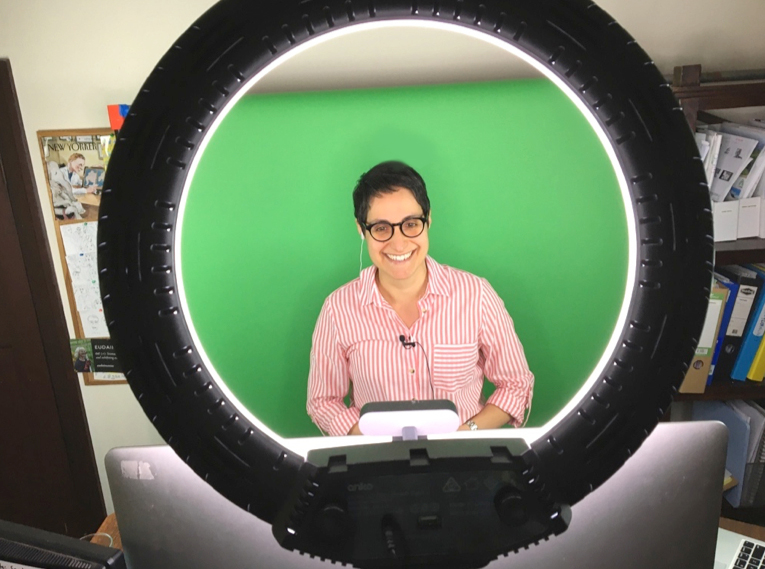
For the last five weeks, I’ve been delivering online sessions in schools.
What a steep learning curve!
But now it feels like second nature. It’s my new normal.
I have to stop and frequently remind myself that it wasn’t that long ago that running online sessions was completely new to me.
A week into the new school year, the state government announced restrictions on group sizes in schools. To prevent the spread of Covid, no large in person gatherings were allowed.
This meant my school talks could not proceed as they usually would.
Now I was faced with a difficult decision to make . . .
Should I stop giving talks and take a break?
Or should I quickly upskill in how to deliver online sessions and set up a home studio?
I thought to myself:
“You teach people how to learn more effectively . . . you know how to pick up new skills quickly, so you can do this! You can learn how to use Zoom, Teams, and Webex and set up a home studio!”
I had to learn a bunch of new skills. And quickly!
I didn’t have a month to learn and set up my home studio. How much time did I have?
Four days!
I had to focus my mind. I wrote a list and I swung into action.
Those were the most intense four days I have experienced in a long time. It was a similar level of intensity to when I used to pull all-nighters to complete my university assignments (this is not something I recommend doing).
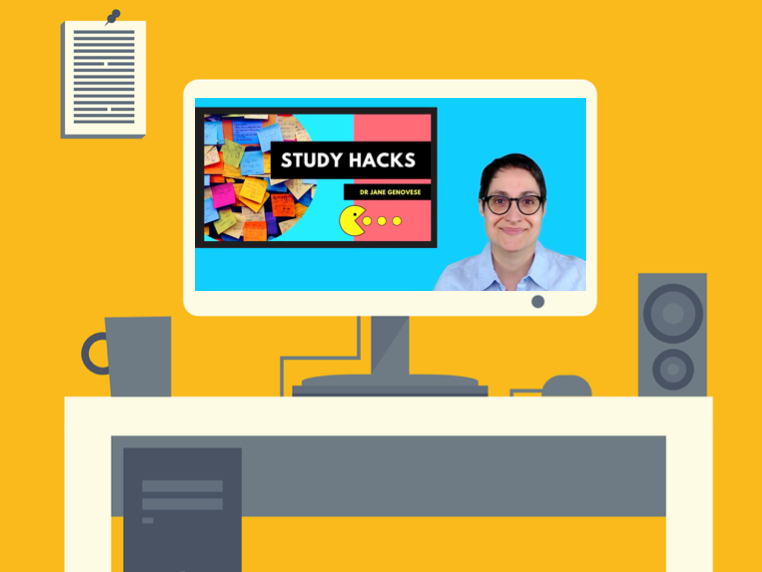
In those four days, I learnt a lot. And not just about lighting, green screens, microphones, webcams and video conferencing software. I learnt some valuable life lessons.
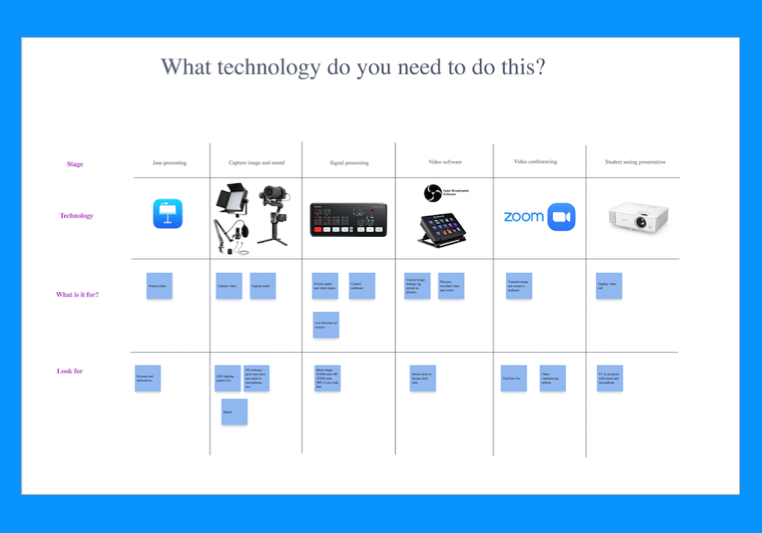
Initially, I felt overwhelmed. I wasn’t sure where to start. So I reached out to a good friend for help. He created a diagram to show me the equipment I needed to create a professional home studio. With his encouragement, I started sourcing equipment from Gumtree, eBay and camera shops.
My friend also suggested a piece of free software that could take my online sessions to the next level: Open Broadcaster Software (OBS). OBS is powerful software which connects in with any video conferencing software (e.g., Zoom, Teams and Webex).
I watched some online videos on OBS. This software looked a bit complicated, but I knew this was something I wanted to learn how to use.
I didn’t realise at the time but OBS requires a powerful computer to run on. The problem was I was using an old MacBook. It didn’t have the processing power to handle OBS. When I did a test run, my computer kept crashing and my image kept freezing on my friend’s laptop.
Was it my laptop? Or was my internet not fast enough?
I had to pinpoint the problem.
My friend Paul Litherland (cyber safety presenter) had mentioned he used OBS for his online presentations with schools. I was desperate, so I contacted Paul for help.
I spent 40 minutes on the phone with Paul, explaining all my tech problems. He said:
“Jane, think of it like this . . . it’s like you’re at the race track and you’re driving a mini and you’re trying to go really fast but you can’t.”

Paul was gently trying to say my tools weren’t up to the job of running OBS. I put down the phone and realised I needed a race car, not a mini.
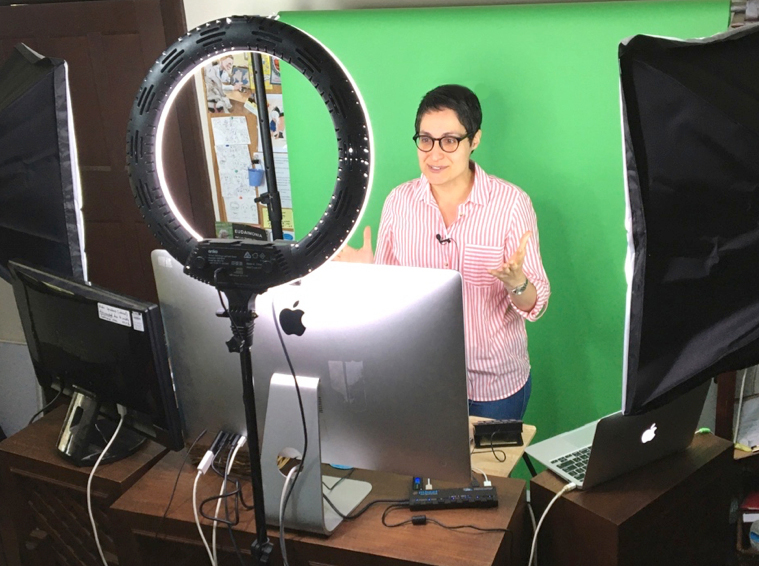
Fast internet, good lights, a green screen, a good quality microphone, a solid computer and second monitor: it sounds like a lot of stuff to purchase but all of these things are essential if you want to run professional online sessions.
But I come from a fairly frugal family. I was taught from a young age to save my money. Mum and dad’s philosophy has always been this:
“If we can make something ourselves or find a cheaper alternative, then that’s what we do!”
When we first went into lockdown in 2020, a school asked me to run an online session. With the family thrifty mindset, my brother helped me to create a home studio on the cheap. I used lamps and spotlights from Bunnings for lighting and big sheets of white corflute as light reflectors. It did the job but looking back, it was kind of clunky and not ideal.
When I compare my new studio setup to the one I created in 2020, I now realise how much of a difference it makes to have good quality equipment. Sometimes it’s worth spending some money to get the right tools for the job. Those tools can make your life a whole lot easier.
I’m not someone who likes to wing things, especially when it comes to technology. I knew I had to do multiple test runs (I did at least 30) using different video conferencing software to iron out any problems.
Delivering a talk to a big group of students can be challenging enough as it is. But when you add the extra element of having to use technology and make sure that all works smoothly, that can take up a serious amount of your brainpower.
I had to get really comfortable with the technology to free up my brainpower to deliver the session. The test runs made this possible.

I would do test runs with my friend late at night (8.30pm). The problem was I felt really tired at the end of the day. But this was the only time my friend was available so I had to work within his schedule.
On the first test run, everything that could go wrong did go wrong! And by the end of it, I was a mess.
I felt completely exhausted. I was not in the right frame of mind to work my way through each problem.
I went to bed feeling frustrated and demoralised on more than one occasion. This was dangerous because with my tired mind, I started to question whether I’d be able to pull off these online sessions that were scheduled in just a few days’ time.
When you’re feeling tired, it’s not a good time to try to solve complex problems. Those problems are more likely to occur as insurmountable and you run the risk of giving up.
The best thing you can do is stop before you reach the point of feeling totally exhausted.
After having a good 8 hours of sleep, I’d wake up feeling refreshed. And with this energy, I was determined to troubleshoot my way through the various issues.
You have to know when to say “That’s enough for today!” and hit the sack.
There were moments when I found myself feeling frustrated and stupid. Why did I keep experiencing problems with running the software (OBS)?
I’d think, “What is wrong with me? Why can’t I figure out how to get the audio working in this video?” But then I would Google the problem and soon discover it was a common issue, which made me feel better.
Luckily, there were lots of YouTube videos and forum posts on the various issues I was experiencing. I’d sit myself down with a notepad and pen, and calmly watch the video or read the forum post, sketching out key bits of information.
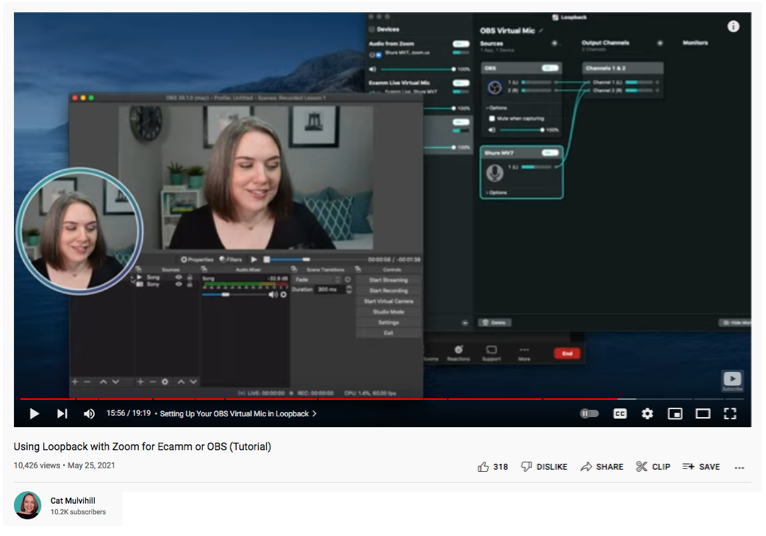
This reminded me that when you feel stuck and confused, you need to stay calm and ask Mr Google (or someone) for help.
I had to face the reality that I wouldn’t be able to use OBS for my first online session. My setup just wasn’t ready (I needed a more powerful computer) and there were some glitches I needed to sort out.
For my first few online sessions, I would need to go back to basics. Initially, I felt frustrated by this prospect. I cried out to my husband, “But I really wanted to use OBS!”.
He looked at me (he didn’t look impressed) and said:
“Jane, you need to learn to walk before you can run.”
He was right.
This was a process. I had to be patient. It was going to take a bit of time to get there.
It can be deeply satisfying when you step out of your comfort zone and learn new skills. With my home studio, I surprised myself by what I could do in a short space of time, but there’s no way I could have done it on my own. I needed help from others. And when things didn’t go to plan, I had to take a step back and go back to basics.
My home studio has evolved and will continue to evolve. Perhaps in a few months’ time, I’ll be packing it all up. The future is uncertain and no one really knows how this pandemic is going to play out. But for now, I’m having a lot of fun presenting remotely from home and learning new skills.
For many people, colouring in is a great way to reduce stress and calm the frenzied mind.
But as much as I love coloured pens, pencils and crayons, I’m not keen on colouring in. Instead of decreasing my stress levels, it has the opposite effect. It makes me feel uptight and on edge.
Why?
Because I associate colouring in with the serious business of winning at all costs.
I observed my older brother enter these competitions and effortlessly win free stuff: remote control cars, a soda stream, giant tins of chocolate powered drink and LEGO® kits.
I wanted to be like my big brother. So I picked up my pens and started colouring in.
From the age of five to eight, I spent countless hours colouring in. I learnt from a young age if I could focus my mind and stay within the lines, I could win a lot of free stuff, just as my brother did.
One Sunday morning when I was five years old, I coloured in a picture of Fat Cat for a Telethon colouring competition.
I channelled 100% of my brainpower into selecting the right coloured textas and carefully trying to stay inside the lines. I was intensely focused and determined to do my best to impress the judges.
I finished colouring in Fat Cat but I did not feel calm. I felt exhausted.
I received a letter in the mail. It stated I had won first place in the competition.
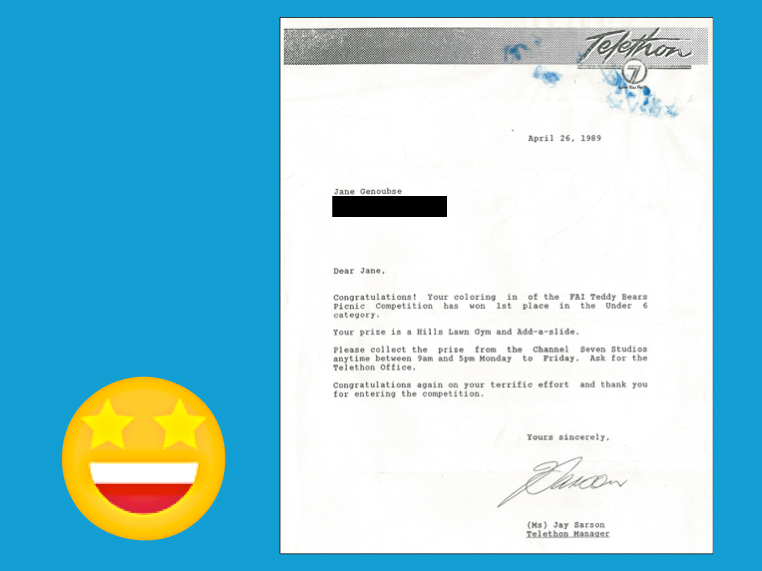
A full kid’s swing set complete with monkey bars and a slide.
It was like I had won the jackpot. I had pulled the lever on the poker machine and landed on three cherries. My brain was flooded with feel good chemicals.
I became hooked on entering kid’s competitions and the prizes started rolling in . . .
From the outside, it seemed like a bit of harmless fun: textas, colour and free stuff.
But I wish my parents had put their foot down and said “Enough!”. I wish they had boycotted my participation in those colouring in contests.
• Those contests were messing with my mind.
• Those contests were training me to become super competitive.
• Those contests made me connect my self worth with winning and having lots of stuff.
With this mindset, I never felt 100% satisfied. I was always chasing the next prize, the next big win . . .
But how can a 5-year-old child top a swing set complete with a slide and monkey bars?
I was on the hedonic treadmill.
I quickly adapted to my prizes and wanted more and more.
If I had known about a simple concept called the Gap and the Gain, I would have been a much happier kid.
I recently finished reading a fantastic book called The Gap and the Gain: The High Achievers’ Guide to Happiness, Confidence and Success by Dan Sullivan and Dr Benjamin Hardy.
The book focuses on two particular mindsets you can adopt:
1) A gap mindset (the GAP)
2) A gain mindset (the GAIN)
The authors define the GAP as “a toxic mindset that stops people from being happy and appreciating their lives.”.
When you’re in the GAP, you’re basically in the comparison trap. You’re comparing yourself to something or someone else or measuring yourself against some ideal.
Dr Benjamin Hardy states:
“Being in the GAP stops you from living within your own experience. It stops you from appreciating where you are. It stops you from being happy.”
In contrast, when you’re in the GAIN you’re focused on your own personal growth. You compare less and compete less and don’t care about what other people think of you. As Dr Hardy says, “you decide what success means to you, and you choose the life you’ll live.”
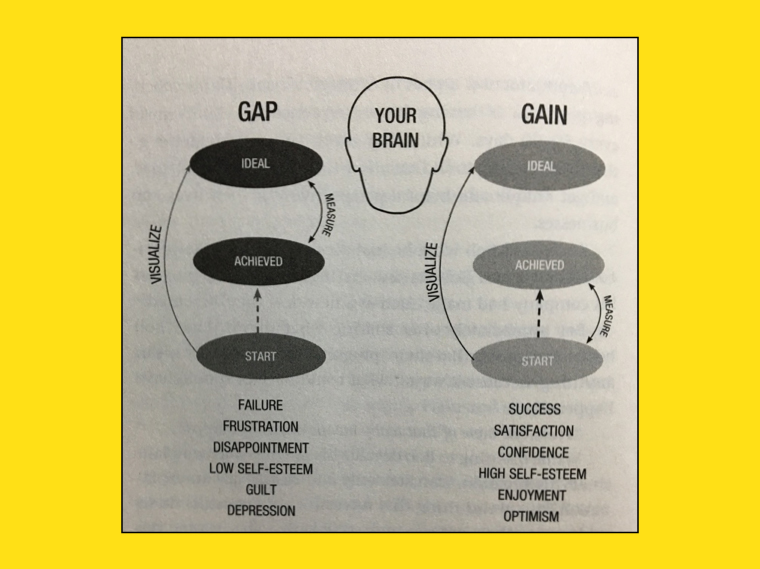
The concept of the Gap and the Gain was developed by Dan Sullivan who has coached entrepreneurs for many years in his Strategic Coach program.
Sullivan had noticed that despite these entrepreneurs having achieved huge financial and material success, a lot of them did not feel successful. In fact, many felt like failures. They were miserable because they were caught in the GAP.
Dr Hardy states:
“Most high performers or “successful” people never took the class on happiness. And there’s a thick narrative out there that in order to be the best performer you can be, “happiness” and “balance” cannot be part of the equation.”
The authors argue this narrative is flawed and they explore ways you can get out of the GAP and in the GAIN (i.e., shift from gap thinking to gain thinking).
The authors argue if you can make this shift you will feel lighter, more energised and more confident rather than feeling anxious, stressed and unhappy (signs of being stuck in the GAP mindset).
All of us fall into the GAP, multiple times a day.
How can you not?
We live in a super competitive culture. The education system, especially ATAR, is a perfect example of this. You’re being ranked against other students.
Student tell me, “I feel like I’m competing against my friends . . . I don’t like it”.
Of course you don’t like it! Trust that disturbing feeling you have. It’s telling you something is not quite right.
Competing against your friends really sucks. It’s can be downright damaging to your relationships, not to mention the toxic stress it adds to your life.
Rather than competing against one another, let’s support each other to do our best.
When we support each other and look out for each other, everyone wins. Everyone gets a bit closer to where they want to go.
Now, if you’re reading this and find yourself currently in the GAP, that’s okay. It’s totally normal.
But I’m going to share with you some simple ways to get out of the GAP and into the GAIN. Because when you’re in the GAIN, you feel happier and more motivated to pursue what really matters to you.
There are several ways you can get out of the GAP and into the GAIN. Here are three strategies I have been practising from the book The Gap and the Gain:
This involves looking at where you are now and comparing it to where you were before.
Why bother doing this?
Because we can easily forget what our lives used to be like. We adapt to our new normal. Dr Hardy states:
“You can forget what you previously struggled with and overcame. You can take for granted how far you’ve come, ignore your progress, and miss out on the confidence of remembering where you were.”
He adds:
“This is why it’s incredibly powerful and important to keep journals, records, or “annual reviews.” . . . you can look back and be reminded of the easily forgotten past.”
One simple practice the authors recommend is taking note of three gains at the end of the day. These gains can be external accomplishments (e.g. prizes and good grades) but also new experiences, personal growth, life lessons, new skills and relationships built.
I’ve been writing down my gains before I go to bed each night. This practice is incredibly simple but powerful!
Dr Hardy states social media is designed to put you in the GAP. It can distract you from your goals and strip you of the freedom to navigate life on your own terms.
If you can get off social media or reduce the time spent on it, this will help you get a clearer sense of who you are, who you want to be and where you want to go.
In the book Stand Out of Our Light: Freedom and Resistance in the Attention Economy, philosopher Dr James Williams says:
“There’s a big misalignment between the goals we have for ourselves and the goals social media companies have.”
As an ex-Google product strategist, Williams used to sit in product design meetings. So he knows the goals of big tech companies. He says they include things like:
• Number of clicks
• Time on site/app
• Number of pages viewed
• Number of advertisements viewed
• Number of conversions
I would be really surprised if you told me your goal was to spend a huge chunk of time scrolling through social media each day. But this is what a lot of people do.
This is why over a year ago, I made the decision to delete all my social media accounts.
Clicking delete was one of the the best things I ever did. I have a lot more clarity about who I am, what I stand for and what’s important to me. It also helped me to get out of gap style thinking.

In the book, Dr Hardy discusses Professor BJ Fogg’s work on Tiny Habits. He shares several Tiny Habit recipes to help us get out of the GAP. Here are a few examples from the book:
After I compare myself with another person, I will say to myself, “Are you in the GAP or the GAIN?”
After I feel discouraged, I will list 3 specific GAINS from the last 30 days.
After someone tells me about a setback, I will say, “What did you GAIN from this experience?”
We are all on different paths in life. We all have a different set of circumstances and access to certain resources. It’s time to focus our minds on doing the best we can.
Start to notice when you fall into the GAP, when you’re distracted by the goals of social media and what other people are doing. Take it from me, getting out of the GAP and thinking in terms of your gains is a much more rewarding and satisfying way to live.