

You’re wasting your money.
“But what if the notes are a total bargain or they are free?”
I still wouldn’t do it.
If it gives you a boost in confidence, sure. Go for it. But don’t delude yourself. And don’t allow those notes to make you mentally lazy.
When I was in law school, my friend’s brother gave me a huge stack of his typed notes for a couple of legal units. I felt like I had hit the jackpot.

I had something that other students didn’t have. I thought “These notes will save me a lot of time”.
Let’s be real. In hindsight, I was fooling myself.
Those notes did not save me time. What they gave me was a false sense of confidence.
Those notes were useless. Not because they were terrible notes (they weren’t). But they weren’t my notes. In order to understand the topic, I had to make my own notes.
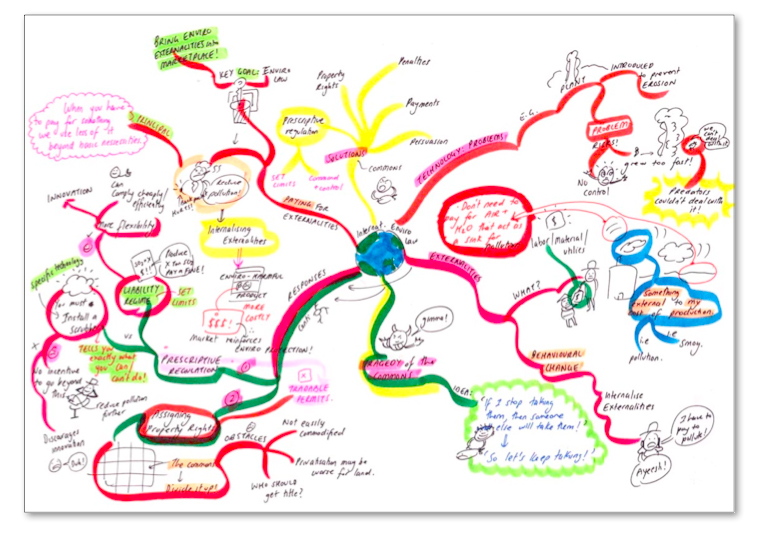
So I threw those notes in the bin and I created my own notes (i.e. a set of mind maps). As it turns out, this is a more effective and rewarding way to learn.
When you create your own notes, you have solid evidence that you’ve wrestled with that topic. Copying and pasting paragraphs from your textbook won’t cut it. That’s not an effective way to learn.
Here’s the thing about learning . . .
We expect learning to be fast and easy. But most of the time, it isn’t easy.
Learning is usually a struggle. My law degree was a struggle. So was my psychology degree. And my PhD was the biggest struggle of all (I nearly called it quits several times). But it felt good to struggle through it and come out the other side with a stronger, smarter brain. I’m not saying this to brag. It’s just what’s so.
My point is there are no short cuts when it comes to deep learning. It’s normal to feel confused when you’re learning something new. But you need to work your way out of the confusion. Creating your own notes in your own words and pictures will help you to do this. You don’t get that same deep understanding by looking at someone else’s notes.
When it comes to deep learning, you need to focus on the process (not the end result). As novelist Tara Moss says:
“Give yourself the mental freedom to enjoy the process. Because the process is a long one.”
The notetaking process helps you to memorise information (especially when you draw pictures). The great thing is you can customise your notes for your brain.
For instance, when I create notes I draw out examples to help me understand abstract concepts. Another person’s notes won’t include examples that connect back to my own life experience.
If you buy someone’s notes, you need to realise that those notes may contain errors, be incomplete, and/or irrelevant. The information in those notes may not be 100% accurate.
When I was writing my PhD thesis, I was reasonably confident that I knew what I was talking about. But one of my examiners (an international expert) picked up on several things I misinterpreted from one of his research studies. He said, “Actually, that’s not what I found in my research . . .”
I had to go back and edit this part of my thesis. What I’m trying to say is no one is perfect. We all make mistakes.
It’s much safer to refer to a textbook, which has been fact checked and carefully edited than another student’s notes.
There are a few things I would consider purchasing from past students:
• Study guides created by experts
• Past exam papers with the answers
• Practice tests with the answers

Since the curriculum can change, it’s always best to double check with your teachers to make sure the resources you have purchased are relevant and useful.
It’s also important to keep in mind that the student’s teacher may have created some of these resources you are about to purchase (or have purchased). If that’s the case, you need to realise that you’re purchasing the teacher’s work (not the students). When you do this, there are ethical and moral issues you need to consider.
The first issue is teachers spend a lot of time and energy creating tests and exams. Many teachers don’t want to have to reinvent the wheel every year. They may want to use those tests again. When a student sells these tests to future students, it creates an unfair playing field by giving some students an advantage.
Last week I was talking to a teacher about this issue. He told me he felt annoyed some of his ex-students were flogging his work to others and making a profit. I get it. I would feel annoyed, too.
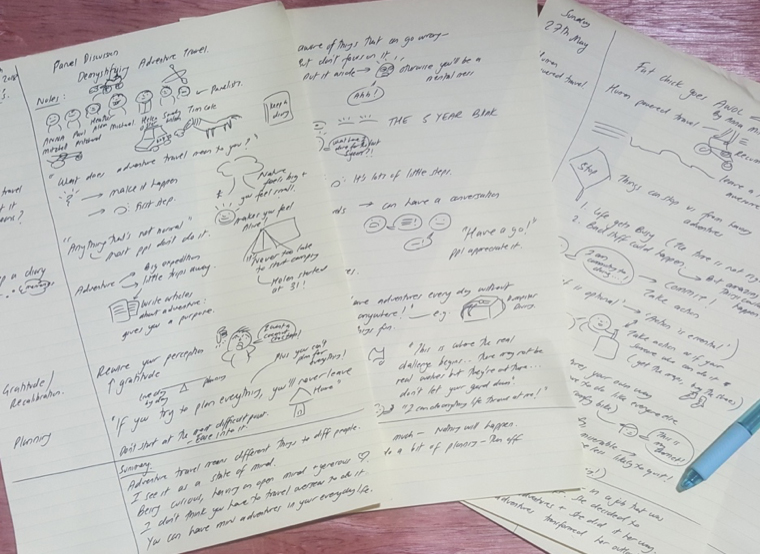
The only reason I would get someone’s notes is for inspiration: to inspire me to create my own notes in my own unique style.
If you haven’t developed a habit of taking notes yet, I would recommend looking at other people’s notes to see how they do it.
But keep in mind, most students create text heavy, typed notes without any pictures. Even though these notes are the norm, they aren’t particularly effective in terms of helping you to retain information.
I would recommend looking at examples of notes that are handwritten and contain lots of pictures, symbols and colour. There are plenty of great examples of visual notes online. You can see some examples of my university notes here. For other examples, google Sketch notes, mind maps, Cornell method, and visual notes.
I still think you should take your own notes. Even if it’s just to keep your mind a little more engaged in class, it’s well worth doing.
Resist the temptation to purchase other people’s notes. Save your money by making your own notes. Experiment with different notetaking methods. Find a way that works for you. And practice. This is a skill that takes time to develop and master.
Remember, there are no shortcuts when it comes to deep learning. You need to sit down, focus your mind and wrestle with the ideas on paper.

The other day, I was getting my haircut when my hairdresser told me something her 15-year-old son had said. His words took her completely by surprise. He said:
“Mum, I need to try harder this year.”
I hear those words a lot. Try harder.
I hear them from students who want to do better at school and from teachers who are trying to motivate students (“You need to try harder”).
But what does it actually mean to “try harder”?
The problem is that this advice is too vague and abstract.
If you don’t have a clear picture of what ‘trying harder’ looks like, you’re in dangerous territory because you’re attempting to motivate yourself towards an abstraction.

In the book Tiny Habits, Professor BJ Fogg explains the problems associated with motivating yourself to achieve a vague goal. He writes:
“You’ve probably seen a well-meaning public-health poster in the doctor’s office that shows lots of colourful vegetables with the headline: EAT THE RAINBOW!
At first glance, you think: Yes, I need to eat better food. But then you’re not sure what practical steps to take. How much green and how much red? That means salad and apples, right? It can’t mean mint ice-cream and red licorice, can it? You are motivated to “eat the rainbow,” but maybe you don’t know how. You feel frustrated and end up being a little hard on yourself.”
I didn’t want my hairdresser’s son to feel frustrated and annoyed with himself. He clearly had good intentions.
I asked my hairdresser, “What does trying harder look like for your son? If he’s trying harder, what is he doing?”
She said she wasn’t sure. So, I kept asking questions.
“Does it look like him sitting down and testing himself with flashcards before a test? Taking notes in class? Listening to the teacher instead of chatting with his mates?”
The answer was clear. She said, “Listening to the teacher! He needs to start listening to his teachers.”
I also mentioned that it would help if he learnt his teachers’ names (you’d be surprised how many teachers tell me their students don’t know their names).
Remembering a teacher’s name, staying focused on what they have to say, resisting distractions, taking notes and reading your textbook may sound easy, but these are skills that require continuous practice.
If you’re not used to doing them, they can feel hard.
Even with years of practice under my belt, understanding new ideas still feels hard. These days, reading feels like weightlifting for my mind!
After getting my haircut, for the next 24 hours, I kept thinking about those words “try harder”.
Something was bugging me about it because I felt it wasn’t helpful to tell yourself to “try harder”. . . and then, like a bolt of lightning, the answer hit me: my hairdresser’s son doesn’t need to try harder. He needs to focus on doing a few specific hard things.

By ‘specific hard things’, I mean concrete behaviours he can do right now (or at a specific point in time) to improve his understanding of his school subjects.
For example, if he wanted to start a home study routine, here are some concrete behaviours I’d recommend he try:
These are just a few behaviours that come to mind when I think about “trying harder” with your studies.
Doing these concrete behaviours just once won’t make you go from good to great. But you’ll be surprised by how much meaningful progress you can make in a single, effective study session.
We live in a world where comfort and convenience are increasingly normalised. We expect things, including learning, to be easy.

You don’t have to cook (thank you Uber Eats).
You don’t have to move (thank you car).
You don’t have to experience boredom (thank you social media and Netflix).
You don’t even have to use your brain anymore (thank you ChatGPT and Claude).
By outsourcing tasks that require physical and cognitive effort, we may save time, but there are hidden costs.
People are losing their skills, destroying their health, and atrophying their brains, all while being flooded with unhealthy levels of dopamine. I’d even go as far as saying that people are losing their lives and what it means to be human.
In every moment, we have a choice: we can do the easy thing that gives us a quick dopamine hit, or we can do the hard thing that gives us a slow and healthy release of dopamine.

When you wake up, you can scroll on your phone or do some physical activity.
At the end of the day, you can order takeaway that is engineered to light up the reward pathways in your brain, or you can prepare a healthy homemade meal.
When you’ve got a spare 30 minutes, you can watch some YouTube or go for a walk outside.
You can use ChatGPT to write your essay, or you can use your brain and build your skills.
You can talk to an AI chatbot and have a friction-free relationship, or you can organise to meet up with a friend.
Every time you choose the hard thing over the easy thing, you build your confidence. You can trust yourself to do hard things and survive them. Over time, as you build your skills, those hard things don’t feel as hard as they once did.
For instance, if the Internet goes down and you’re not dependent on ChatGPT, you know you’ll be okay. You can rely on yourself to think and entertain yourself (thank you brain).
This is why I’m committing to doing hard things this year. I’m challenging myself, and I know I’ll be better for it.
Just to be clear, I’m not talking about self-harm or inflicting extreme pain on myself.
I’m referring to activities that bring up a cringey discomfort and make me think, “Ahhh, I don’t want to do this!”.
These include activities that require sustained focus and/or mental and physical effort, such as writing an article, going for a run, riding my bike to the shops, and meditating.

The simplest way is to ease into doing those hard things. Turn those hard things into tiny habits.
Here is a list of tiny habits for hard things I’m focusing on doing:
Some of these things may not seem like much, but all of these behaviours require mental and physical effort. Remember, there’s a much easier alternative: sitting, tapping, swiping, and scrolling on your phone.
For instance, I don’t need to chop vegetables and cook my meals. I could eat out or order food to my door. This would save me time and effort (cooking my meals can feel like a part-time job).
But I know I would suffer at some point (physically, mentally, and financially).
Chopping vegetables and cooking take effort, but it helps me cultivate calm. When done with a focused mind (not listening to podcasts or talking on the phone), I really enjoy these activities.
If I were to outsource these activities, I’d be going backwards, because I’d most likely lose my valuable cooking skills over time.
Similarly, writing articles like this one feels hard. But hard doesn’t mean bad. It’s satisfying to focus my mind, wrestle with ideas, and write.
Many of us mistakenly believe that an easy life is a better life. But it’s not. A life where you are constantly pursuing pleasure and taking the easy path can lead to anhedonia.
Anhedonia is the inability to experience pleasure in things that were once pleasurable (e.g., a homecooked meal or a sunset). Some people describe it as life in greyscale.

It turns out the more pleasure we pursue, the more pleasure we need and the more pain we experience.
It may sound counterintuitive, but pursuing hard things makes you feel more motivated and more positive about life.
As humans, we want to challenge ourselves. We’re wired for it.
Psychiatrist Dr Anna Lembke encourages us to take on difficult, even painful, activities as a way of “aligning our primitive wiring with our modern ecosystem”. She writes:
“We are survivors. We’re wired for struggle, especially of physical nature. Yet we live in a world in which we’re largely insulated from pain. And not just pain, but also discomfort of any kind. Everything is supplied to us at the touch of a finger. Now we struggle just to get up off the couch. Our modern ecosystem incentivizes inactivity. Inactivity breeds lethargy. Lethargy breeds anxiety and depression. We must fight against this.”
So, forget trying harder. Work out a few hard things you want to do and focus on doing them instead.

It has made me a calmer, better focused, happier, more mentally flexible, and creative person.
It takes anywhere from 20 to 45 minutes to do this practice, but trust me, this morning practice is time well spent.
It usually feels hard at first, but by the end, I feel strong, confident, and clearer in my thinking. As clichéd as it sounds, this practice helps me be the best version of myself.
What simple morning practice am I talking about?
I’m talking about my movement practice.
Before I do any work (e.g., check my email or messages, read the news, or deliver a presentation), I make myself do some physical activity.
I usually run on a treadmill, ride a stationary bike, or lift heavy weights.

I can’t say I’m leaping out of bed with joy at the thought of exercising. There’s always a little voice in my head that grumbles, “Ugh, do we have to do this?”
But I push forward and lace up my running shoes because I know that by the end, I’ll feel amazing.
Twenty minutes into my movement practice, my husband says he can hear me ‘whooping’ with joy from the other end of the house.
The natural ‘runner’s high’ people talk about is real.
I can relate to Cultural Historian Vybarr Cregan-Reid when he describes his running highs in the following way:
“They are as strong as bootleg whisky. They make you want to stop everyone that you pass and tell them how beautiful they are, what a wonderful world this is, isn’t it great to be alive?”
The amazing thing is that a year ago, I couldn’t run for more than a minute without being completely out of breath. Now I can run for 45 minutes nonstop. And I’m hooked.
How did I get here? And more importantly, how can you cultivate a movement practice that leaves you feeling energised, less stressed, and in a great mood?
Do you remember, as a child, running around the playground, swinging on the monkey bars, and playing games like Chasey?
You did these things naturally and effortlessly, and you enjoyed doing them. No one had to force you to move.
You ran for the sake of running. You ran because it made you feel good and fully alive.

This is what movement does for me. It makes me feel excited about life.
I’ve discovered this is the key to building a long-lasting movement practice: you have to find delight in moving your body. And you have to hang in there for long enough for the delight to show up.
You see, the delight probably won’t be there straightaway. Instead, what you’ll usually find is that there’s some discomfort and resistance for the first 10 – 15 minutes of your movement practice.
But if you persist, trust me, the delight will come knocking at your door and sweep through your house like a group of wild party animals.
Just to be clear, you don’t have to run to experience this delightful feeling. Any moderate-intensity physical activity, such as riding a bike, dancing, and swimming, will do the job.
In the book The Joy of Movement, psychologist Dr Kelly McGonigal makes it clear that you can achieve a natural high from any sustained physical activity.
She says the key to experiencing this ‘exercise induced euphoria’ is to put in the time and effort. She writes:
“You just have to do something that is moderately difficult for you and stick with it for at least twenty minutes. That’s because the runner’s high isn’t a running high. It’s a persistence high.”

The thing about movement is that it takes effort. But that effort is what delivers the delight!
When you do hard things for a sustained period of time, your brain rewards you by serving up a cocktail of feel good chemicals, such as dopamine, endorphins, serotonin, noradrenaline, and endocannabinoids.
From an evolutionary perspective, this makes sense.
Life for our ancient ancestors was hard work and often dangerous. To survive, they had to forage and hunt for food, find water, build shelters, and run from wild predators.
These neurochemical rewards (e.g, dopamine and serotonin) would keep them going. And keep going they did!
Hunter-gatherers clocked up thousands of steps each day. They were constantly on the move because their survival depended on it.
But here’s what I find really interesting . . .
Despite being incredibly active, hunter-gatherers’ brains were wired for comfort and laziness. This wiring served them well, especially when food was hard to obtain. Conserving energy through sedentary behaviour was a survival trait.
This explains why most of us feel resistance to the idea of physical exercise.
Fast-forward 30,000 years to today: our modern environment is completely different from that of our ancient ancestors, but our brains are still the same (i.e. wired for comfort).

Want food? You can order it with the tap of a button. In our modern world, you don’t have to move much, if at all.
Because of our ancient wiring, some resistance to physical activity will always be there. We just have to push ourselves to do the hard things first (e.g., exercise), knowing that the rewards will come if we persist for long enough.
As you start moving your body, during those first few minutes, you may find yourself thinking, “Why am I doing this? This doesn’t feel good!”
To which, I say: Can you feel your heart pounding in your chest? Can you hear yourself huffing and puffing? Is that sweat dropping off your face and onto the ground?
Fabulous! You’re on the right track. Hang in there. It won’t be long before your mood starts to shift in a dramatic way.
I have come to love the feeling of my clothes soaked in sweat after I exercise. There was a time when I thought that was gross. But not anymore.
Those sweaty, stinky clothes are evidence that I’ve worked hard. It’s proof that I pushed myself and the feel good chemicals are flowing through my brain and will continue to do so for the next few hours.
In The Official Dopamine Nation Workbook, psychiatrist Dr Anna Lembke explains what happens at a neurochemical level when you do hard things. She writes:
“While engaging in these kinds of painful activities [exercise, meditation, ice-cold water plunges, etc], our dopamine levels rise slowly over the latter half of the activity and remain elevated for hours afterward before going back down to baseline, without ever going below baseline.”

This is why Dr Lembke starts her day by avoiding her phone and doing the hard things first. She said on a recent podcast interview:
“I won’t even go on my laptop until I’ve exercised, eaten breakfast, I’ve read a paper that gets delivered to my house, I’ve made my bed . . . I’ve done all the things I need to do to centre myself for the day.”
Similarly, I equate my movement practice with getting my brain ready for the day and accessing parts of myself that would otherwise lie dormant.
Sometimes movement helps me to experience a wonderful flow state. I feel in tune with my mind and body. Things just feel easier.
But even if I don’t reach a state of flow, moving helps me be more present and show up as the best version of myself in the other areas of my life, such as my work and when I’m with my family.
My movement practice is something I’ve come to genuinely enjoy. It’s not something I need to rush through to tick off a list.
If you’re reading this and thinking “But I don’t like movement” and “I’m not an athletic person”, I get it because I wasn’t always a super active person.
There was a time when movement felt like a grind. I felt clumsy and awkward. It was something I just had to get done.
So, what led to this dramatic shift in how I related to movement?
I shifted from training for my appearance (to stay lean) to training to feel good.
Psychologists would say I became intrinsically motivated to move rather than extrinsically motivated.
When you’re extrinsically motivated, you’re moving to lose weight, achieve a particular look (e.g., the fitness influencer look), or have a sexy body. You’re trying to reach some place in the future, and it often takes you to a place of misery.
In my early twenties, I became friends with a businesswoman who was also a female bodybuilder. I was inspired by her discipline and focus, so when she invited me to attend a Bodybuilding competition, I jumped at the chance. I thought, “Why not?”
I should point out that this was in the pre-social-media era, when you couldn’t easily watch videos of people flexing their muscles online. You had to go to competitions like these, or watch a documentary (rented from a video store), to get a glimpse into the world of bodybuilding.
As we sat in the audience at the Bodybuilding Championships, one perfectly chiselled body after another walked onto the stage and flexed their muscles. I felt inspired.

Without knowing what went into getting visible abs and perfectly toned bodies like these, I remember thinking, “I want a body like that!”
A couple of hours later, the judges announced the bodybuilding champions, and shortly after, the party kicked off as everyone hit the dance floor, including the bodybuilders I had watched strut their stuff across the stage.
At one point, I found myself dancing next to the Female Bodybuilding Champion. She was holding her massive trophy, and I couldn’t help but notice that her face had a pained expression and she was struggling to move and stay upright.
She’d just been crowned Bodybuilding Champion of the Year, so I thought, “Why is she looking so sad and weak?”
I spun around, told her she looked amazing, and congratulated her. I then asked her (shouting over the loud music) how she was feeling. Her answer took me by surprise. She said:
“I’m so tired and hungry. I just want to go home and eat a pizza!”
That’s when I realised she had been starving herself for the competition, and just like that, the idea of achieving a body like hers quickly vanished from my mind.
To achieve the ‘perfect’ look, bodybuilders and fitness influencers often severely restrict their diets, which can be harmful.
In the book How Not to Die (Too Soon), Professor and Personal Trainer Devi Sridhar states:
“For most women, achieving visible abs requires an extremely low body fat percentage (less than 17 per cent, below the 20-23 per cent healthy range), which is often linked to irregular menstruation, brittle nails, feeling faint and disrupted hormone production.”

So, unless you want to feel faint and constantly crave pizza, think twice before setting a goal to look like a bodybuilding champion or a fitness influencer!
When the focus is on aesthetics, you undermine the joy of movement.
In the DW documentary Muscles – More than Power and Pumping Iron, social media influencer and former Bikini model champion Sophia Thiel shared her experience of training to achieve the ‘perfect’ body. She states:
“When you train for the sake of your appearance, it can quickly tear you apart and take away all the joy that the sport normally brings with it.”
Post competition, Sophia found it difficult to maintain her competitive form and stick to her competition diet. Her weight began to fluctuate, and the nasty online comments about her appearance started to take their toll on her mental health.
At some point, Sophia shifted her focus from her appearance to how lifting weights made her feel. She said:
“Today my motivation for working out is very different. It brings a lot more balance to my life. I can deal with stress better. The way I carry myself is completely different, which gives me self-confidence. My sleep and concentration are better too. In other words, training improves my quality of life.”

Making the mental shift, like Sophia did, from wanting to look good to feeling good, is a total game-changer.
But in our image-obsessed world, it’s easy to lose sight of the mind and mood-altering effects of physical movement (spending less time on social media and unfollowing fitness influencers can help with this mental shift).
Harvard Professor John Ratey sums it up nicely when he says physical exercise is like “a little bit of Prozac and a little bit of Ritalin”. It does wonders for your brain (especially your attention and mood) with no nasty side effects.
To sum up
Instead of reaching for your phone first thing in the morning, try reaching for your running shoes, a set of dumbbells, or a yoga mat.
Developing a morning movement practice is one of the simplest and most powerful things you can do to benefit your brain and improve the quality of your life.
But the key is to find delight in moving for the sake of moving. You need to persist with the movement for long enough – at least 20 minutes – for your brain to reward you with a dose of feel good chemicals.
When movement becomes inherently enjoyable, you’ll find yourself doing it more often. Before you know it, it will be a non-negotiable part of your day. In the words of Dr Kelly McGonigal, “regular exposure to exercise will over time teach your brain to like, want, and need it”.
Image 6: “2013 Fall Classic Natural Bodybuilding Competition – U.S. Army Garrison Humphreys, South Korea – 28 Sep 2013” by USAG-Humphreys is licensed under CC BY 2.0.

But just to be clear – this car wasn’t in bad shape when I first got it. I turned this car into a jalopy through neglect and ignoring basic warning signs.
Whenever I gave my friends a lift in this car, I remember that they always looked visibly uncomfortable. They’d say with a nervous laugh:
“Jane, what’s that strange rattling sound?”
“Why is there a red warning light on your dashboard?”
I wasn’t fussed about the red light or the strange rattling sound.
Somehow, I’d missed the adulting lesson on basic car maintenance.
For many years, I never bothered to get my car serviced. I drove it to the point where it rattled and shook violently, the engine would cut out while driving, and the brakes squealed at a painfully high pitch.
It got to the point where I could no longer ignore these problems, but by then, it was too late. My car was beyond repair and could only be salvaged for scrap metal.

I’m embarrassed to share this, as that’s no way to treat a car that gets you from A to B and uses the Earth’s finite resources. But stay with me because there’s an important point I want to make, and it’s this. . .
When I was younger, I engaged in several unhealthy lifestyle practices. Whilst I never smoked, took drugs, or consumed alcohol, I ate huge amounts of processed junk food (I didn’t know how to cook).
I also frequently sacrificed sleep to pull all-nighters to complete my assignments (I struggled with procrastination).
My body seemed resilient. It appeared capable of handling the shocks. But over time, I started feeling tired and rundown. Still, I kept pushing myself like my old car. The only time I could rest was when I got sick.
These days, everything’s quite different.
I am physically unable to thrash my body around like an old jalopy.
Something as simple as consuming too much salt or sugar can send my brain spiralling out of control.
I was reminded of this a couple of weeks ago when I visited a friend in hospital. Because I was spending a lot of time at the hospital, my usual routines of grocery shopping and cooking from scratch were disrupted.
But then to make matters worse, I was given $80 worth of vouchers to spend at the hospital cafeteria. I thought, “How bad can hospital cafeteria food be?”.
It turns out really bad.
Cheese kranskys (sausages), heaps of salty hot chips, deep-fried chicken, and soft drinks were the main options at this hospital cafeteria.
Unhealthy food seemed completely normalised in this hospital environment. My jaw dropped when I saw a patient order not just one but five cheese kransky sausages!
In this hospital setting, I also started to eat poorly. It was on my third day of eating hot chips from the hospital cafeteria when I noticed that these chips weren’t doing me any favours. I was feeling off my game.

So I decided enough was enough. I gave the remaining hospital food vouchers to a homeless man who was hanging around the cafeteria, desperate for a feed. It was back to home cooked meals for me!
This greasy processed hospital food had a ripple effect on the rest of my life. I slept badly, which impacted my ability to run the next morning (my joints hurt). I felt resistance to using my treadmill desk because everything felt much harder than usual. Since I was moving less, I was more distracted.
I know all this might sound a bit dramatic, especially to those of us who enjoy a few hot chips (e.g., my husband). Given my friend was in a hospital bed and couldn’t walk, I am fully aware of how lucky I am to be able to run in the first place (even with sore joints).
The point I’m trying to make is this . . .
I also know that small decisions, like eating too many hot chips or staying up late, can add up and take their toll on your mind and body. These tiny decisions can have a big impact on the way you feel.
When I was younger, I could eat whatever I wanted and still feel pretty good. Sometimes I’d feel a bit off, but not in a noticeable way.
As Dr Randy J Paterson states in his book How to Be Miserable in Your Twenties:
“In your twenties, some people can do practically anything to their bodies, experience no immediate physical consequences, and feel emotionally more or less well. Random sleep cycle, sedentary lifestyle, lousy diet, 90 percent of the day staring at screen, binge-drinking, isolation, the works. The body doesn’t completely fall apart, and the mind, while not thrilled, hangs on.
Later on, the effect is more immediate. Live exactly the same way at thirty-five, at forty-five, and things don’t go so well. Take a middle-aged car and drive it aggressively down jolting roads, loaded to the max, old oil clogging the engine, and it’s not going to last long. The baseline mood at forty-with no maintenance, no exercise, no dietary adjustment, no stability, and no social life- is misery. ”

Like a car, the human body requires regular basic maintenance. I see this basic maintenance as a collection of small behaviours that leave me feeling calm, grounded, and focused.
Here are a few things I need to do to keep myself running smoothly:
Every now and then, I’ll abandon these behaviours. I’ll have a day where I eat and do whatever I like. I’ll order takeaway, sit on the couch and binge-watch a series until late at night. I usually pay for it the next day, but it also gives me a better appreciation of these healthy practices and what they do for my body and mind.
It’s all about tuning in and noticing how certain things make you feel. For example, when I was in my mid-20s, I noticed every time I ate deep-fried chicken, I experienced sharp stomach pains.
That was like the red warning light on my car dashboard going off in my body. But instead of ignoring it, I paid close attention. Eventually, I decided it wasn’t worth the pain. So I stopped buying greasy deep-fried chicken and eventually went plant-based, which immediately improved my mental and physical health.

There’s no doubt that modern life can be hectic and stressful. When you’re rushing from one thing to another, it’s easy to overlook the basics and ignore the warning signs.
I’m not proud of how I treated my first car, but I learnt from the experience. Now I make sure I get my car serviced regularly. This saves me time, money, and stress in the long run.
Similarly, we need to pay attention to the way in which we look after ourselves. By dedicating time, energy, and attention to the small things that make us feel better, our experience of the present moment becomes richer. As longevity researcher Dan Buettner says, “You can add years to your life and life to your years”.
“Suzuki Swift 1.3 GTi 1990” by RL GNZLZ is licensed under CC BY-SA 2.0. (used in image 1)
“Scrap yard 22l3” by Snowmanradio at English Wikipedia (Original text: snowmanradio) is licensed under CC BY-SA 3.0. (used in image 2)
“KFC Wicked Wings” by avlxyz is licensed under CC BY-SA 2.0. (used in image 5)