I experienced this firsthand when I was an exchange student living abroad. When I was 16, I travelled to the south of Italy to live in a small village called Spinazzola.
This had been my dream, and my parents forked out over $2,000 to make it come true (thanks, Mum and Dad!).,
I wanted to make the most of this once-in-a-lifetime opportunity, so I set off with an ambitious goal to come back fluent in Italian.
Before I left for Italy, several people had told me that I would pick up the language “just like that!”. I was told that I’d be fluent in no time.
I took their words as gospel truth.
So I became concerned when, after just a few days in Italy, I wasn’t speaking like the locals. I thought, “Why am I not fluent in Italian by now? What’s going on? Is something wrong with me?”
Panic and worry set in. I became stuck in an anxiety loop. Thoughts rolled through my head, such as:
“Am I learning the language fast enough?”
“Am I going to come back knowing enough?”
“How will I compare to the other Australian exchange students? What if my Italian sucks?”

This anxiety spilled over into almost every amazing experience I found myself in: a trip to the local pizzeria with my new friends from school, family dinners, and day trips with other exchange students.
To counteract my fears, I doubled down on my study, carrying a mini pocket Italian dictionary with me everywhere I went (this was well before mobile phones and Google Translate existed).
About a month into my student exchange experience, out of the blue, a young man snatched the pocket dictionary out of my hands.
This man was called Gianluca. He was my host sister’s 18-year-old cousin who had travelled with his parents from Milan to spend Christmas with my host family.
Gianluca was a character. He had wild, voluminous curly hair, a cheeky smile, and a sense of style.

Gianluca was also a slightly arrogant man. He would say whatever was on his mind, seemingly without caring if he upset or offended others.
For example, one of my first interactions with Gianluca was when I sat down on a stool, thereby exposing my white socks. He gasped loudly and said in Italian:
“Jane Christine, white socks with black shoes is a fashion crime! No, No, No!”
I took his words very seriously and have never repeated this fashion faux pas.
But it was the moment when Gianluca snatched the dictionary out of my hands that I remember more than anything else. This moment had a profound impact on the rest of my exchange experience, and I am deeply grateful to him for that.
It was late in the evening. A group of us had been talking and playing Italian card games. Remember, these were simpler times (there were very few mobile phones back in those days and no social media).
I was struggling to follow the conversation in Italian, so I picked up my dictionary to look up a word, but Gianluca stopped me. He grabbed hold of the dictionary and said:
“Put the dictionary down. You don’t need this! Just be here in this moment!”
Gianluca was trying to tell me to relax. To stop hiding behind my dictionary. To stop trying so hard to learn Italian.

He was right. Sometimes, when you try too hard and are too fixated on achieving a future goal, it can get in the way of actually doing what you need to do (in my case, learning Italian).
Oliver Burkeman writes about this in his book Meditations for Mortals. He argues that there are benefits in not trying so hard. He writes:
“The less I’m trying to get something out of an experience, the more I find I can get into it, and the more I can be present for other people involved.”
Those first few weeks in Italy, I had been trying too hard to master the language and get the most out of my student exchange experience. I was trying to frantically get to a place where I could tick the ‘Fluent in Italian’ box.

I can now see clearly that by trying so hard to learn Italian, I was sacrificing my enjoyment in the present moment. I was also undermining my ability to learn Italian.
You’ve probably heard the phrase “La Dolce Vita”. This directly translates to “The Sweet Life”.
But what it means is a relaxed, easy-going approach to life. An approach where you enjoy the simple things: a hearty, simple meal shared with your family, a reviving nap in the middle of the day, and an evening stroll (‘passeggiatta’) down the main street with friends.
Whenever I picked up my dictionary, which was frequently during those first few weeks in Italy, I embodied the polar opposite of “La Dolce Vita”. I transformed a potentially fun, rich moment into an anxiety-fuelled study session.
I also took myself out of the present moment. And effective learning (and living) is all about being present.
Gianluca’s words – “Put the dictionary down!” – hit home. That evening, I put my pocket dictionary away and gave up on trying to master Italian in a day. I took the pressure off myself and relaxed into the experience.
Soon after, I asked my host mother Rosa if I could join a local exercise class. I knew that movement always made me feel better. It relaxed me. I was so happy when Mamma Rosa agreed.
At this class, I’d slip on some special socks over my shoes and slide from side to side on a slippery mat (a slide board).

I took this crazy exercise class with a bunch of middle-aged Italian women wearing spandex and leg warmers (it was Winter). Occasionally, someone would lose control on their slide board and fall to the ground.
For 60 minutes, I was able to get out of my head and get grounded in my body. This exercise class, as strange as it was, made all the difference. It relieved my anxiety and fears straightaway. It calmed my mind and made me feel like I was doing okay.
Ironically, once I felt calmer and less pressured to ‘learn Italian’, I started to pick things up. Learning the language became easier and easier. It didn’t happen in an instant. But it was happening. Slowly but surely, my language skills improved.
When I came back to Australia, I hadn’t mastered Italian (can you ever really master anything?), but I could hold a solid conversation with my nonna in Australia.
The whole student exchange experience fundamentally changed me. I learnt so much more than just Italian.

I learnt the power of a good nap after lunch (strictly enforced by my host mother), the importance of connection and community, and that if you’re having pasta, you must mop up the last bit of sauce with some bread (this Italian tradition is called ‘scarpetta’).
But I also learned not to try so hard. Instead of rushing to get to a specific destination, it’s okay to just explore, learn, and grow at your own pace.
“Mappa ferr Spinazzola-Barletta” (Used in Image 1) by Arbalete is licensed under CC BY-SA 3.0

Every holiday, I tend to pack either too much or too little.
At the start of the Easter long weekend, I was overwhelmed by the task of packing for a four-day trip.
To be fair, other things were on my mind, such as the chaotic state of the world and the chaos within my home (i.e., the mess I would be returning to).
I know what you might be thinking…
“Stop your whinging, Jane. What a privilege to be able to pack your bag to go away!”
Indeed, it is! An absolute privilege.
Yet, rather than experiencing gratitude, anxious thoughts swirled through my mind.
“Have I packed enough socks and undies?”
“Do I have enough food to avoid going into the crowded shops?”
“Will the traffic be bad?”
“Will my husband insist on getting hot chips at the Service Station?”
“What books should I take?”

Among these packing questions, one stood out: what books should I take? This question weighed heavily on my mind and here’s why.
When it comes to packing books, I tend to go overboard.
I overestimate how much I can read in a single weekend. I’ll weigh down my backpack with several heavy books, only to find that I don’t end up reading any of them. Ugh.
You’d think more books equal more reading. Wrong.
More books mean more choice. And more choice usually results in decision fatigue and overwhelm.
Determined to change my usual approach this holiday, I told myself it was time to be in reality. I gave myself strict orders: I could only pack what I could realistically read in the time I would be away. That was one book.
Fifteen minutes before I was due to set off, I selected this book: Reasons not to worry – How to be stoic in chaotic times by Brigid Delaney.

I’d purchased this book several years ago, and for whatever reason, I stopped reading it after just 20 pages. I wasn’t ready for it. And when it comes to reading certain books, it’s all about timing. Every book has its time.
Now, I was finally ready to listen to what these Stoic philosophers had to say about living well in times of chaos.
We are living in unstable times. I don’t need to lay out what’s going on. You’ve seen the headlines.
It’s easy to feel powerless and unsure about what to do.
Where should you focus your limited time and energy during chaotic times? How can you focus and study for an exam when the future feels uncertain?
This is why I felt open to wisdom of the ancient Stoics. The Stoics, such as Seneca, Epictetus, and Marcus Aurelius, had many great ideas for dealing with the challenges of everyday life and for facing life’s disappointments with grace. This is what I desperately needed!
On my trip, I read most of Reasons not to worry—a breakthrough in itself! Even more powerful, however, were the book’s ideas, which left me feeling calmer.
In this blog, I want to share the most powerful idea I learnt from the Stoics: the control test—a tool that helps you focus on what you can control and let go of what you can’t.
The Stoics believed the secret to happiness and tranquillity was to focus on the things you can control and not worry about the rest. As Bridget Delaney writes in Reasons not to worry:
“The step the Stoics took first, before taking action, was to run everything through a basic test. Called the ‘control test’ or the Dichotomy of Control, the Stoics assessed what they could and could not control about a situation, and focused their attention on areas they could control.”
Delaney provides the following useful image to illustrate the control test.

This image shows that you have full control over three things: 1) your character; 2) your reactions; and 3) how you treat others.
If something relates to one of these three things, it’s within your control and you can take action.
Stoic philosopher Epictetus was a strong proponent of the control test. He believed knowing what you can control and what you can’t was the key to living a tranquil life. In his manual The Art of Living, he lays out what’s within our personal control:
“Within our control are our opinions, aspirations, desires, and the things that repel us. These areas are quite rightly our concern, because they are directly subject to our influence. We always have a choice about the content and character of our inner lives.”
In contrast, what other people think and do is out of our control. Epictetus believed that if we focus on trying to control or change these things, we will torment ourselves and waste our precious time and energy.

Thinking back to the start of the Easter long weekend, I can see that if I had run my anxious thoughts through the control test, I would have felt a lot more relaxed.
Instead of telling myself, “You’re so bad at packing!”, I could have viewed packing as a skill, as something I could work at becoming better at.
For my next trip, I could make a packing list. I could also start packing my bag the night before or even two nights before. Those things are within my control.
It’s also within my control to lower my expectations about packing. Is it really the end of the world if I don’t pack enough socks and undies? Couldn’t I just wash them if I run out?
As for concerns about the traffic being bad, this is out of my control! I can’t control how many cars are on the road or how fast they’re going. However, what I can control is my own driving ability (e.g., sticking strictly to the speed limit and taking regular breaks to recharge).
What about my husband buying overpriced hot chips at the Service Station? It is within my control to encourage him to buy a healthier snack, but ultimately, it’s my husband’s choice. If he wants hot chips, I can’t stop him. But it is within my control not to eat those hot chips.
Since reading Reasons not to worry, I’ve been applying the control test to my life several times a day. When I notice I’m feeling worried, upset, or unhappy about something, I ask myself, “Is this within my control?”
This simple practice has helped me to chill out, conserve my energy, and be less of a control freak. As a result, I feel better, and so does the rest of my family.
As Delaney writes:
“Used well, the control test will change how you use your energy and where you place your care and attention. Your energy should be focused on the first part of the equation: doing the thing well. And you should not direct any energy or worry to things out of your control, such as the outcome or people’s response to what you do, because that is wasted energy. You will only end up with your tranquillity disturbed”.
The control test can help us prepare effectively for tests and exams. You can’t control the way your grades are scaled, the exact questions you’ll be asked on the exam, what your exam timetable will look like, or if you’ll have back-to-back exams. Those things are externals, so the Stoics would say don’t waste your energy worrying about them.
But what you can control is how much you prepare for your exams, how much study you do, how much sleep you get, the strategies you use to learn the information, whether you refer to the syllabus, and how focused you are as you study.
How you prepare is within your control. And the more prepared you are, the better you will do in your exams.
Does the Control Test mean you shouldn’t try to help others in your community or push for environmental, social, or political change?
Not at all.
Delaney writes:
“. . . Stoics were not passive people. Historically they were people of action: political leaders, emperors and soldiers. But they knew that even if they trained hard, acted with integrity, built alliances and put in a lot of effort, they couldn’t control the outcome. They could only control their own character, own actions (and reactions) and how they treated others.”
The control test can help you to stop stressing about things that are out of your control and worrying about what other people think. In the spirit of the Stoics, focus your energy on doing your best work, being the best version of yourself, and treating people with kindness.

This means you need to prepare yourself mentally and physically for them.
You can work so hard to memorise large quantities of information for an exam, but if you’re not mentally and physically prepared, all that hard work can sadly go to waste.
When it comes time to take your exams, you have to relate to yourself as a professional athlete. Leading up to the day of the big performance (i.e. the exam), you need to eat nutritious food, be in the right frame of mind, manage your nerves, and allow your body to rest. These simple things can make all the difference to your exam performance.
You may be thinking “But isn’t this just common sense?”
It is! But creating healthy habits takes time and practice.
It’s one thing to intellectually know you should be eating well but it’s another thing altogether to incorporate healthy meals and snacks into your lifestyle.
I see a lot of students drinking energy drinks, getting very little sleep, and eating highly processed foods in the days leading up to exams. I have to admit, there was a time when I engaged in these behaviours too. I can tell you from personal experience, this is a recipe for mediocre grades and a miserable existence.
Here are my top 10 tips to prevent burnout and boost exam performance:
Sleep is critical to the learning process, exam performance, and wellbeing. Yet it’s usually the first thing students sacrifice to get more study done.
If you miss two hours of sleep each night for a week, the cognitive effects are as bad as going without sleep for two days straight!
Studies have also found that if you stay awake for 18 hours straight that’s like having a blood alcohol level of 0.05. In other words, it’s like being legally drunk. Your ability to focus, think, and learn will be seriously impaired.
You can’t adapt to getting less sleep. As adolescents, you need about 9-10 hours of sleep per night to be as alert as possible when you wake up.
If that feels unachievable, try to just get an extra 15 minutes of sleep tonight. Gradually increase this each night until you reach your target.
Often students stop exercising when they start preparing for exams. They think “I don’t have time to exercise!”. It’s as if they think they must spend every moment studying. Don’t fall into this trap.
Movement is your friend when it comes to studying for exams.
Research shows engaging in regular physical movement will help you to study more effectively. Firstly, it’s a great way to relieve stress and release feel good chemicals. Secondly, it gets the blood flowing more efficiently to your brain, which can give you a cognitive boost.
One study found students who engaged in 5 minute movement breaks every 17 minutes during a lecture retained more information and could focus better.
Every time you engage in a short movement break, you’re enhancing your study sessions.
Research has found that students who skip breakfast experience a decrease in cognitive performance and alertness compared to students who eat breakfast.
Eating a nutritious breakfast will give you a cognitive boost before an exam. It will also help you to feel fuller for longer, stabilise your mood, and give you plenty of energy to get through the exam.
Here are some healthy breakfast ideas:
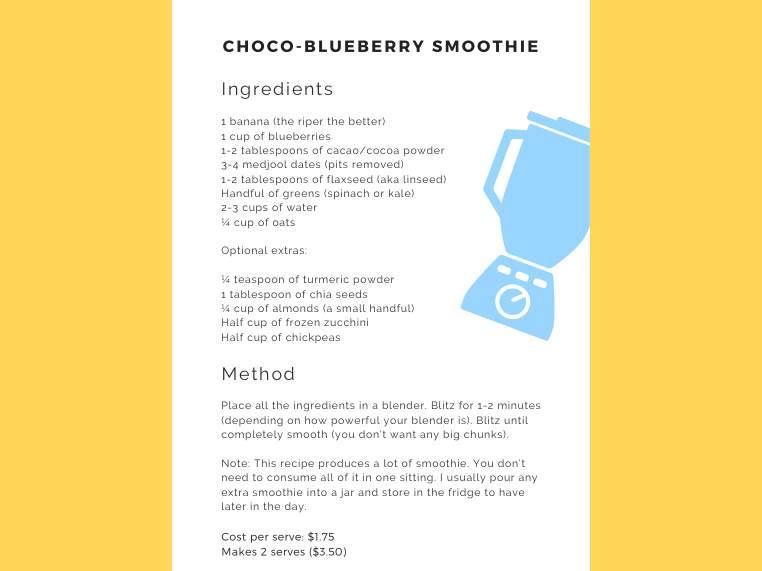
Muesli or porridge with nuts and fresh fruit (e.g., berries) Wholemeal toast with a variety of toppings (e.g., baked beans, tomatoes, and avocado) and a piece of fruit A healthy homemade smoothie (click here for my brain boosting smoothie recipe)
Your brain requires adequate hydration to function properly. Drinking water ensures that your brain receives the necessary fluids to perform tasks efficiently, such as retaining information and problem-solving.
Take regular sips of water as you study. It’s a good idea to have a glass of water or a reusable drink bottle within arms reach.
You may even want to create a tiny habit to remind yourself to engage in this simple behaviour (e.g., “After I finish answering a practice exam question, I will take a sip of water”).
Many years ago, I started thinking that my teachers and lecturers were out to get me. I thought they would mark me down wherever they got the chance. As a result of this distorted thinking, I became too scared to write anything in one of my first tests at law school. After receiving a terrible grade (5%), my brother said to me:
“Remember sis, your teachers want you to do well. They will try to give you marks wherever they can. It’s in their best interest to do so.”
Don’t worry about writing a perfect answer. If you’re unsure, be brave and still write something down. Even if it’s just a few dot points, it’s better than nothing. You may not get any marks for it, but your teachers won’t take marks off.
Just remember, most of the time your teachers are on your side and they want you to succeed. When you do well, it makes them look good.
Chances are there will always be something that you could have studied more thoroughly come the day of your exam. But on the morning of an exam, you can’t do much about that, so there’s no point worrying. Worrying will just deplete your finite energy, which you need to conserve for the exam.
Instead of worrying, try saying this to yourself before each exam:
“I now know so much more than I did before. I’ll be able to answer many questions in this exam.”
Telling yourself this positive micro-thought will allow you to enter the exam in a calm and confident frame of mind.
It’s normal to feel a bit nervous before an exam. But there are certain things and people that can push your anxiety levels into dangerous territory and impair your exam performance.
For example, coffee and energy drinks will skyrocket your stress levels. Similarly, hanging out with people who have a lot of nervous energy and are venting about the exam (“I’m going to fail!” and “I hardly studied!”) are going to leave you feeling distracted and a little jangled.
Before the exam, do your best to isolate yourself from these people. If you’re worried about offending someone who is venting to you, you could say “I’m sorry but I really need to do some last minute cramming”. Then proceed to pull out your notes and pretend to read them.
How many times have you stayed back after an exam to talk to your friends about what you put for each question? Have you ever felt terrible after doing this?
It can be reassuring to know that you wrote the same answer as your friends. But if you find out that you wrote something completely different, you may start to second guess yourself. If you have another four or five exams to go, this may throw you off your game.
This is why I don’t recommend engaging in a postmortem of the exam until you get your results/exam paper back.
When you walk out of the exam room, tell yourself:
“That exam is over. There’s nothing I can do to change how I went. It’s time to move on!”.
You could imagine yourself locking the exam in a box and throwing it off a cliff or rolling it up and stuffing it in a bottle and throwing it out to sea. The point is you need to mentally disconnect from that exam and focus on studying for the next one.

If you come across a question that you’re not sure how to answer, stop for a moment and take a few deep breaths (in for the count of 4 and out for the count of 4).
A simple breath activity you can try is the Box Breathing Technique. This involves imagining yourself breathing along the sides of a box (breathing in for the count of four on one side, out for the count of four on the next side, etc). Repeat this 2-3 times. Then take a look at the question again.
If you are still unsure how to answer the question, move on to another question.
The worst thing you can do is panic (remember, stress impairs your ability to think and recall information).
By engaging in Box Breathing, you can help yourself to remain in a calm and stable state.
Many of us are familiar with writer’s cramp. This can be caused by gripping onto your pen too tightly. Try loosening your grip a little.
Alternatively, experiment with a range of different pens. Some biros require you to press down hard on the page to make a mark, but not gel pens. The ink just flows onto the page!
The reality is, even with a good gel pen, your elbow will start to hurt at some point if you’re taking a 3 hour exam. When it does start to hurt, have a rest for a few seconds (yes, you have time to do this). Stretch your arm out. Shake it a little.
Treat each exam like a mountain hike rather than a 100 metre sprint. Resting for a few moments here and there will be time well spent and will enhance your overall performance.
These simple strategies can help to elevate your exam performance. My advice is to start small. Even if your exams are several weeks away, select one or two of these ideas and start testing them out today. At first, the strategies will require a bit of mental effort. But like anything in life, if you persevere they’ll become second nature to you and they’ll just be things you do without even thinking.
Want to learn more exam strategies? Click here to download a free copy of 70 ways to ace your exams.

All of us have had the experience of watching videos instead of writing an essay. We can all relate to telling ourselves, “I’ll do it tomorrow”.
The problem is our brains are wired for comfort. We’ll try to do everything we can to avoid experiencing pain and discomfort. But through our avoidance behaviour, we ultimately create more pain and suffering for our Future Selves.
You can avoid working on a project, but eventually your Future Self will have to pay the price.
As Dr Benjamin Hardy states in his book Be Your Future Self Now:
“The more you put your Future Self in debt in terms of health, learning, finances, and time, the more painful and costly will be the eventual toll. There will be a lot of interest to pay if you continually accrue debt.”
This is why it really helps to cultivate habits and develop systems that help you get started with your work early (well before the deadline).
Over the last few months, I’ve come across several novel and effective ways people are combatting procrastination around the world. I write about each of these below.
The Manuscript Writing Café is a place where writers go to avoid distractions and meet their writing deadlines.
This is a disciplined environment where the owner Takuya Kawai won’t tolerate socialising over drinks. As Kawai states in a social media post:
“The Manuscript Writing Cafe only allows in people who have a writing deadline to face! It’s in order to maintain a level of focus and tense atmosphere at the cafe! Thank you for your understanding.”
In order for this café to run smoothly, Kawai has established a set of rules writers must follow upon entering.
Here’s how it works:
When you enter the café, you commit to a specific goal (how many words you want to write) and a time you plan on finishing. You write this down on a goal card.
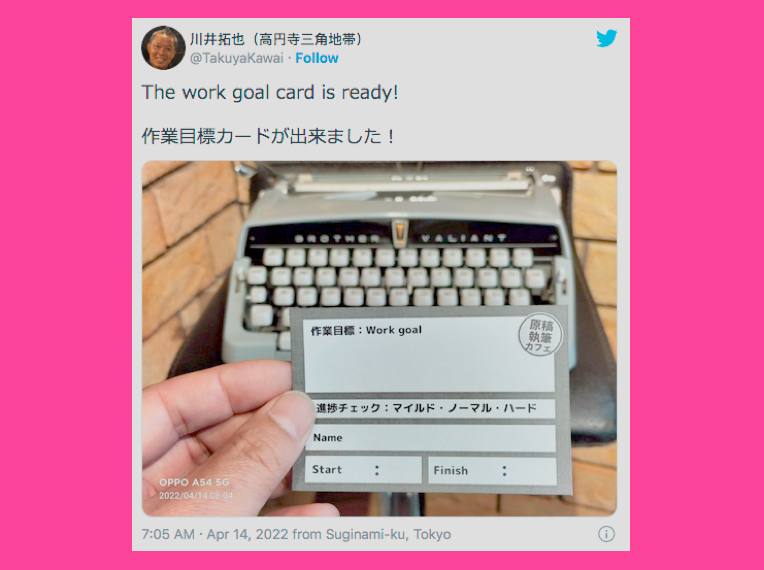
You then select from three levels of progress checks:
1) Mild: You get a progress check at the time of payment
2) Normal: You get a progress check every hour
3) Hard: Staff frequently stand behind you and watch you working.
You can’t leave the café until you finish your writing goal.
Once you complete your writing goal, your goal card is stamped with a cute Japanese stamp and displayed on the wall with all the other completed goals.
Let’s unpack the psychology of how this clever café works . . .
Besides the fact you are working in a focus friendly environment away from all your usual distractions, it helps that you are in the company of other people who are also working towards clear goals.
When a staff member stands over your shoulder, you don’t want them to see you scrolling through social media or checking your email. You want them to look at you and think, “Oh wow! This person is super focused and on a roll. Look at them go!”
If you go to this café enough times and achieve a feeling of success after completing each writing goal, your identity will begin to shift. Instead of seeing yourself as someone who procrastinates, you start to see yourself as the sort of person who just gets on with doing the work.
It also costs money to be there. It is 130 yen ($1.30 AUD) for the first 30 minutes and then it increases to 300 yen ($3 AUD) per hour. Being charged a fee provides incentive to just get on with doing your work (procrastination equals parting with your hard earned money).
The owner insists his café is a supportive environment and his tactics are not heavy handed. He states:
“As a result, what they [the writers] thought would take a day was actually completed in three hours, or tasks that usually take three hours were done in one.”
You may not have an anti-procrastination café in your neighbourhood, but there’s nothing to stop you from setting up your own writing café experience and applying the same or similar rules.
This is what a group of PhD students and I did to help us write our theses (you can read more about this here).
This event is run by a number of universities around the world. Students are encouraged to come along with a work project they have been avoiding.
Educators, mental health nurses, therapy dogs, librarians, and academic coaches are on standby, ready to help students tackle their specific procrastination issues.

For instance, if a student is procrastinating with writing an essay because they don’t know how to write an academic essay, they can get help from an academic coach.
If a student is procrastinating because they get easily distracted, they can receive coaching on various strategies, such as the Pomodoro Technique, that will help them to deal with distractions and focus their mind.
When it comes to procrastination, there is no one size fits all approach. Nights Against Procrastination are popular and effective because they offer students a smorgasbord of different strategies and solutions to combat procrastination.
The Beeminder app is a commitment device/goal setting app that helps you stay on track with achieving your goals. Here’s how it works:
You commit to a goal (e.g., Read 70 pages per week). You set a daily target (e.g., 10 pages per day). If you get derailed from achieving your goal, you get stung with a charge from your credit card (you pledge the particular amount).

It sounds harsh but this app is your accountability buddy. There’s a real consequence associated with not engaging in the behaviour. This can give you the extra motivational boost you need to make a start.
The great thing about this app is it integrates with other apps and programs (e.g., Fitbit, Garmin, Duolingo, and RescueTime). Once you set up these integrations it’s a lot harder for you to weasel out of your goals. The data gets automatically imported into the Beeminder app and the data speaks for itself. You either achieved your daily goal or you didn’t.
If you’re going to use this app, you need to be really clear about your goals. And you need to be serious about achieving them because let’s face it, losing money hurts.
Cave Days are online focused work sprint sessions that take place on Zoom. You’re instructed to leave your camera on, put your phone away, close any unnecessary tabs, and work for 45 – 52 minutes. Before your work sprint session, you set a goal for what you want to accomplish.

These work sessions are facilitated by a ‘Trained Cave Guide’. The Cave Guide doesn’t tell you the exact time the session will go for because they don’t want you to be watching the clock the entire time. At the end of each work session, your Cave Guide will facilitate short break activities.
If you want to check this out, you can register for a free 7 day trial to see if this work method works for you.
There are many different ways you can combat procrastination. But be careful – searching for the perfect solution can become a form of procrastination!
The thing is there is no perfect solution. When it comes to doing difficult work, here’s what I find makes a difference: having your phone away from your body (preferably in another room), being clear on what you need to do, taking a deep breath, and getting started with a small task (even if you don’t feel like doing it).