
What do you do if you don’t understand something?
Keep reading the same sentence over and over again? Maybe that will work. Maybe it won’t.
Or you could grab some coloured pens and mind map out the content.
This is what I do when I’m struggling to understand something. And this has worked for me without fail for the past 10 years.
Whilst I’m sold on mind mapping, I realise you may not be. Common barriers to mind mapping are time (“It takes too long”) and the perception of a lack of artistic ability (“I can’t draw”).
But here’s the thing: I’m time poor and I can’t draw particularly well but I haven’t let that stop me.
You see, mind mapping is actually insanely easy to do and if you practice and silence your inner critic you can save a whole heap of time studying.
A student recently said to me –
“I thought mind mapping would take a lot of time to do but actually it saves me time because I don’t have to read my notes over and over anymore”
Mind mapping helps you to study less because you understand the information at a deep level as a result of creating mind maps. If you just read your notes over and over chances are you’ll only understand the content at a superficial level and you’re going to waste a lot of time.
So if you’re serious about reclaiming your time and being able to study less and do more of the things you really want to do, then it’s worth giving mind mapping a shot.
Below are 5 important things you should keep in mind when you first start mind mapping.
1. Draw Pictures, even if they look rubbish
Draw lots of pictures. When you get sick of drawing, take a deep breathe and continue to draw some more pictures.
The Picture Superiority Effect shows that humans retain more information about an idea when it’s conveyed as a picture than just using words on their own (check out this 30 second explanation).
You don’t actually have to draw pretty pictures on your mind maps. Pretty, intricate pictures are actually a distraction from doing what you have to do when you mind map: learn information at a deep level.
And if the picture is absurd and exaggerated, that’s even better for aiding memory retention and recall.
2. Create your own mind maps
A year 11 student got really annoyed with me a few years ago because I didn’t give her a copy of a mind map I’d created before her human biology test.
Here’s the thing: it wouldn’t have made much difference if I had given it to her.
Why? Because she didn’t create it.
You don’t learn complex information very well (if at all) by looking at someone elses mind map and absurd images. You get the edge by taking the time to think through the different ideas and map them out.
Sorry, there are no short cuts. You have to put pen to paper.
3. Be proud of your mind maps
People can be patronizing and even down right rude when they see you mind mapping. I experienced this several times in law school. “Isn’t that cute!” students would say as they saw me mind map out legal ideas. But looking back, I can’t help but think that maybe these people were slightly insecure.
If someone makes a comment like “Cute pictures!” or “That technique doesn’t work for me. I need to take notes on my laptop” just smile politely, say something like “You have to do what works best for you” and carry on mind mapping.
4. Pen and paper works best for mind mapping (not a computer or iPad)
Don’t get me wrong, I think technology is great but just not for mind mapping. When you mind map you want a sense of freedom to explore ideas. You don’t want to be limited in any way and you certainly want all your senses to be engaged.
As Luc Glasbeek offers –
“It [mind mapping by hand] provides more cognitive stimulation than, say, a smart phone which reduces our world to a sterile and odorless screen barely the size of a coaster. This is limiting, whereas creation should be about expansion and freedom and discovery and roaming.
There’s something meditative about making a mindmap with a fountain pen, seeing the ink flow and watching it dry as we pause to gather our thoughts from time to time. Paper doesn’t crash. Paper is quiet, paper is patient.”
That’s right, paper doesn’t crash. Paper also doesn’t beep to notify you that you have a new message or email.
Despite all the amazing technological advancements, when it comes to efficient learning I believe simple methods (e.g. working with pen and paper) are often the best.
5. Use colours on your mind maps
Let’s face it, everyone loves a rainbow, especially a double rainbow. All those colours are nice to look at.
Just like your brain appreciates a rainbow, your brain prefers to look at lots of different colours on a page than just one colour (e.g. black or blue).
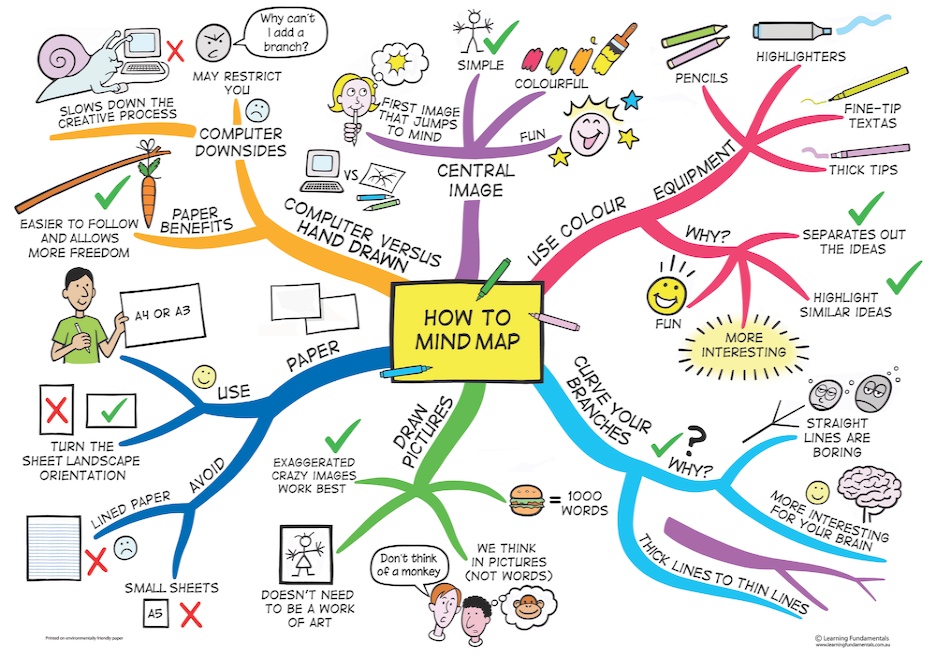
Using different colours for the branches on your mind map helps to separate out each of the ideas as well as highlight and group together similar ideas.
Above is a mind map on how to mind map. Whilst this mind map looks nicely illustrated and has been touched up on a computer, just remember your mind maps don’t have to be. Your mind maps can be as messy as you like. In fact, I recommend that you give yourself permission to create messy mind maps, especially if you’re a perfectionist.
Your challenge
So here’s a challenge for this week: set aside 20 – 30 minutes to understand some information you’ve been grappling with by creating a mind map. Grab some coloured pens, a sheet of A3 or A4 paper, a timer and work through the information (follow the tips on the mind map above). When a little negative voice says “That looks like rubbish”, keep going. When you get bogged down, create another branch. The key is to keep moving.
Treat it as a fun experiment. Maybe it will work. Maybe it won’t. But like anything in life, you won’t know unless you try.
Want to learn more about mind mapping?
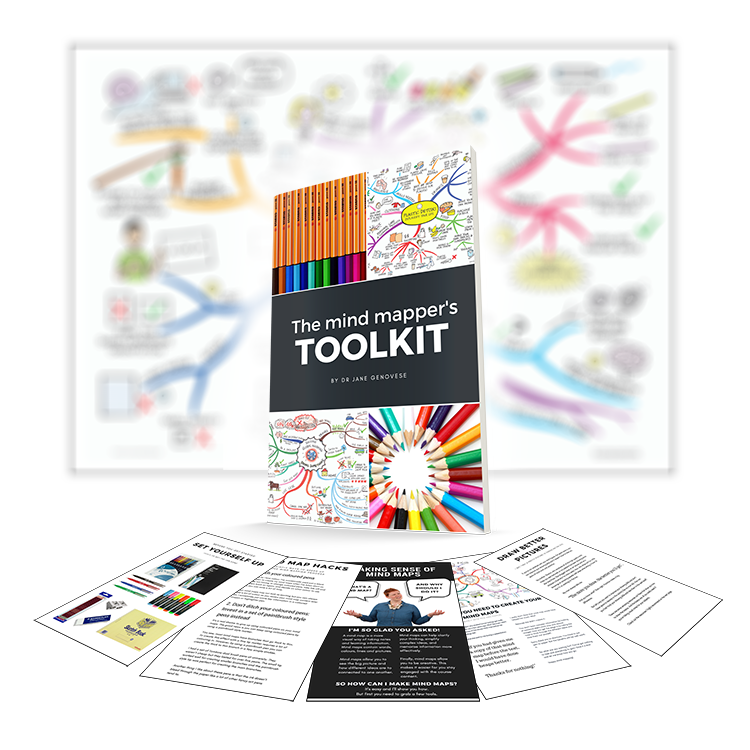
Pick up your free copy of The Mind Mapper’s Toolkit by clicking here.

Before adopting any new technology, the Amish will carefully consider how the device or app could impact their values, community, and way of life.
In these times of rapid change, I believe this is a valuable practice for all of us.
I recently received an email from a company that had developed an AI mind-mapping tool.
The email included a special offer. If I blogged about this AI mind mapping tool, I’d receive a year’s free pro-subscription.
Look, I love free stuff. When I see the word ‘free’, something funny happens in my brain.
I come from a thrifty family who hate waste and excessive consumption. For as long as I can remember, we’ve always received free items from others. Old bikes, broken laptops, and fridges (you name it!): we’d take the stuff, fix it, and use it.
As a family friend used to joke, “If it’s too good to throw away, give it to the Genoveses!”
But as I looked at this offer of a free subscription to mind mapping software, the usual rush of dopamine I’d get when I saw the word ‘FREE’ just wasn’t happening.
I felt nervous and uneasy.
I took a closer look at the website. At first glance, the tool looked quite impressive. You could import text, PDFs, images, and books into it, and the tool would automatically generate a mind map for you within seconds.
The website claimed this was a tool “Empowering 100,000+ thinkers”. It said it could save me time. I could generate and seamlessly edit mind maps. All of this sounded good in theory.
So, why was I having such a strong negative reaction to this new AI tool?
I recently finished reading a book called The Extinction of Experience: Reclaiming Our Humanity in a Digital World.

In this book, author Christine Rosen argues that we are facing a human crisis caused by Big Tech. The widespread adoption of technologies, such as social media, dating apps, and smartphones, has fundamentally altered the human experience — and not for the better.
Interacting with screens all day long and living in virtual worlds that reward us for sharing our most private thoughts has diminished the human experience and left us feeling disconnected.
Rosen argues we run the risk of developing habits of mind and machine-like behaviours that lead us towards an impoverished experience of the world.
In one part of her book, Rosen discusses the decline of skills like handwriting. She states:
“Like species decline, skills decline gradually.”
This sentence made me stop in my tracks. It stood out to me. Why? Because I have felt some of my skills declining in recent years.
So, when I checked out this AI mind mapping tool, I put my Amish cap on and asked myself the following questions:

If I were new to the practice of mind mapping and had only just discovered mind mapping software, things might have been different. I would have had no awareness of what I was missing out on.
But I have been mind mapping by hand, with pen and paper, for over 20 years. I don’t use any fancy apps or software (I never have).
This has been a deliberate choice on my part to preserve and sustain a practice that helps me understand and learn new information in a highly effective way.
I worry that switching from pen and paper to keyboard, mouse, and computer will cause something fundamental to change (and be lost) about my current mind mapping experience and practice.
Before adopting any app or device, you need to get clear on what job you are hiring this piece of technology to do. I use mind mapping to learn and clarify my thinking. Could this mind mapping tool do this for me?
This mind mapping software could produce a mind map for me within seconds. As one student writes in a testimonial on the website:
“I post my own lecture notes to generate a very concentrated mind map for me. I don’t have to spend 3-6 hours writing my own mind maps, which I often can’t do very well.”
Another person leaves a five-star review, “No more messy brainstorming”.
However, all of this completely misses the point of mind mapping.
The process of mind mapping is just as important as the final, often messy, mind map.
When I mind map, I’m not concerned about creating a work of art or saving time (it takes as long as it takes to understand a topic). I want to take my time, settle into the process, and avoid feeling rushed. Mind mapping by hand allows me to do this.

Creating a mind map on a computer screen quickly and outsourcing the job to AI puts me in a speedy, turbocharged frame of mind, which is not conducive to deep learning.
Mind mapping is a practice that forces me to slow down.
This slowing down is super important because the world around me is sending me signals to speed up and go faster and faster! When I’m in turbocharge mode, I’m more likely to get distracted and feel overwhelmed.
I’m trying to resist this frantic pace because I want to do things thoroughly and at my own speed. Watching a mind map get created within seconds isn’t what I want or need. It shifts me into overdrive mode, which makes it much harder to learn.
Mind mapping by hand also allows me to think deeply about ideas and how they are connected. The only way I can see those connections and understand them is by reading through the information, thinking about how I would convey that information as a picture and in mind map form.
When you outsource the process to mind mapping software, you don’t get the same deep understanding as you would if you took the time to do it yourself by hand. It feels superficial. To me, it feels like the McDonald’s of Mind Mapping: fast, convenient, but ultimately, not particularly nourishing for my brain.
Using mind mapping software also bypasses something else that brings me joy and satisfaction: it feels really nice to work with my hands.
As Rosen says, “We have a human need to see, touch and make things with our hands”.
Making a mind map with your hands may not be quick, easy, or convenient, but it provides a very rewarding experience for your brain and soul. Personally, it makes me feel calm, grounded, and more connected to ideas, myself, and the world.
I don’t want to be ignorant or closed-minded. This is why I created a free account with this mind mapping AI tool and attempted to generate three mind maps.
The first mind map was on an article I’d read. The mind map focused on just a small section of the article (conspiracy theories). If I hadn’t read the entire article, I would have missed the important science on this topic.
The second mind map was on creating a meal plan for a trip away. Although the mind map provided some ideas, I was left feeling dissatisfied and uninspired. You can see my hand-drawn mind map on a meal plan, which I created for a family trip, compared to the AI-generated one below.
Which mind map do you prefer?


For the third and final mind map that I tried to create, I entered the following prompt:
“Create a mind map on the book ‘Die with Zero’ by Bill Perkins?”
I encountered this error message:
“System resources have been exhausted. Please try again later.”

Instead of feeling frustrated, I was grateful for this message as it highlighted another problem with using mind mapping software: when the tech goes down or power goes out, you are rendered helpless. It also reminded me of how energy-intensive AI is to run.
I went away and mind mapped this book by hand (I’d just finished reading it and had marked up several ideas). You can see the mind map I created below (it took me approximately 40 minutes to do).

I was curious to see if my mind map would resemble the one the mind mapping software generated. So the next day, I entered the same prompt again. Less than 3 seconds later, a mind map appeared on the screen (you can see it here). Was this a mind map on the same brilliant book I’d just read?
It seemed like AI slop.

I felt disconnected from the ideas. The spirit of the book just wasn’t there! I preferred my own mind map.
There is a freedom in mind mapping by hand, away from screens and without AI. The freedom comes not only from using your hands, brain, and creativity, but also from being able to focus on the task at hand.
It’s all too easy to get distracted when working on a computer. That’s why I have set up a dedicated space in my office, away from screens, where I do my mind mapping practice.

Mind mapping is a sacred practice for me. Doing it on a computer and outsourcing the process feels abstract and detached. I can see and feel what is being lost from the process.
Some tech enthusiasts may label me a “luddite”, but as Rosen says, “not every new thing is an improvement on the old”.
I say, stick with what works. Let’s not overcomplicate something that is simple but highly effective when it comes to learning. Put aside your fear of creating messy mind maps, step away from the screen, and enjoy the experience of making a mind map by hand.

When you start using this strategy, it can feel clunky and awkward. It requires some mental effort to get going.
Why can it feel hard to start mind mapping?
Because it isn’t a habit (not yet, anyway). But once mind mapping becomes a habit, it can feel easy and deeply rewarding.
So, how do you get to that point where mind mapping feels easy? Even fun?
In this article, I will explore how you can create a habit of mind mapping. I’ll show you how to remove friction or pain points so it’s much easier to put pen to paper and absorb ideas.
Let’s start by looking at what gets in the way and stops many people from creating mind maps in the first place. I’ll also share some strategies you can use to overcome each of these barriers.

When you look at a mind map with all the pictures and different colours, it seems like something that would take a fair amount of time and effort to create.
If you’re comparing mind mapping to the time it takes to read your book passively, then yes, mind mapping will take more time. But you need to understand that reading your book passively is not an effective way to learn. In contrast, mind mapping is super effective.
People often fall into the trap of trying to make their mind maps look like works of art. Try lowering your standards and allowing yourself to make a mess when you mind map. This will speed up the process.
Another time trap is trying to mind map as you read and trying to mind map everything you read. I find it’s much faster to read and tab key ideas worth mind mapping later on. Once I’ve finished reading either the chapter or book, I then commence the mind mapping process. By this stage, I have a better understanding of the key ideas and what’s worth mind mapping.
Some people get hung up on the way their mind maps look. They can’t stand looking at messy pictures and scribbled words. If that’s you, perhaps you could take your drawing skills to the next level with some practice and sketch classes. But it’s not necessary.
Mind maps are not there to look pretty. They are there to help you learn. I am a big fan of badly drawn mind maps. If you look at my mind maps from university, they’re not works of art but they contain loads of important ideas. And that’s what matters most when it comes to learning.
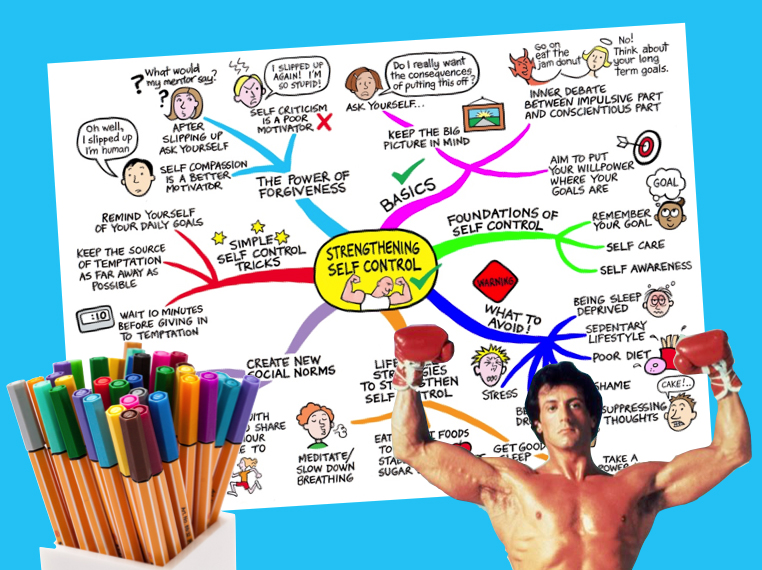
Here’s a simple hack: invest in a set of nice, vibrant coloured pens. A bit of colour on the page will make your mind maps more visually appealing.

Mind mapping is straightforward. You draw a central image, curved lines, a few pictures, and write down key ideas. That’s it!
It’s not something you need to read a book about. You don’t need to enrol in a 10 week program to learn how to do this.
If you want some tips on how to mind map, check out my free Mind Mapper’s Toolkit. It’s a quick and easy read.
It’s important to realise that the first time you engage in any new behaviour, it will most likely feel strange and uncomfortable. You may feel a bit clumsy and awkward. You may have questions, “Am I doing this right?”. All of this is normal and to be expected.
Even something as simple as the pen you mind map with can make or break the mind mapping process.
You’ve probably noticed that some pens don’t feel pleasant to write or draw with. For instance, I’m not a fan of the popular Sharpie pen range. I don’t like the way these pens bleed through the page. And I really don’t like the way they smell.
These may seem like minor irritations and quirks, but trust me, they’re not. Your mind mapping experience will be diminished by a pen that doesn’t feel good in your hand or on the page. And any behaviour that feels unpleasant is much harder to sustain.
I’ve since ditched my Sharpie pens. I mind map with a uniball signo pen and non-toxic Tombow paintbrush pens. As far as coloured pens go, I won’t lie, these pens are pricey! But you can find them online for $25 cheaper than in Officeworks (a big stationery store in Australia).
What I love about these pens is that they are super easy to use, feel lovely to strike across the page, and they won’t leave you with a splitting headache from the ink smell.
Here are some things that have helped me to establish this habit in my life:
When is the best time for you to mind map? Where in your day can you easily slot in a 15 minute mind mapping session?
I like to mind map when I feel fresh and mentally alert (first thing in the morning).
Find an activity that you do every day without fail (e.g., having a shower, eating breakfast or dinner) and use that to prompt you to start a mind mapping session.
For instance, after I have completed my morning routine (workout, breakfast and shower), that’s my cue to sit down and start mind mapping.
Before you start your session, set yourself up with everything you need to mind map. I like doing this the night before my morning mind mapping sessions.
Before I go to bed, I lay out a sheet of A3 paper, my pens, and my timer. The book I am mind mapping is open on the page where I need to start working. The next day, all I need to do is sit down, start my timer, pick up a pen, and away I go!

What’s one thing that can slow down the mind mapping process?
For me, it’s digital distractions (e.g., text messages and notifications).
You probably already know the things that tend to derail you. Create a barrier between you and those things.
For example, my phone is the biggest distraction for me. How do I deal with this? Before I start mind mapping, I take my phone and place it away from my body in another room.
This signals to my brain that my phone is off-limits and it’s time to knuckle down and focus on my work.

Don’t wait until you feel pumped and inspired to create a mind map. Set a timer for 10-15 minutes and start mind mapping (regardless of how you feel).
If you miss a day, don’t beat yourself up. It’s no big deal. Just say to yourself, “Tomorrow is a new day. I will get back into mind mapping then”.

When the timer goes off at the end of your mind mapping session, say to yourself, “Good job!”. Do anything that makes you feel instantly good. I often clap my hands or do a fist pump.
According to Professor BJ Fogg, the secret to wiring in any new habit is to release a positive emotion within milliseconds of engaging in the new behaviour. When you release positive emotions, this releases dopamine in your brain. This makes it more likely that you’ll engage in this behaviour again.

I mentioned this before, but it’s important to repeat it: don’t go cheap with your mind mapping tools. Invest in good pens and paper. My favourite pens for mind mapping are uniball signo pens (0.7 tip) and Tombow paintbrush pens. Regarding paper, I love using Rhodia paper (it feels like your mind mapping on butter).
It may sound a little dramatic, but mind mapping changed my life. I used to read books and then feel frustrated that I couldn’t retain much information. But now, I have a strategy I can easily use to help me understand and remember complex ideas. This gives me confidence when it comes to learning new skills and information.
I encourage you to be playful with this strategy. Don’t get too hung up on how your drawings look. Your top priority is to leave perfectionism at the door and have some fun. Because when it comes to mind mapping, done is better than perfect.
The funny drawings, the colour, and creativity can transform any dry subject into something that’s interesting for the brain.
But mind mapping is also a great life strategy. You can use it to create plans, capture ideas from books, set goals, clarify your thinking, organise your finances, and work your way out of messy situations.
Below I explore some different ways you can use mind maps in your day-to-day life.

Do you ever read books and then feel frustrated when you can’t remember much from them?
This is why I mind map out every non-fiction book that I read.
I know that there are limits to my memory. If I want to be able to extract ideas and strategies from a book and apply them to my life, I’m going to need to create mind maps.
There are two ways you can mind map a book:
1) You can mind map as you read: this forces you to slow down and really think about the ideas. I highly recommended doing this if the content is really complex. But this approach can be slow going!
2) You can mind map once you’ve finished reading: I use mini post-it notes to tab key ideas as I read. Once I’ve finished reading the book, I go back and mind map out the tabbed ideas. This way I have some perspective and can identify what’s important and what’s not (rather than assuming every sentence is important and needs to be mind mapped).
After I’ve finished mind mapping the book, I select a strategy that I’ve captured on the mind map to test out.
My husband has always been amazed at how I can take ideas from books and apply them to my life. But there’s no magic to this. I’m able to use lots of different strategies because mind mapping helps me to understand and remember them.
Let’s face it, if you can’t remember a strategy, you can’t use it!

Let’s say you have a test or exam coming up. Here’s how you can use mind maps to effectively prepare . . .
Push your notes and books to the side (you can’t look at them). Now grab a blank sheet of paper. Set a timer for 5 minutes and try to create a mind map on the main ideas you can remember.
Don’t try to make these mind maps look pretty. You’ve only got 5 minutes, so scribble and draw out as much as you can remember.
Once you’ve exhausted your memory, pull out your notes and pick a different coloured pen. Take a look at your messy mind map: What did you get right? What did you get wrong? Where are the gaps in your knowledge?
This strategy is called Active Recall and it’s the most effective way to retain information. You can read more about it here.

When you feel overwhelmed by life, everything can feel urgent and important. But not everything is urgent and important. A little prioritisation can save you a lot of stress and drama.
Grab a big sheet of paper, draw a circle in the middle, and write inside it Stuff to do. Now get everything out of your head and on to the page!
Once you’ve finished your mind map, look over all the tasks.
If a task is important, give it a tick.
If a task is urgent, circle it.
Focus your energy on knocking off the tasks that have ticks and circles around them (they are urgent and important).

Research shows the more connected you are to your Future Self, the more committed you will be to achieving your goals and the wiser decisions you will make in the present.
Draw a circle in the middle of page and write inside it My Future Self. You can create branches for your Future Self in:
• 3 months’ time
• 6 months’ time
• 1 year’s time
• 3 years’ time
• 5 years’ time
Then off each of these main branches, write down your goals. What do you want to have accomplished by this time?
As Dr Benjamin Hardy states in his book Be Your Future Self Now:
“The clearer you are on where you want to go, the less distracted you’ll be by endless options.”
Note: Imagining your Future Self is not an easy thing to do. We are terrible at imagining where we are going to be in the future. So, don’t overthink it. Just get some ideas down on paper. As you gain more clarity around your goals and values, you can always add extra branches to your mind map.
I’ve found mind mapping to be a fun and effective way to capture, organise, and retain information. Even if I never look at the mind map again, the process of getting ideas down on paper makes a big difference. It helps me to feel more in control and on top of things.
If you need some clarity in a particular area, stop ruminating. Pick up a pen and start mind mapping!
