
The small things pile up. And those small things start to feel like big things.
But you can’t let it overwhelm you.
No matter what is going on in your life right now, you need strategies to help you get out of bed and get on with the day.
Below I’ve listed 10 strategies and tools that I highly recommend.
A really good day starts the night before. The last hour of your day plays a critical role in determining how well you sleep, when you wake up, and how mentally prepared you feel to take on the day.
In the book ‘The Gap and The Gain’, the authors state:
“What you do during this one hour has effects that far outweigh what you do with the other hours of your day. It determines how productive and purposeful you are, as well as influences how well your brain functions. If you use this one hour powerfully, the next 24 hours will be successful.”
In the last hour of my day, I like to do things such as:
• Prepare my breakfast (overnight oats)
• Lay out my exercise clothes for the next day
• Do some gentle stretches
• Tidy my work desk and set things up for the next day
• Fill in my gratitude journal
• Write a short to-do list for the next day (only three things)
• Read a book to calm my mind
I avoid screens an hour before going to bed, too. Locking my phone in a Kitchen safe helps with this.
Being constantly bombarded with notifications, never-ending feeds of information, click-bait, and endless entertainment options can leave us feeling mentally fatigued.
If you want to feel more in control and less exhausted, you need to find ways to stop running to your devices for quick shots of dopamine (instant gratification). Don’t rely on your willpower to do this.
We don’t have superhuman willpower. I’m fairly disciplined but I know I can’t take on the armies of industrialised persuasion (e.g. social media, Netflix, and YouTube).
This is why I have invested in tools that create a solid barrier between myself and my digital devices.
One of these devices is a Kitchen Safe.
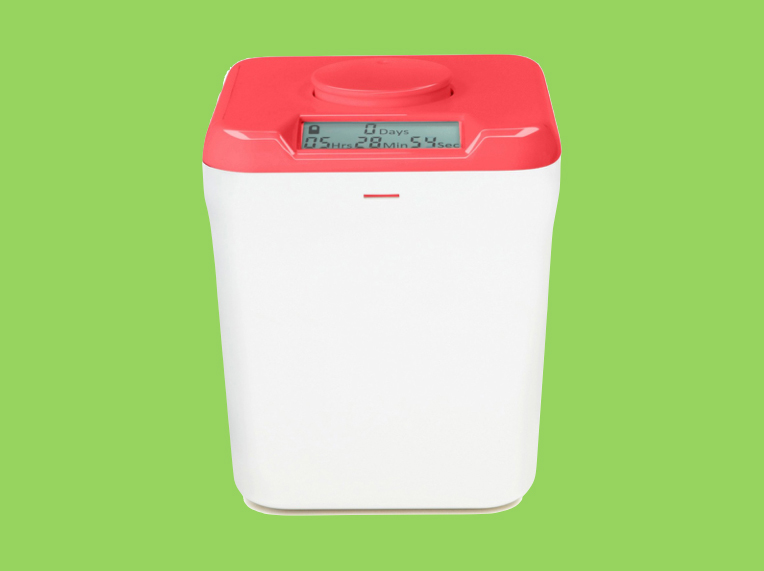
When I work and sleep, my phone is away from my body and locked in this safe. It needs to be locked away because it’s just too tempting otherwise (especially when I’m doing challenging work).
If you don’t want to spend $100 on one of these devices, I get it (it’s a lot of money). A free alternative is to hand over your phone to someone you trust. Or place it on silent in another room.
Electronic timers can help you cultivate time awareness. Setting timers can help you keep track of how long you spend on tasks. They prompt you to wrap things up and move onto the next thing you need to do.
I have various timers scattered all over my house and office. Depending on the task, I usually set them for 10, 20, or 30 minutes before I give myself a break.
Stressing about something? Go for a walk to clear out the mental cobwebs.
Walking is a great way to get out of your head, clear your mind, and refresh yourself.
Whenever I’m feeling overwhelmed, I put on my sneakers, I head outside, and I walk. Usually after a walk, I have a fresh perspective on things. I realise the thing that was upsetting me isn’t such a big deal after all.
Diaries are super handy. They are the ultimate life management tools.
I think of my diary as being like a mini assistant. I open up my diary, I look at the week ahead and it tells me what I need to do, when I need to do it and where I need to be.
I’m going to share a simple trick to make using a diary simple and easy to do:
As soon as you know a test or event is coming up or an assignment is due, write it down. This takes less than 30 seconds to do.
Then have a set time each day when you open up your diary and look at it. That’s it.
Write stuff down in your diary. And look at it.
When you’re stuck in a rut, you need to pull yourself out by being in action. A to-do list can help you with this.
I use an app called Complice to create my to-do lists. I like Complice because it helps me set intentions/tasks that are aligned with my goals.
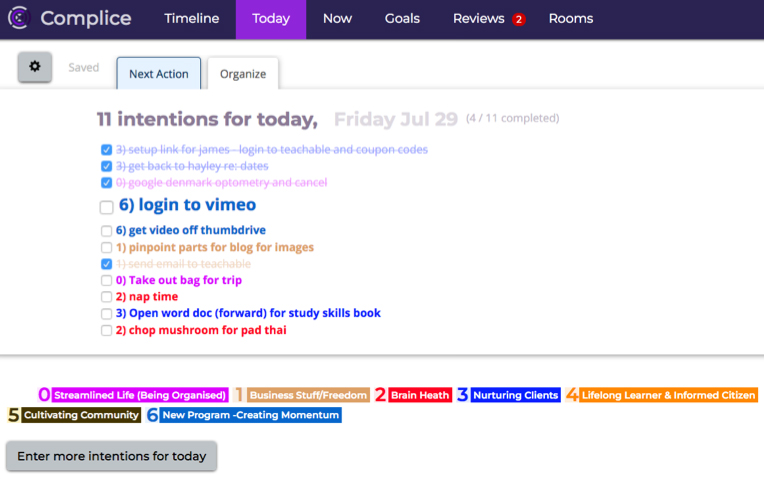
But you don’t need to use a fancy app. A piece of paper and a pen will do the job.
When I need a break from my work or I’m not sure what to do next, I pull out a random game I created (inspired by my friend and Tiny Habits coach Val McKinley).
This game involves a pile of old defunct pens placed in an old jam jar (but you could use pop sticks or little bits of paper). Here’s how the game works:
Each pen has a sticker attached to it. On the sticker is a tiny task (e.g. do one push up, put away one item, hit play on an upbeat song, clean whiteboard, sigh 3 times). When I’m not sure what to do next, I randomly pick a pen (like a lucky dip). I read the task and then I count down . . . 5 . . .4 . . . 3 . . .2 . . . 1! And then I go do that thing.

Every decision you make takes effort and mental energy. But you can conserve some of your mental energy by creating habits.
I’m a huge fan of Professor BJ Fogg’s Tiny Habits Method. He has made the process of creating habits feel fun and easy.
You can practice the Tiny Habits Method by taking Professor BJ Fogg’s free 5 Day Tiny Habits Program.
If you have lots of thoughts swirling around in your head, get those thoughts out of your head and down on paper or onto a whiteboard. This frees up your brainpower and helps you get back on track with what you need to do. Once the idea is captured, you don’t need to worry about it. You can come back to it later.
This is why I have notepads and/or whiteboards strategically placed in locations where I sit and think. For example, by my bed, in the kitchen, on my desk, in my bag, next to the toilet, and in the car.
What do I do with all these ideas that I’ve scribbled down?
Every few weeks, I collect them all up and go through them. Ideas that seemed great at the time but now don’t seem so amazing, I toss. But any good ideas or bits of information, I’ll file away for future projects or action them straight away.
Psychologist Dr Faith Harper recommends creating a set of coping cards to get through tough times. These are cards that contain quotes, mantras, grounding exercises, images or actions that calm you down and/or make you feel better. When panic hits, reach for your cards and go through them.
Dr Harper acknowledges that this strategy is cheesy stating, “It’s cheese with extra cheese sauce”. But it works when it comes to rewiring our brains. Your coping cards are a simple and effective way to help ground you in the present moment when you’re hit with a tsunami of powerful emotions.
Whatever it is you’re currently facing, you can find a way to get through it. These strategies help me to get going and get into the day, regardless of how I feel.
I reckon there’s at least one strategy in that list of 10 that you could benefit from. The key is to try them out and see which strategies work for you. So, why not choose one now and see how you go?

Efficiency was the name of the game.
In an attempt to be ‘time smart’, I started ordering my groceries online and having them delivered straight to my door.
Yes, it was convenient.
Yes, it was efficient.
But over time, I saw that this convenience and efficiency came at a cost.
I’m not talking about the $20 monthly subscription fee to the supermarket. I’m talking about the cost to my lived human experience.
Earlier this year, I realised that by having my groceries delivered, I was missing out on a lot of valuable micro-interactions.
I was depriving myself of experiences that made me feel connected to other people and my community.
You may be thinking, “Yeah, big deal, Jane! Don’t you have better things to do with your time than grocery shopping?”
My younger ‘optimised’ self would have thought so. And that’s certainly what the Big Tech companies want you to believe. Big tech wants you to believe that a good life is an optimised life and one that is friction-free.
While I used to think grocery shopping was a waste of my time, I don’t think this way anymore.
Shopping for food in person at your local farmers’ market, bulk food store, or supermarket is an experience worth having. It’s time well spent.

Besides acquiring the best fresh produce and ingredients, the in-person shopping experience offers unexpected micro-interactions.
Here’s an example of what I’m talking about . . .
Last week, I popped into a new supermarket to pick up a few items. I was looking for plant-based sausages, but after going all around the store, I couldn’t find them. I knew I needed help.
I approached a young employee who was busily stacking tubs of hummus in a refrigerator. I asked her if she knew where the vegan products were.
She said, “Oh, I think you’ll find them over here” and then she took off like a rocket. I was practically running with my shopping cart to keep up with her.
I said to her, “Wow, you walk really fast!”
To which she said, “Oh… sorry!”
I said, “No, don’t apologise! I think it’s great!”
We arrived at the plant-based sausages, I thanked her, and she sped off again.
This brief social interaction probably lasted less than 60 seconds, but it made my day. It got my heart rate up and put a smile on my face.
I felt inspired by her young person energy. It also dawned on me that I could probably push myself a little harder in my next workout session.
I’m not exaggerating when I say my life was enriched by this tiny social interaction. Had I just ordered my plant-based sausages online, I would have missed out on this joyous experience.
This experience got me thinking about why I love talking to complete strangers so much. Unless I encounter a total grump, I usually always leave the interaction feeling better than before.
I was curious. Had any research been done on this?
It turns out quite a bit!
Dr Gillian Sandstrom has written a book that explores the many benefits of talking to strangers. It’s called Once Upon a Stranger: The Science of How “Small” Talk Can Add Up To a Big Life.

In an interview, Dr Sandstrom explains some of the benefits of talking to strangers. She states:
“The first benefit that we’ve found consistently is just that it puts you in a good mood. When you talk to a stranger, you usually walk away feeling a bit happier and more connected, which we know is so important for humans.
Another thing from the research is that we tend to learn more than we expect to when we talk to strangers. It brings novelty into our life, makes our life richer. There’s research about how well-being can arise from not only happiness, purpose, and meaning, but this third source: psychological richness. I think talking to strangers gives you richness, because it brings novelty and learning and those kinds of things into your life.”
Famous author Kurt Vonnegut understood this psychological richness that came from talking to strangers out in the world (not online).

He could foresee the problems associated with technology back in 2005 (well before social media, online shopping, and generative AI became widely adopted).
In a PBS interview, Vonnegut tells a story about going to the shops to purchase a single envelope.
Before leaving the house, his wife says to Vonnegut:
“You’re not a poor man. You know, why don’t you go online and buy a hundred envelopes and put them in the closet?”
Vonnegut continues the story, telling the PBS interviewer:
“I pretend not to hear her. And go out to get an envelope because I’m going to have a hell of a good time in the process of buying one envelope.
I meet a lot of people. And, see some great looking babes. And a fire engine goes by. And I give them the thumbs up. And, and ask a woman what kind of dog that is. And, and I don’t know…
And, of course, the computers will do us out of that. And, what the computer people don’t realize, or they don’t care, is we’re dancing animals. You know, we love to move around. And, we’re not supposed to dance at all anymore.”
The ‘Computer people’ Vonnegut referred to are the Tech bros of today. They have designed apps that have made us addicted, isolated, and lonely.
But we don’t have to go down this path. We have a choice.

Instead of choosing convenience, efficiency, and comfort, we can choose real contact with the world and people.
This is why I am resisting using AI. It’s why I don’t use any social media. It’s also why I have now gone back to buying my groceries in person and avoid the self-service checkouts as much as possible (even if it means waiting in line for five minutes).
Sometimes the checkout person is dead tired and doesn’t want to talk (which is fair enough). Or I’ll try to strike up a conversation and the other person doesn’t want to talk (this is rare, but it does happen).
You also need to be careful about who you choose to strike up a conversation with. Some people can be dangerous and unhinged, but in my experience, most people are kind and friendly.
If you have concerns about ‘Stranger Danger’, Dr Sandstrom suggests:
“Choose a situation that feels safe, such as a public place in broad daylight with plenty of people around.”
She goes on to add:
“In my life, instead of being a danger, strangers have been game changers.”
I couldn’t agree more.
Even if you do end up talking to someone who is a grump or not in the mood for a chat, you’ll learn something about yourself and the human experience.
By resisting the pull to be efficient and by seeking out micro-interactions, your life will be a whole lot richer. As Kurt Vonnegut once said: “We are here on Earth to fart around, and don’t let anyone tell you any different.”

For context, she was a sales manager who used a BlackBerry phone for work (a fancy, expensive device at the time).
Every minute of the interview, her phone pinged with a notification or she received an email alert on her laptop. She’d glance at one of her devices and, with a panicked look, say, “I need to answer this!”
It was an awkward and disjointed conversation, full of stops and starts. I have to admit, her behaviour annoyed me. I soon realised I wasn’t the only person feeling this way.
The sales manager mentioned that she had a 4-year-old daughter who would get upset with her.
She told me that her little girl would beg her to put her phone and computer away. She’d tug at her clothes and cry, “Mummy! Mummy! Put your phone away!”

I appreciated this woman’s honesty, especially when she said to me:
“On the weekend, I’m with my kids but not truly with them… if you know what I mean”.
I knew exactly what she meant.
That was over 10 years ago. Fast forward to today, and we’re all a bit like that sales manager. But things are a lot worse now.
Instead of being overwhelmed and distracted by phone calls and work emails, we’re dealing with powerful Big Tech companies that hijack our time, energy, and attention.
They’ve made us weak-willed and impulsive.
We’re now in a position where distraction is something we crave rather than put up with.
When we have a gap in our schedule or we have to wait in line, what do most of us do? We reach for our phones without even thinking.
Rather than be alone with our thoughts, we desperately try to fill the space with ‘phone snacks’.
When we feel confused, frustrated, or bored, we run to our devices to escape the discomfort and our brains reward us for doing so.
Every time we switch tasks, our brain releases a little shot of dopamine.
It’s these quick hits of dopamine that train us to crave checking our phones and, ultimately, multitasking.
In an environment of unrestricted tech use, my brain is like a wild monkey. It wants to run around, make a mess, and explore many different things all at once.

I can relate to Dr Nancy Colier when she writes in The Power of Off, the mind on technology is like a “wild, locked-up monkey that’s drunk two bottles of wine chased by a shot of Scotch and been stung by a whole swarm of bees”.
When I start multitasking (and it doesn’t take much to get me going), I feel amped up, frenzied, and agitated. My energy feels a little crazy.
Research shows that as we quickly switch from one task to another, we rapidly deplete our finite mental resources and put our brains under a lot of stress.
But it gets worse . . .
When we multitask, we also experience what researcher Sophie Leroy calls Attention Residue.
In a research paper called Why is it so hard to do my work? Leroy explains Attention Residue as the extent to which your attention is only partially focused on the current activity because a prior activity (the task you rapidly switched from) is still holding part of your attention.

Why does this matter?
Leroy’s research found that when you experience Attention Residue, your performance suffers.
It’s as if you’ve taken a big dollop of the previous task and put a thick slather of it all over the current task, thereby making a mess of the present moment.
The good news is we can stop messing with our precious moments by focusing on one task at a time.
In his excellent book Time Surfing, Zen Monk Paul Loomans encourages us to focus on one task at a time, with minimal interruptions, and do it until completion. He says if we do this, we will experience a sense of calm and pleasure in everything we do.

Even tasks we consider boring or mundane (e.g., peeling potatoes or cleaning your room) can be transformed into artistry when you are truly present.
Part of the problem is that we’re often in a rush to get to the next thing on our to-do lists. But as Loomans warns, “Rushing is like gulping down time. You’re not living for now but for later”.
To counter this frenetic urge to race ahead, Loomans suggests that we accept whatever we are doing as “the activity of the moment”. In other words, we view the task before us as the most important thing we can be doing in this moment and we forget the rest.
It’s a simple but powerful mental shift.
I’ve noticed that when I accept whatever I am doing as the thing I should be doing right now, I no longer feel the urge to work with such intense energy. I feel calmer. An added bonus is that when I slow down, I make fewer mistakes and tend to do a better job.
At the heart of it, doing one thing at a time means showing up to life and being present, to the good stuff but also the painful, boring bits.
If you find yourself reaching for your phone more than you’d like, ask yourself this question:
“Am I reaching for my phone to escape the present moment?”
For me, the answer is usually yes. I’m trying to avoid the discomfort of life. But life tends to be more meaningful and enjoyable when I stay fully present to what’s happening around me, with my phone out of sight.
Technology will dominate your life, and multitasking will be an issue unless you have strategies to protect your time, energy, and attention.
What motivates me to set limits on my tech use (specifically my phone) is a desire to feel calm, grounded, and focused. I also want to live a life of substance, not one in which I am constantly chasing instant gratification.
Here are the strategies that I am currently practising to help me decrease multitasking and cultivate calm:

When I’m with someone or working on an important task, I put my phone away and keep it out of sight. I want to be fully present with the person I’m with or the task at hand. Why?
Because attention is how we show others they matter.
When someone is checking their phone in a social situation, it communicates “I’m more interested in what’s happening on this screen than I am in you”.
When I think back to the interview with the sales manager, it would have been a better experience for everyone if she had put her phone on silent, left it in her bag, and closed her laptop.
There would have been fewer times saying “What was the question again?” and “Sorry, I can’t remember what we were talking about”.
We probably would have felt more connected, too.
Note: Even when my phone isn’t within arm’s reach, I can still catch myself rapidly switching between web browsers and tasks. However, I’ve noticed that my multitasking significantly increases when my phone is within arm’s reach.
You’ve probably heard of intermittent fasting, where you have a window for eating (e.g., 10am to 6pm). But have you heard of phone fasting?
Phone fasting is a period during the day when your phone is not within reach.
As TJ Power states in The Dose Effect:
“A phone fast enables your dopamine to replenish and creates the opportunity for connection and restoration.”
So, as an experiment, for 30 days, I phone fasted from 8pm until 12noon the next day (allowing myself to make urgent calls if needed). I discovered that this made a big difference to my ability to focus. I also experienced a sense of calm like never before.
At the start of the day, I create a ‘Wish List’ (another wonderful concept from Paul Looman’s Time Surfing book).
I write down all the things I’d like to do in the day, but there’s no pressure to do all of them. I then put the list away, and depending on how I feel, I listen to my intuition and trust myself to choose the right activity to begin with.
Before I start a work session, I also declare what I intend to do (e.g., “Chop vegetables for curry” or “Write for 45 minutes”). If possible, I also like to share what I plan to do with another human (I use an online coworking community called Cave Day to do this).

After every 25-30 minutes of work, I aim to take a short movement break (usually 2-5 minutes in duration). This helps me to stay energised and alert. But most importantly, it gives me a brain boost.
What I wish I had understood when I was younger is that you can’t focus for hours on end. It’s not humanly possible because your brain has a finite amount of attentional resources. This means as you focus on doing a task, your attentional resources get depleted (and if you multitask, you accelerate the depletion even more!).
However, research shows you can boost your attentional resources by taking short breaks or, as Paul Loomans likes to call them, ‘breathers’.
A ‘breather’ is any activity that allows you to get out of your head and grounded in your body.
Some of my favourite breather activities include going for a short walk, chopping vegetables, or riding my bike to pick up a package from the post office. These activities allow my brain and thoughts to roam free.
Although many of us default to checking our phones during breaks, resist the urge. The problem with using your phone on a break is that you’re still in your head. This means you’re churning through your attentional resources instead of replenishing them.
The sense of calm and pleasure I experience when I stop multitasking and focus on doing one thing at a time is second to none.
But in the age of the Attention Economy, with so many companies trying to hijack our attention, it takes discipline and practice to stay focused.
Without strategies in place to protect your focus, the default will be multitasking and its friends – chaos, stress, and fatigue.
We may not have a 4-year-old child tugging on our clothes when we’re using our phones. But perhaps we should all listen to the wisdom of that little girl and put our phones away.

In our modern world, overwhelm and distraction threaten to constantly derail us.
As artist Austin Kleon states in his book Keep Going:
“Your attention is one of the most valuable things you possess, which is why everyone wants to steal it from you. First you must protect it, and then you must point it in the right direction.”
In this article, I share a powerful practice that can help you protect your attention and point it in the right direction: working like a sprinter.
As a teenager, I remember watching Australian Aboriginal athlete Cathy Freeman run in the 400-metre race at the Sydney 2000 Olympics.
In that incredible race, Cathy did one thing and one thing only: she ran as fast as she could in a focused, intense burst.
She was 27 years old and had been training for this event for 17 years. Having won silver at the previous Olympics, the pressure was on. The entire nation was watching Cathy.

To this day, I still get goosebumps when I watch the footage of this race (you can watch it here).
Cathy was in the zone. She was completely focused on the task at hand. She knew what she needed to do: run.
Shortly after crossing the finish line, Cathy sat down to catch her breath and process what she had just accomplished (she had won gold). The crowd went wild and was completely absorbed in the moment, too.
Back in the year 2000, during the Sydney Olympics, smartphones and social media didn’t exist. Not everyone had access to the internet (my family did, but it was slow, expensive, and could only be used at home on a computer). In this environment, it was much easier to focus.
It’s fair to say that the early 2000s were simpler times.
Some scholars (e.g., Dr Jonathan Haidt, and Dr Anna Lembke) argue that smartphones and social media have caused several harms to society, including a reduced capacity to pay attention and an inability to tolerate discomfort.
Despite the noise and chaos of the modern world, it’s possible to train yourself to focus better.
How do we cultivate better focus?
One way is to tackle our work like sprinters.
The practice of working like a sprinter is refreshingly simple: You work in a short, focused burst (25-45 minutes), then take a break to rest and recover (5-15 minutes). After that, you repeat the process a few times before taking a much longer break (30 minutes).

I usually work this way for about 3 – 4 hours a day.
But I’m not fixed and rigid about this practice. This technique is adaptable. The key is to listen to your body and tune into what it needs. Make this practice work for you.
If you develop the habit of working in this focused way, you’ll be amazed by how much you can get done. More importantly, instead of feeling mentally fried at the end of the day, you’ll feel energised. You’ll also experience a delightful sense of calm and peace.
In short, this is a practice well worth cultivating.
In a nutshell, working like a sprinter involves three distinct phases:
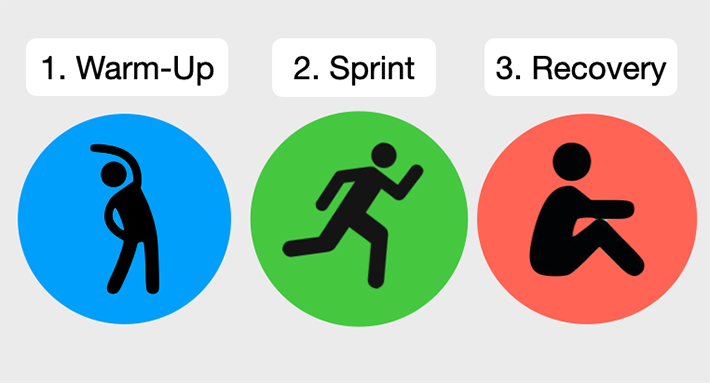
It’s simple, but it’s a practice that takes practise.
Below, I delve into each phase in more detail and share some things that help me work in focused sprints.

I do my best work sprints in the morning between 9am and 12noon. But these focused sprints don’t just magically happen. It’s not like I roll out of bed and dive straight into a work sprint. First, I need to warm up.
The warm-up phase allows me to get in the right headspace and set up my environment to be focus-friendly. It has a dramatic impact on my brain’s performance, affecting my ability to focus, creativity, productivity, and mood.
Just to be clear, the stars don’t have to align, and the conditions don’t need to be perfect to kick off a work sprint. I’ve simply noticed that I can work better after engaging in a few behaviours and morning practices.
Here’s what I’ve found makes a difference . . .
What distracts you when you’re trying to work? What things frequently derail you?
Take note of the things that hijack your attention and throw you off track.
In one of my favourite books on getting organised, Organizing Solutions for People with ADHD, Susan Pinsky writes:
“The more you explore the distractions that keep you from working, as well as the tools that help you to focus, the more organized and productive you will become.”
Once you know what distracts you, you can figure out ways to deal with those distractions, which brings me to the next point . . .
For each distraction, think of ways to make it harder to engage with it. What barriers or strategies could you put in place? Are there any tools that could help you focus better?
For example:
Dealing with distractions from the outset (before you sit down to do your work sprints) makes it easier to stay focused and on track.
Many of us have become used to constant stimulation; without it, we feel anxious. This is why we reach for our phones and scroll through our feeds as soon as we experience a slight pang of boredom.
If you can relate to this, you will benefit from engaging in a daily meditation practice.
If you’re new to meditation, I recommend starting with the following tiny habit of doing a micro-meditation:
After I put on my shoes, I will pause and breathe in and out three times.
Not sure how to meditate? Close your eyes and focus on your breath, going in and out. If a random thought enters your mind (and it will), notice it and let it go. Then, return your focus to your breath.
Alternatively, you could listen to a guided meditation using an app such Insight Timer.
Clinical psychiatrist Dr John Ratey describes exercise as “like a little bit of Ritalin and a little bit of Prozac”. It’s powerful stuff.
Research shows that physical movement can help us focus better and learn faster. In terms of counteracting stress and boosting our mood, movement is like getting a biochemical massage.
This is one reason getting on my treadmill and doing interval training has become a non-negotiable part of my day. In the words of Tara Schuster:
“[Working out] is my preventative measure against the anxiety that lurks in my mind. I must throw myself out of bed in the morning and make it to the gym because I will always, always feel better for it.”
By warming up my body through physical movement, I’m able to warm up my brain by bathing it in feel good chemicals.
Deliberately exposing myself to the discomfort of running also helps me sit with the unpleasant feelings that arise when faced with difficult work. As Alex Soojung-Kim Pang states in his book Rest: Why You Get More Done When You Work Less:
“Exposing yourself to predictable, incremental physical stressors in the gym or the playing field increases your capacity to be calm and clear headed in stressful real world situations.”
On the days when I skip my morning run or a weightlifting session, my wellbeing and productivity take a hit. I don’t feel as mentally sharp or confident about tackling my work. I’ve also noticed that I’m more likely to get distracted and give in to instant gratification during a work sprint.
Can you do anything in the evening to prepare for your morning work sprints? Completing a few quick tasks before bed can help you conserve energy the next day.
Here are a few simple things I like to do in the evening to get ready for the day ahead:
Doing these simple things allows me to carry out my morning routine with ease. Then, I can hit the ground running with a clear, focused mind for my first work sprint.
If I check my phone for messages and engage in frivolous texting first thing, I crave distraction and the dopamine hits that come with it for the rest of the day.
For these reasons, I have implemented the following tech rules:
This may sound extreme, but these restrictions are incredibly liberating. As the author of the book Stand Out of Our Light, James Williams states:
“Reason, relationships, racetracks, rules of games, sunglasses, walls of buildings, lines on a page: our lives are full of useful constraints to which we freely submit so that we can achieve otherwise unachievable ends.”
By blocking myself from digital distractions and all the noise that comes with it, I can focus on chipping away at the projects that are most important to me.
Just like a chef prepares all the ingredients before cooking a dish (i.e. they create the mise en place), set yourself up with everything you need to do your work. The last thing you want is to get a few minutes into a work sprint and realise you need to go find a pen that works.
If you have everything you need within arm’s reach, it’s easier to stay focused on the task and get into a flow state.
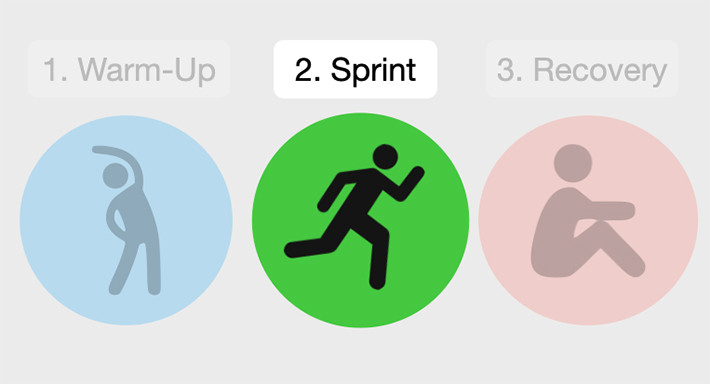
Once the warm-up phase is complete, we move into the sprint phase. Now, it’s time to do the work.
If you’ve done the work in the warm-up phase, the sprint phase is a lot easier. All you need to do is:
There’s no need to feel rushed as you work. You’re not competing with anyone else. This is not a race. It’s totally fine to take things slow.
Don’t expect the sprint phase to be pleasant. Even after a fabulous warm-up, you will most likely feel some discomfort and resistance about doing the work. This is normal.
You’ll feel the urge to run from this discomfort. But instead of running from it, befriend it. Remind yourself that the point of these work sprints is to move the needle on the things that really matter to you.

When the timer goes off, take a moment to acknowledge yourself for showing up to do the work. Remember, this practice takes practise, and you just got some reps in.
Now it’s time to rest. You’ll probably have some momentum by now, so you’ll feel like pushing on but stop what you’re doing and step away from your work. As Ali Abdaal mentions in his book Feel-Good Productivity:
“Rest breaks are not special treats. They are necessities.”
I’m not going to lie: this phase has been the hardest for me to master. As someone with workaholic tendencies, I’ve had to work hard at getting rest.
Why is the rest phase so important?
Because the longer you focus, the harder it is to maintain your focus. The act of focusing depletes your brainpower.
The best way to recharge a depleted brain is to rest.

Like focus, rest is a skill. It takes practise. You have to be able to resist the lure of busyness and our fast-paced, always-on culture.
Here are some of my favourite ways to rest and recharge at the moment:
Whenever I find myself wondering whether to keep working or take a break, I ask myself:
“What kind of boss do I want to be for myself? A mean-spirited, hard taskmaster? Or a generous, caring boss who looks out for their employees’ wellbeing?”
The answer is simple: I choose to be a generous boss to myself. Therefore, I give myself permission to rest.
I’ve come to see each of the phases of working like a sprinter (Warm-up, Sprint, and Rest and Recovery) as critical to staying healthy and balanced. Through trial and error, I’ve learned that skipping the warm-up or rest phase or going too hard in the sprint phase can lead to chaos and exhaustion.
As you cultivate the practice of working like a sprinter, significant things will happen to you. Not only will you notice that your productivity goes through the roof, but you’ll experience mental calm and clarity like never before.
As digital distractions no longer dominate your day, the noise of the world gets dialled down. You’ll find it easier to tune into what you need and what matters most to you.
I cannot stress enough that this is a practice that takes practise! One or two sprints won’t cut it. You need to persevere for long enough to experience the incredible benefits of this powerful practice.